
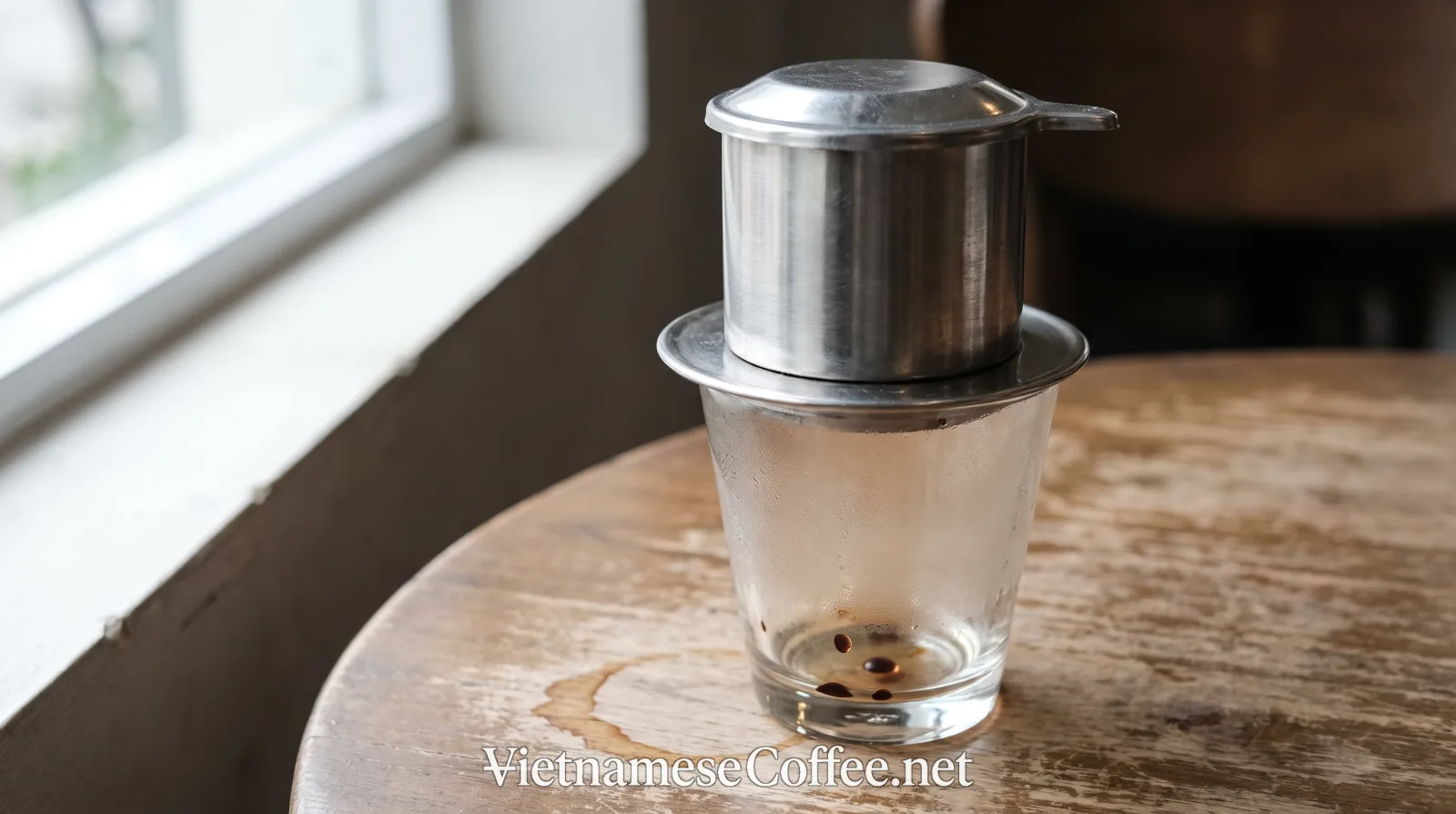
Phin at a glance
| Material | Stainless steel, most common today, or aluminum in older and cheaper models |
|---|---|
| Standard sizes | 2-cup, about 60 ml, up to 8-cup-plus, about 210 ml; 4-cup is most popular |
| Coffee dose | About 12 to 14 grams for a 4-cup phin, usually coarse to medium-coarse |
| Coffee-to-water ratio | Roughly 1:6 to 1:10 by weight |
| Brew time | 4 to 8 minutes, by gravity drip alone |
| Typical price | USD 3 to 30 for manual models; USD 50 or more for electric versions |
| Number of parts | Four: saucer, brewing chamber, press disk, and lid |
| Origin | Vietnam, adapted from a French drip design during the colonial period after 1857 |
What is a phin, exactly?
A phin, also called phin cà phê, is a small, single-serving coffee brewer that sits directly on top of a cup or glass. It uses no paper, no cloth, and no electricity. It relies entirely on gravity to pull hot water through a bed of ground coffee. The result is a concentrated, full-bodied cup that most Vietnamese coffee drinks are built on.
The name phin comes from the French word filtre, a linguistic trace of the device's colonial-era origins. Unlike a pour-over cone or an automatic drip machine, the phin has no moving parts and needs no calibration. Water goes in, coffee drips out, and the pace of that drip is treated as part of the ritual rather than something to rush.
Because a phin uses a perforated metal base instead of paper, natural coffee oils and fine particles pass into the cup. That produces a heavier, more textured brew than a typical paper-filtered coffee. The body is closer to a French press, but the cup is stronger and more concentrated per ounce.
Most Vietnamese households and cafes brew a phin with dark-roasted robusta beans. That pairing balances the bean's natural bitterness against sweetened condensed milk. For more terminology around the brewer and drinks, start with the Vietnamese Coffee Glossary.
Where the phin came from
Coffee did not exist in Vietnam before French colonization began in 1857. French missionaries introduced coffee cultivation to the region during that period. Along with the crop itself, the French brought a metal drip coffee pot that had already been used in Europe for decades.
That original device was invented in 1795 by Francois Antoine Henri Descroizilles, a French chemist. His design worked on a simple principle: grounds sit in a perforated canister, hot water is poured on top, and brewed coffee drips through into a vessel below. Vietnamese craftsmen and traders later adapted that French design into something smaller and simpler.
By the early 20th century, the phin had become the standard brewing method across both urban and rural Vietnam. It was used in street stalls, private homes, and formal cafés in Hà Nội and Sài Gòn. The device survived the Vietnam War, national reunification, and the Đổi Mới economic reforms of 1986 that reopened Vietnam to international trade.
Today, Vietnam is the world's second-largest coffee producer by volume, behind only Brazil. The phin remains its single most recognizable brewing tool, more closely tied to Vietnamese coffee identity than any bean variety or brand. For the broader timeline, see the history of coffee in Vietnam.
Parts and how a phin works
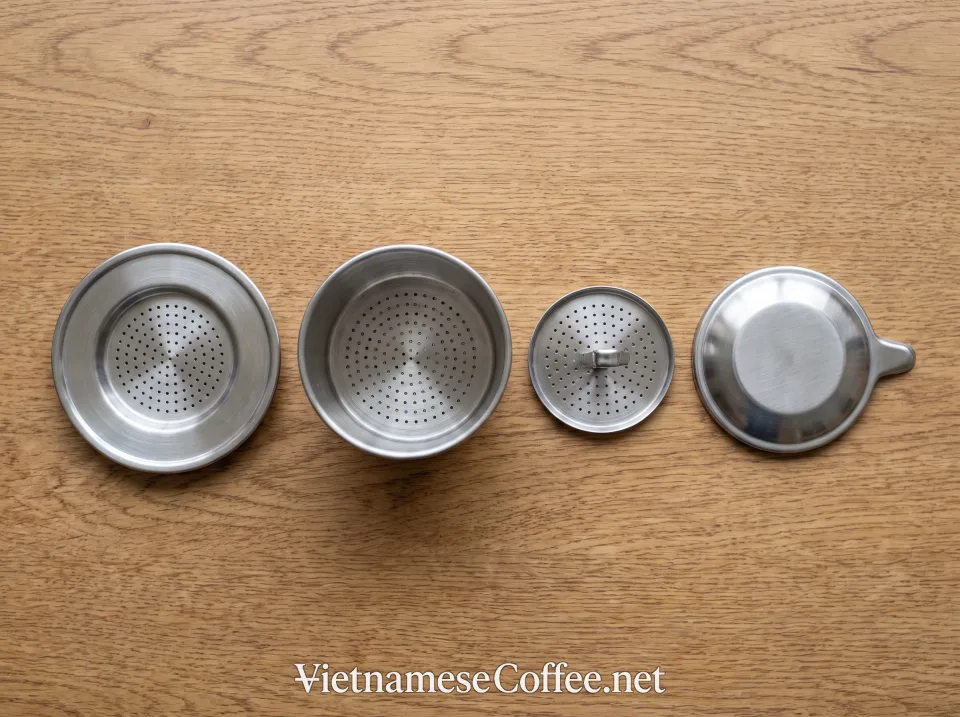
A traditional phin is built from four stainless steel or aluminum pieces that stack together over a cup. The saucer is a flat, perforated base that rests on the rim of the cup. It supports the chamber that sits above it during brewing. The brewing chamber is the cylindrical body that holds the ground coffee, with a perforated floor that acts as the filter itself.
On top of the grounds sits the press disk, a flat perforated insert. It rests under its own weight to compact the coffee bed evenly and regulate the drip rate. Traditional designs are gravity-only, relying purely on that weight for pressure. Screw-press variants also exist for brewers who want finer control over flow speed.
A lid covers the assembly during brewing to retain heat inside the chamber. Once brewing finishes, the same lid doubles as a small resting tray for the wet chamber, keeping the table clean. This four-part stack is deliberately simple. Each piece can be separated for cleaning in seconds.
Brewing follows a short, repeatable sequence. Grounds go into the chamber first, then the press disk sits on top of them. A small amount of hot water blooms the coffee before the rest is added. The full method is covered in the guide on how to brew Vietnamese coffee.
Sizes, materials, and prices
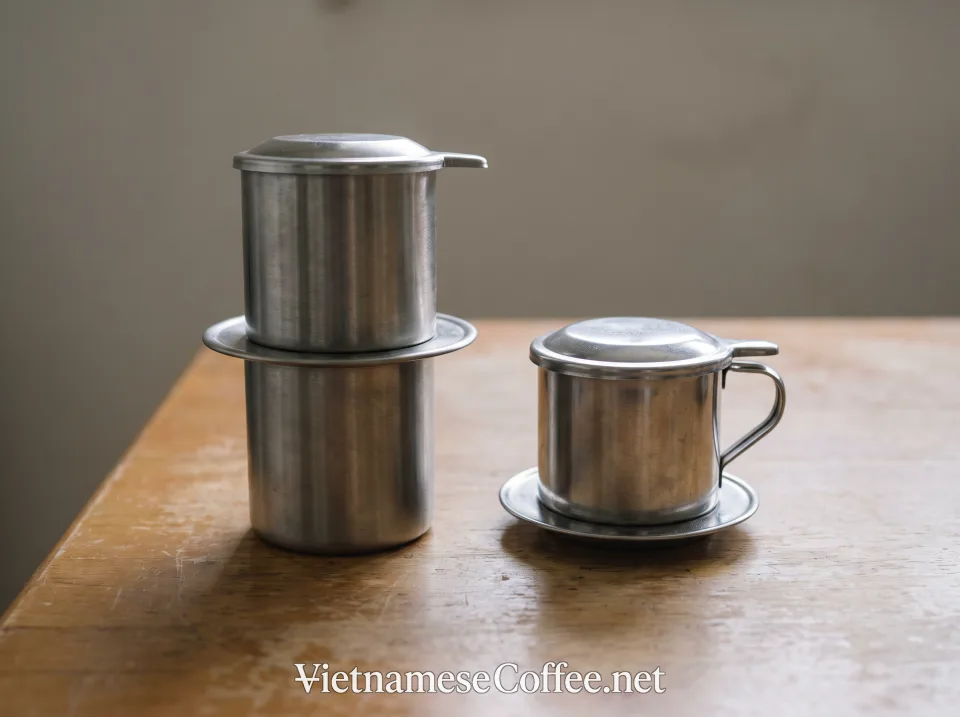
Phins are sized by capacity, measured in the number of servings, or cups, they hold. A Vietnamese cup in this context is closer to 2 ounces of concentrate than a full Western coffee mug. A 2-cup phin holds about 60 ml, a 4-cup model around 90 ml, a 6-cup around 150 ml, and 8-cup-plus versions run to roughly 210 ml.
Material affects both price and everyday performance. Stainless steel phins retain heat better, resist corrosion, and generally last for years of daily use. That durability makes them the preferred choice for households and cafes that brew coffee every day. Aluminum versions are lighter and cheaper to manufacture, but they corrode faster over time.
Price ranges widely depending on brand, material, and finish quality. Basic stainless models from Vietnamese grocery stores, or the widely available Trung Nguyên brand, typically cost USD 5 to 10. Heavier-gauge specialty versions can run USD 25 to 30. Modernized electric phins that automate water flow are also available, usually priced at USD 50 or more.
Despite that higher-end tier, the manual version remains by far the more common choice across Vietnam and its diaspora. Most daily drinkers see little reason to pay a premium for automation on a device this simple.
How the phin compares to other brewing methods
The phin sits in a specific niche among manual brewing devices. It is slower and more concentrated than a pour-over, similar in body to a French press, and far less pressurized than espresso. Its metal filter and long contact time are what separate its flavor profile from nearly every other common brewing method available today.
Because the phin uses no paper, it lets more coffee oils and fine sediment through than pour-over methods. That difference gives the finished cup a heavier, more textured mouthfeel than most filter coffee. Its brew ratio is also tighter than a typical French press, closer to a concentrate than a full cup of coffee.
| Method | Filter type | Typical brew time | Body |
|---|---|---|---|
| Phin | Perforated metal | 4 to 8 minutes | Heavy, oily, concentrated |
| French press | Metal mesh | About 4 minutes | Heavy, gritty |
| Pour-over | Paper | About 3 minutes | Clean, bright |
| Espresso | Metal puck screen | 25 to 35 seconds | Thick, with crema |
None of these methods is objectively better than another; each serves a different pace of drinking and a different flavor goal. A pour-over rewards patience with clarity, while a phin rewards patience with strength and body. Espresso trades both qualities for speed and intensity, brewed under pressure in under a minute.
The phin in daily Vietnamese coffee culture
Beyond its mechanics, the phin functions as a cultural fixture across Vietnam. Its slow, unhurried drip is treated as part of the experience, not a delay to be engineered around. That patience is especially visible at the sidewalk cafés central to everyday Vietnamese coffee culture, where customers plan to sit and wait rather than rush.
The device's low cost and simplicity also give it a democratic reach that few other brewing tools share. It requires no training, no electricity, and only a small upfront cost to own. That accessibility is why it appears equally in rural kitchens, urban street stalls, and diaspora households far from Vietnam's borders.
Overseas Vietnamese communities in the United States, France, and Australia continue to use the phin as a direct, portable link to home. Many households pack one when they travel, treating it as an essential rather than a novelty souvenir picked up on a trip. That emotional weight is unusual for such a simple kitchen tool.
Coffee shops that market themselves on authenticity, both inside Vietnam and abroad, often use a visible phin as a signal of tradition. Its presence on a table tells a customer what kind of coffee experience to expect before the first sip.