
| Province | Đắk Lắk, Central Highlands, Vietnam |
|---|---|
| Provincial capital | Buôn Ma Thuột, approx. 500 to 600 meters elevation |
| Coffee growing altitude | 500 to 700 meters province-wide, per VCU |
| Primary variety | Robusta, with a smaller amount of arabica |
| Coffee cultivation area | About 213,000 hectares, reported December 2025 |
| Annual output | About 545,000 tonnes, reported December 2025 |
| Share of national production | Roughly 30 to 35 percent |
| Harvest season | November to January; VCU gives November to December |
| Geographical indication status | Registered 2005, amended 2020, current regulation effective January 2025 |
Geography and terrain
Đắk Lắk sits in Vietnam's Central Highlands, a plateau region in the country's south-central interior. It is one of several provinces profiled on the Vietnam's Coffee Growing Regions hub, and by far the largest by cultivated area and output.
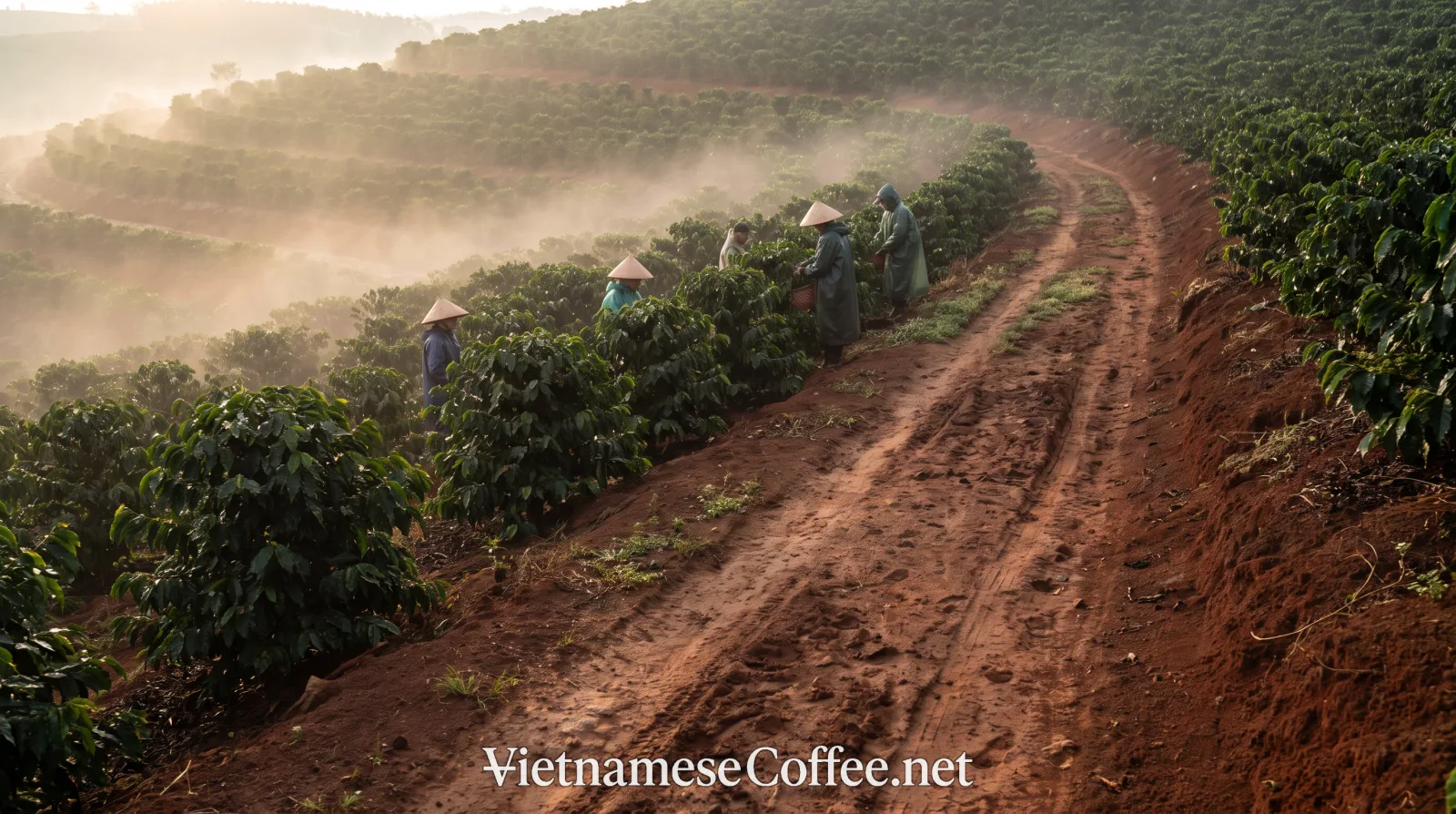
The provincial capital, Buôn Ma Thuột, sits at roughly 500 to 600 meters above sea level, according to Vietnam.vn. That outlet describes red basalt soil with strong water retention and nutrient-absorption properties.
Vietnam.vn also states that Buôn Ma Thuột and surrounding areas within a 20-kilometer radius were selected for robusta coffee after soil, climate, altitude, and alluvial deposits were surveyed around 1914.
For the province as a whole, VCU cites a broader elevation band of 500 to 700 meters. It describes Đắk Lắk as primarily growing robusta, with a smaller amount of arabica also present.
VCU also cites average annual rainfall of around 2,000 millimeters and an average annual temperature of about 24 degrees Celsius. These conditions explain why robusta became the dominant crop.
Scale: Vietnam's largest coffee province
Đắk Lắk is the largest coffee-producing province in Vietnam by both area and volume. Vice Chairman Nguyen Thien Van described the province as Vietnam's coffee capital in a December 2025 Nhân Dân report.
He cited about 213,000 hectares under coffee cultivation and annual output of around 545,000 tonnes. That represents an estimated 30 to 35 percent of Vietnam's coffee production.
VCU separately cites 212,915 hectares dedicated to coffee cultivation, a figure close to the provincial government's count. That corroborates Đắk Lắk's position as the country's largest coffee-growing province.
VCU also traces the province's production history. By 1975, cultivated area had reached about 8,600 hectares, with annual production over 11,000 tonnes, mostly robusta.
After 1986 economic reforms, specialized growing areas expanded in Krông Pa, Cư M'gar, and Ea H'leo districts. VCU says these three districts now account for 86 percent of provincial coffee area.
Buôn Ma Thuột's geographical indication
Buôn Ma Thuột coffee holds Vietnam's original protected geographical indication for a coffee product. Vietnam's National Office of Intellectual Property issued the original certificate on October 14, 2005.
The same official record states that Decision No. 939/QD-SHTT amended the certificate on April 5, 2020. A later Đắk Lắk provincial regulation became effective on January 3, 2025.
A historical VietnamNet report describes the 2005 registration as covering about 100,000 hectares across eight Đắk Lắk districts. That figure describes GI scope at registration, not current provincial output.
Nhân Dân reported in December 2025 that the Buôn Ma Thuột geographical indication is now protected in 32 countries and territories. That updates its earlier, smaller protection footprint.
The official GI record also describes dry, wet, and semi-wet processing methods. Green coffee sold under the GI must meet specified sugar and moisture parameters after drying.
Harvest season and coffee culture
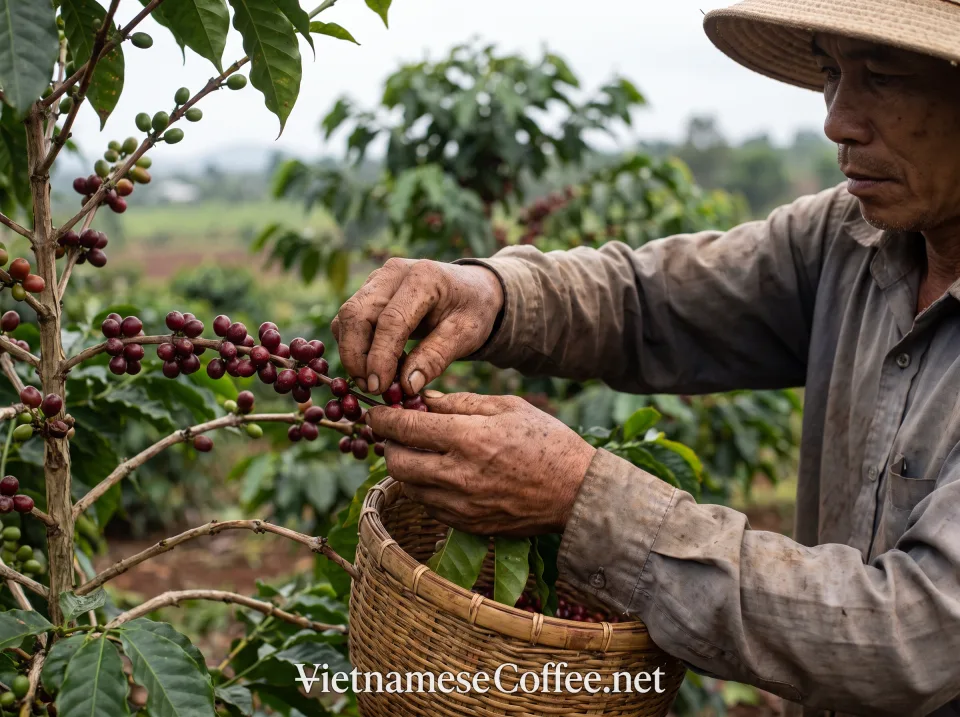
Đắk Lắk's coffee harvest follows the Central Highlands' wet and dry seasons. Vietnam.vn describes the harvest season as November to January, with a rainy season from May to October.
VCU gives the main harvest window as November to December, a slightly narrower range within the same period. Both accounts place the harvest at the turn into the dry season.
Vietnam.vn describes a bustling atmosphere around Buôn Ma Thuột during these months, with growers focused on picking cherries within a compressed window.
Coffee is also central to organized events in the province. The 9th Buôn Ma Thuột Coffee Festival ran from March 9 to 13, 2025, and drew about 250,000 visitors.
VietnamPlus also reported that coffee cultivation and processing knowledge in Đắk Lắk has been recognized as national intangible cultural heritage.
Flavor and processing standards
Đắk Lắk's coffee is almost entirely robusta, and robusta as a species has documented flavor and chemical differences from arabica. The National Coffee Association describes robusta as bolder and more caffeinated.
The NCA overview describes the robusta species generally, not Dak Lak specifically. Within Đắk Lắk, the Buôn Ma Thuột geographical indication adds documented production standards for eligible coffee.
Coffee grown within the registered GI area may be processed using dry, wet, or semi-wet methods. The GI record also specifies sugar content and drying-moisture parameters.
These standards apply to coffee produced within the registered GI area by licensed companies. They do not automatically apply to every bag of robusta grown elsewhere in Đắk Lắk.
For a fuller comparison of robusta and arabica, see Robusta vs Arabica: Why Vietnam Grows Robusta. For caffeine in the cup, see Caffeine Content in Vietnamese Coffee Explained.
Certification and traceability
Certification and traceability programs have become visible in how some Đắk Lắk coffee reaches export markets, especially toward the European Union. EUDR requires proof that coffee entering the bloc was not grown on recently deforested land.
Simexco Đắk Lắk announced a program in April 2025 that Vietnam Agriculture News described as EUDR-aligned. That program covered 4,957 farmers and 5,375 hectares of linked production area.
A later Nhân Dân report described Simexco as operating a wider network of 50,000 farmers producing raw materials the company describes as EUDR-compliant.
The same report stated that Đắk Lắk coffee areas became the world's first to receive the EU's 4C-EUDR deforestation-free certification. The sources reviewed do not explain the gap between those two farmer figures.
Other certification schemes apply to specific lots rather than a whole province's output. For a general explanation, see Coffee Certifications Explained.