
Robusta at a glance
| Scientific name | Coffea canephora |
|---|---|
| Historical origin | Central and western sub-Saharan Africa, Congo Basin |
| Year introduced to Vietnam | 1908, per VICOFA |
| Typical altitude | Sea level to 800 meters |
| Caffeine content | 2.2 to 2.7 percent by dry weight |
| Sugar content | 3 to 7 percent sucrose |
| Tasting notes | Bold, earthy, dark chocolate, roasted nuts, heavy bitterness |
History and botanical origins
Robusta coffee is the common name for Coffea canephora, a coffee species with roots in the humid forests of central and western sub-Saharan Africa. World Coffee Research traces its origin to the Congo Basin and notes that documented commercial cultivation began around 1870. French botanist Louis Pierre formally applied the botanical name Coffea canephora in 1895.
Robusta entered global coffee history at a moment when arabica was vulnerable. Coffee leaf rust had damaged plantations across major producing regions, and growers needed a hardier species. Coffea canephora showed stronger resistance to disease and became known commercially as robusta because of that resilience.
Vietnam's robusta story began under French colonial agriculture. The Vietnam Coffee - Cocoa Association records coffee's first introduction to Vietnam in 1857 and robusta's introduction in 1908. Over time, cultivation shifted toward the Central Highlands, where warmer conditions and basaltic soils suited the species.
That shift reshaped Vietnamese agriculture. Provinces such as Dak Lak and Dak Nong became central to Vietnam's coffee output. The crop that began as a colonial introduction became the backbone of the country's modern coffee economy.
Physical traits and growing conditions
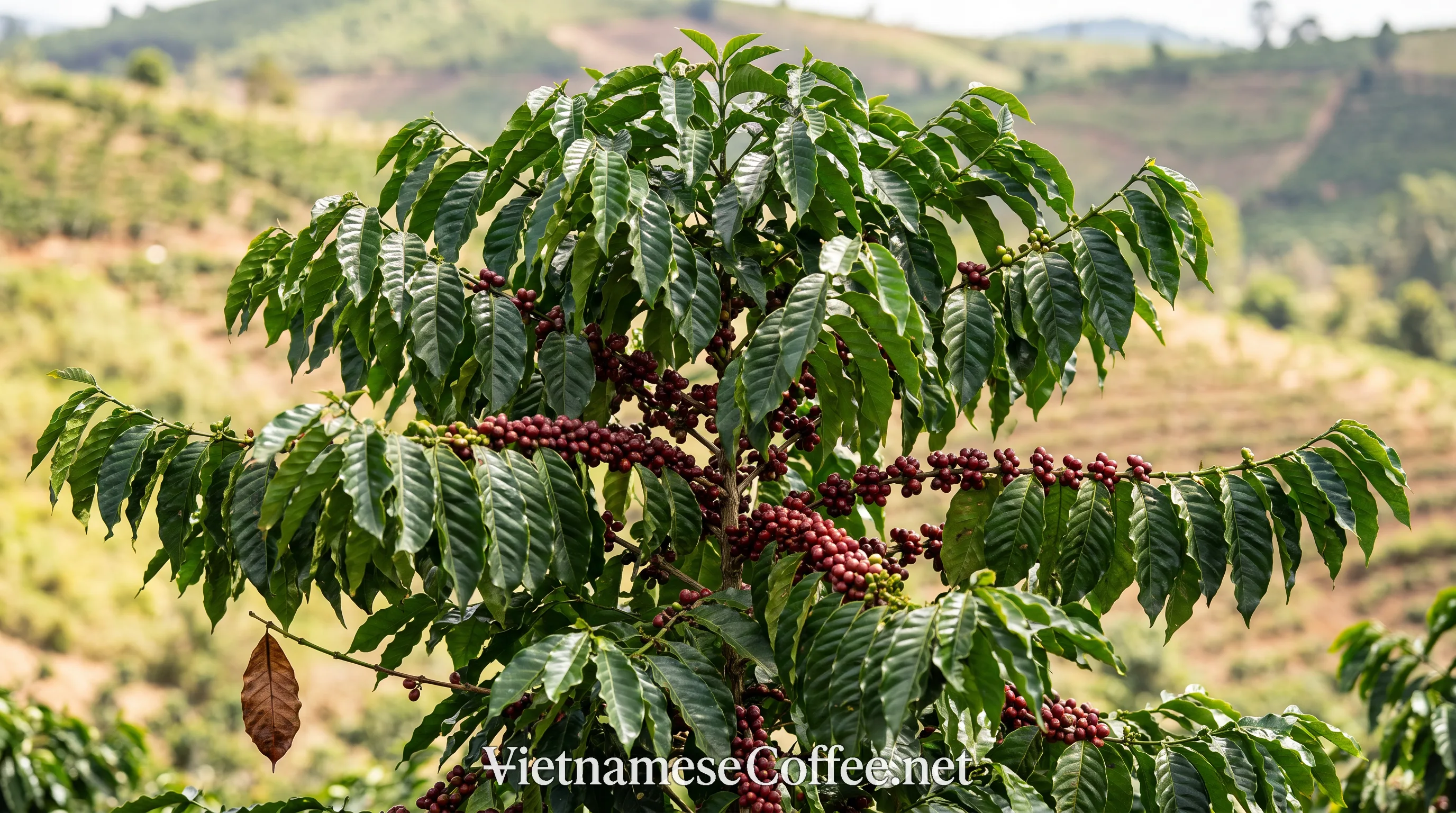
Coffea canephora differs from Coffea arabica in appearance and in agronomic needs. Robusta plants are generally larger, with a broad canopy, large leaves, and dense cherry clusters. The green beans are typically smaller, rounder, and denser than the elongated beans associated with arabica.
The plant is also adapted to different terrain. Robusta can grow at lower elevations, often from sea level to about 800 meters, while arabica usually needs cooler mountain conditions. Robusta is comfortable in warmer tropical climates, especially where wet and dry seasons are clearly defined.
Its agricultural value comes from hardiness. Higher caffeine and chlorogenic acid levels contribute to natural resistance against common pests and diseases. That resistance helps explain why robusta can be farmed at large scale across Vietnam's productive plateau regions.
GreenTech reports that Vietnam produces over 40 percent of the world's robusta. That figure reflects the species' fit with the Central Highlands and the economic importance of high-yielding robusta farms to Vietnam's export sector.
Chemical composition and flavor profile
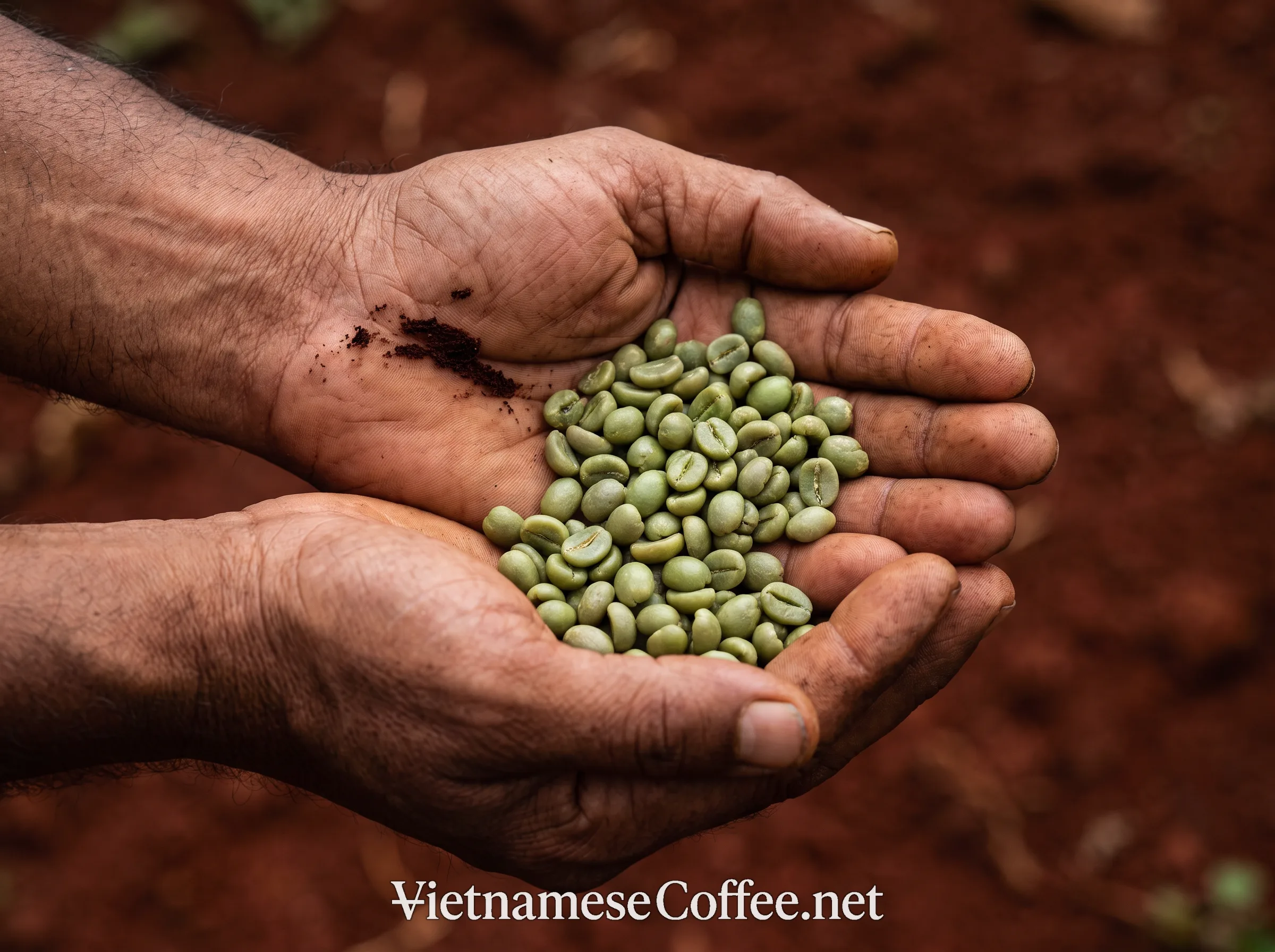
Robusta's flavor is shaped by its chemistry. Coffeester reports that green robusta beans contain about 3 to 7 percent sucrose, compared with about 6 to 9 percent in arabica. Robusta also has less lipid content, which affects sweetness, aroma, and perceived smoothness after roasting.
With less sugar and fewer lipids, robusta does not usually show the bright acidity and fruit-like sweetness prized in many arabica coffees. Instead, it gives a heavier cup with bold, earthy, and bitter flavors. Dark roasting makes those traits stronger.
In Vietnam, that intensity is not treated as a defect. It is the structure that lets the coffee stand up to condensed milk, egg cream, ice, and sugar. A mild coffee base would disappear inside many traditional Vietnamese drinks.
Common tasting notes include dark chocolate, roasted nuts, raw grain, and charred wood. These are the flavors that many drinkers associate with strong Vietnamese coffee, especially when brewed through a phin filter.
Caffeine content and strength
Robusta is known for caffeine. Art de Vivre Coffee gives a range of about 2.2 to 2.7 percent caffeine by dry weight for robusta, compared with about 1.2 to 1.5 percent for arabica. That chemical difference is one reason robusta drinks taste and feel stronger.
Traditional Vietnamese brewing can make that strength especially clear. A concentrated robusta brew made with a metal phin filter may contain roughly 150 to 200 milligrams of caffeine, according to Local Beans Roastery estimates for a 20-gram robusta serving.
Pure black robusta coffee is also very low in calories. Art de Vivre Coffee places plain black Vietnamese coffee around 2 to 5 calories before sugar or milk are added. The number changes as soon as a drink becomes cà phê đen with sugar or a milk-based recipe.
Because robusta is naturally high in caffeine, caffeine-sensitive drinkers often approach it carefully. The important point is not that robusta is simply harsher than arabica, but that it is a different species with a different chemical profile.
Role in Vietnamese brewing and global markets
Robusta is the traditional foundation of Vietnamese coffee brewing. The metal phin filter works well with dark-roasted robusta because its slow gravity drip creates a dense, concentrated cup. That cup can be served black or used as the base for milk, egg, and iced drinks.
In Vietnamese iced milk coffee, robusta balances the sweetness of condensed milk. In egg coffee, it cuts through a rich whipped egg yolk topping. In black coffee, it stands alone as a bitter, aromatic, and highly concentrated drink.
Globally, robusta has often been associated with instant coffee and espresso blends. Its high extractability, body, and crema can be useful in blends, even when the species is not named on the package. Vietnam's export role has therefore shaped coffee far beyond Vietnamese cafes.
Robusta's reputation is also changing. Climate pressure on high-altitude arabica has renewed interest in Coffea canephora, while Vietnamese farmers and roasters are applying more selective harvesting and processing methods. That movement is often called Fine Robusta.