

What you need before starting
A phin filter is a small, four-part metal brewer: a base cup, a perforated brewing chamber, a loose insert or "gravity press," and a lid. Most versions are made of stainless steel or aluminum, and the standard size holds enough water for a single serving. According to Roastopedia, the design is Vietnamese in origin, adapted from French drip brewing equipment during the colonial period, and it has stayed essentially unchanged since.
The coffee itself matters as much as the filter. Vietnamese phin brewing is built around dark-roasted robusta, which produces the heavy body and low acidity the method is known for. A finer, lighter-roasted arabica will still work mechanically, but it will not produce the same traditional cup. Any Vietnamese-labeled ground coffee, or whole beans ground at home to a medium consistency, will brew correctly in a phin.
Beyond the filter and coffee, only a few items are needed. These include hot water heated to just under boiling, a glass or cup to brew into, and a spoon for stirring once brewing finishes. For the iced version of Vietnamese coffee, ice and sweetened condensed milk are added afterward, not during brewing itself. A kitchen scale is optional but useful. Most modern brewing guides measure coffee by weight rather than by tablespoon, and weight-based measurements stay far more consistent from one brew to the next.
Step-by-step phin brewing method
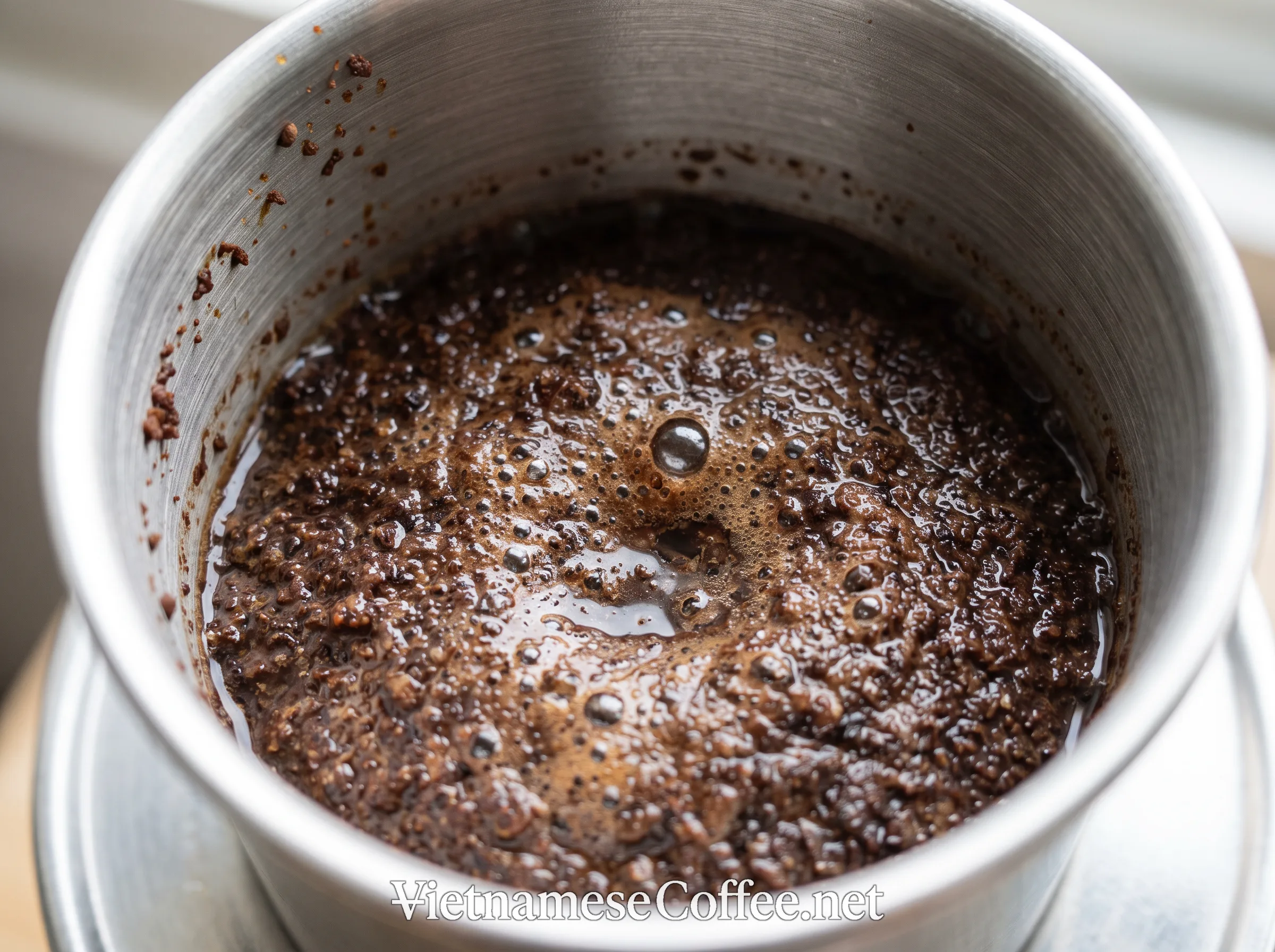
The following sequence reflects one defensible, widely used method for phin brewing, built primarily on Phin Ratio's step order and figures. It is worth noting upfront that brewing guides do not fully agree with each other. Grind size recommendations range from fine, "like sand," to medium or medium-fine. Press pressure guidance, bloom sequencing, and total brew time also vary between sources, and those specific disagreements are addressed directly in the ratio and troubleshooting sections.
Step 1: Rinse and preheat the phin

Pour a small amount of hot water through the empty phin filter before adding any coffee. According to the Vietnam Ca-phe Project, this step warms the metal and keeps the chamber from pulling heat away from the coffee once brewing begins. Discard this rinse water, dry the base cup if needed, and set the warm phin aside on top of the serving glass, ready for the ground coffee.
Step 2: Add the ground coffee
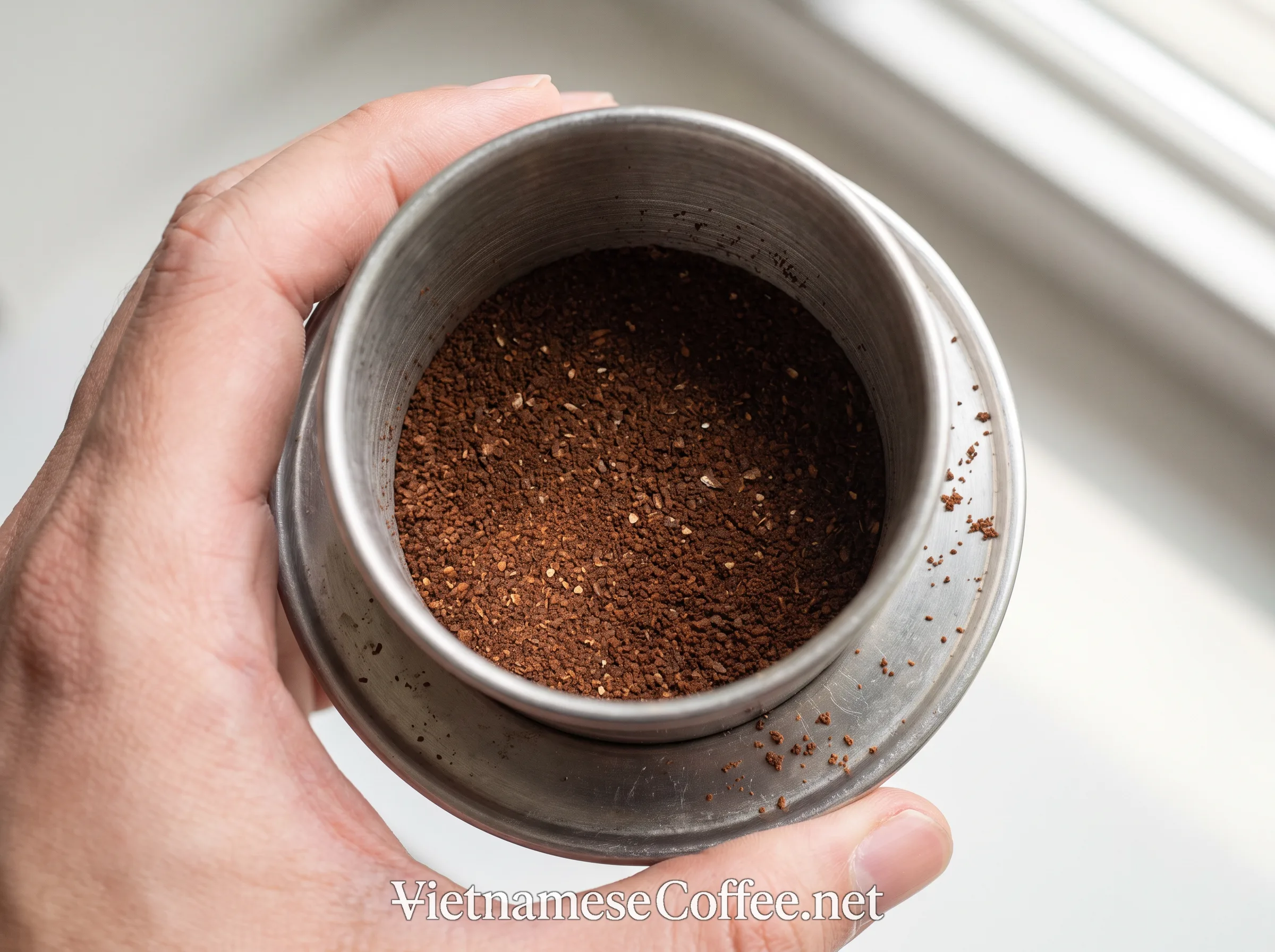
Add roughly 20 to 25 grams of medium-ground coffee into the brewing chamber, a starting point recommended by Phin Ratio for a standard 4-ounce phin. Give the chamber a gentle shake from side to side to level the coffee bed evenly across the base. Avoid tamping or pressing the grounds down at this stage; a level, loose bed is what most current guides recommend.
Step 3: Place the gravity press
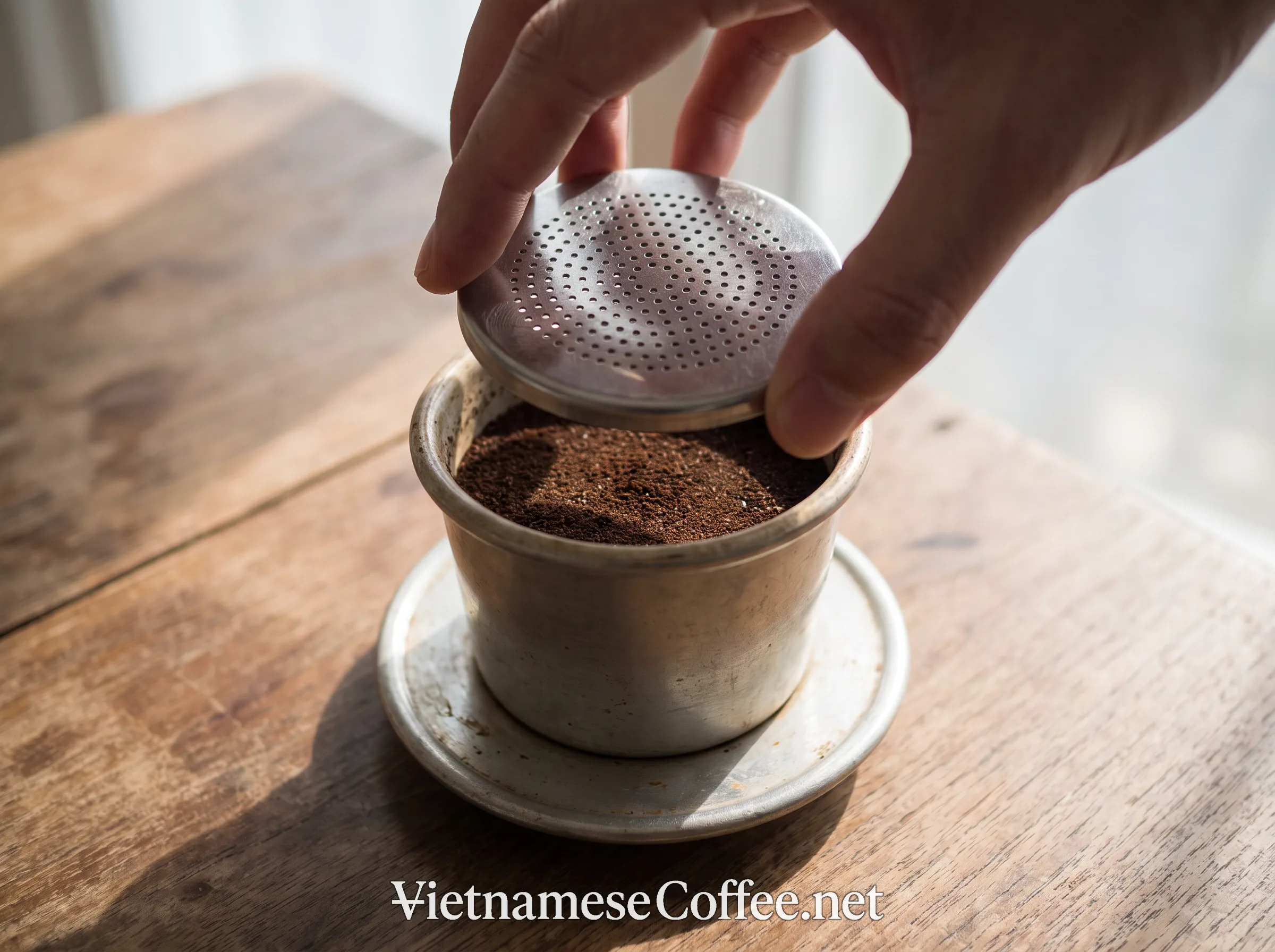
Set the metal insert, often called the gravity press or filter disc, directly on top of the leveled coffee. Phin Ratio describes placing this piece before blooming, resting flat under its own weight rather than screwed down tightly. Other guides sequence this differently; the Vietnam Ca-phe Project blooms the coffee first and installs the press afterward. Either order is workable, but this guide follows Phin Ratio's sequence throughout.
Step 4: Bloom the coffee

Pour a small amount of hot water, roughly 25 to 30 milliliters, just enough to wet the grounds beneath the press. Phin Ratio, Cafely, and the Vietnam Ca-phe Project all describe an initial bloom pour as a distinct stage, separate from the main brew. Let the coffee sit for 30 to 40 seconds so trapped gases can escape before the full pour begins.
Step 5: Fill the chamber with the remaining water
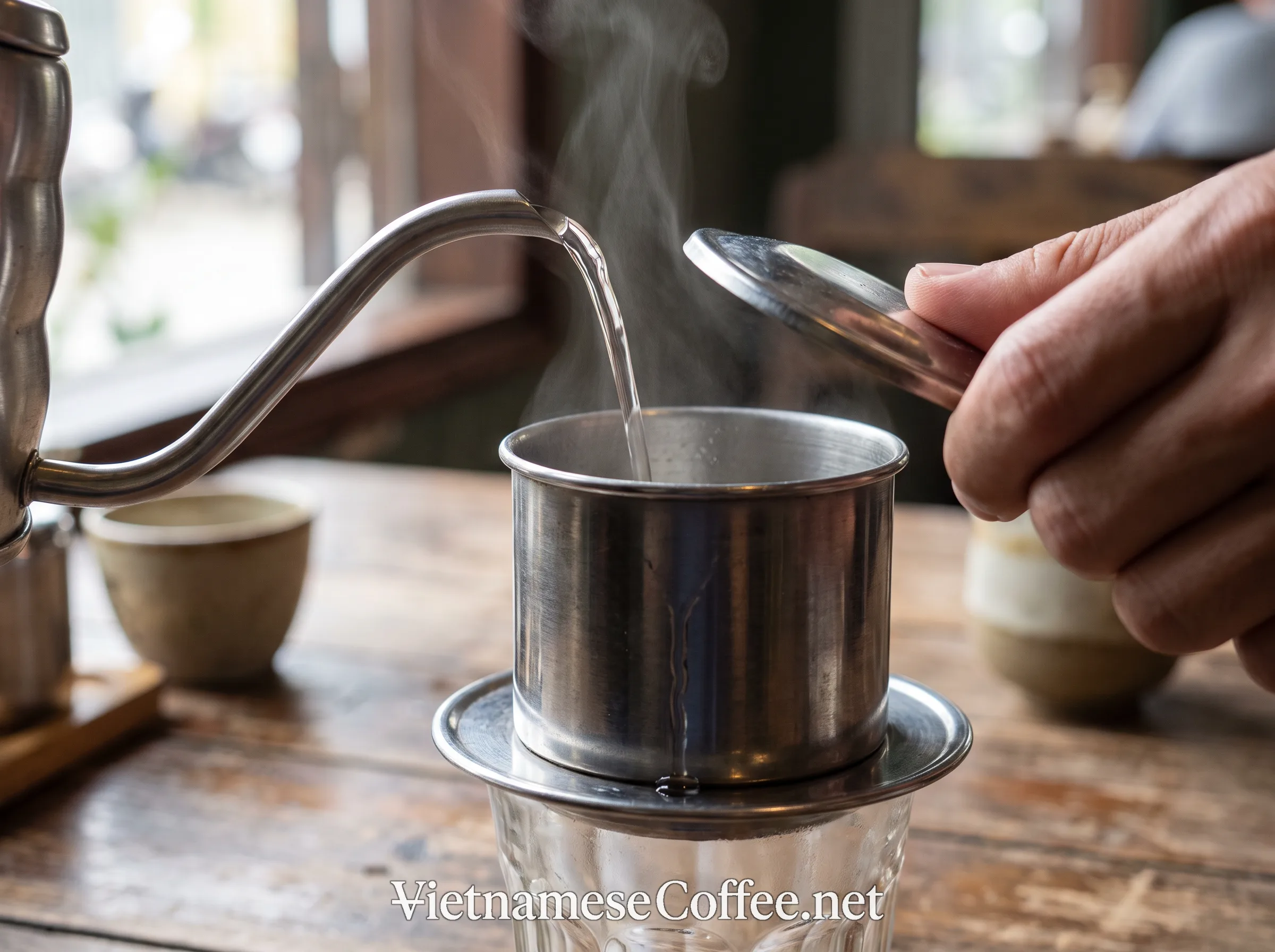
After blooming, pour the rest of the hot water slowly into the chamber, filling it close to the rim. Water heated to roughly 92 to 96 degrees Celsius, just off a full boil, is the range most consistently recommended across brewing guides, including Phin Ratio and the Online Coffee Guide. Place the lid on top of the phin immediately after this pour to help hold the water's temperature as it drips through.
Step 6: Let it drip

Set the phin over the serving glass and let gravity do the rest. A properly ground, leveled bed of coffee should produce a slow, steady drip, roughly one drop per second, according to Phin Ratio. The full brew typically takes about 4 to 6 minutes after the bloom. Total time can run closer to 8 to 10 minutes on some traditional phins, per the Vietnam Ca-phe Project.
Step 7: Stir and serve

Once dripping stops completely, lift the phin off the glass and set it upside down on its lid to avoid drips on the table. Stir the brewed coffee well, especially if condensed milk is sitting at the bottom of the glass, since the two liquids do not mix on their own. Serve immediately while hot, or pour the stirred mixture over a full glass of ice for the iced version.
Why ratios vary so widely between guides
Anyone comparing multiple phin brewing guides will notice the coffee-to-water ratio is far from standardized, and this deserves an honest explanation rather than a single invented number. Phin Ratio and the Online Coffee Guide both point to roughly 1:5 as a reasonable starting point for a strong, traditional cup. That works out to about 20 to 25 grams of coffee for 100 to 125 milliliters of water. Coffee Machine DE cites a wider range of 1:10 to 1:12 for a milder result. Viet80s Supply describes a much more diluted 1:14 to 1:16 ratio, designed specifically for a pour-over-style approach using the same filter.
Older, more traditional recipes measure by volume instead of weight, which adds another layer of variation. Nguyen Coffee Supply and Food52, which shares the same Sahra Nguyen recipe, both describe a roughly 1:2 ratio using tablespoons of coffee to ounces of water. This measurement convention does not translate directly into the gram-based ratios used by more recent guides. Ground coffee density varies with grind size, so tablespoon-based measurements are inherently less precise than a kitchen scale. This is part of why weight-based ratios have become more common in newer brewing content.
The most useful approach for a first attempt is to start near the 1:5 range recommended by Phin Ratio, taste the result, and adjust in either direction. A stronger, more concentrated cup calls for more coffee relative to water; a milder cup calls for less. Phin filters vary slightly in size between brands, and grind size affects extraction significantly. No single ratio works identically in every phin, which is exactly why experienced brewers treat these numbers as a starting range rather than a fixed rule.
Common mistakes and how to fix them
The most frequent phin brewing problem is a drip that runs too fast or stalls out completely. Grind size and press pressure are the most common causes. Coffee ground too coarsely lets water pass through quickly, producing a weak, under-extracted cup. Grounds that are too fine, or packed too tightly under the press, can clog the filter and stop the drip almost entirely. Coffee Machine DE's troubleshooting notes explicitly link a slow or stalled drip to two possible causes: either the grind is too fine, or the press has been tamped down too hard.
Uneven bloom time is a second common issue. Skipping the bloom stage, or pouring the full amount of water immediately, can trap gas inside the coffee bed and cause an uneven, sometimes bitter extraction. Sticking to the 30 to 40 second bloom window described by Phin Ratio, Cafely, and the Vietnam Ca-phe Project helps. It lets the grounds release trapped carbon dioxide evenly before the main pour begins.
Temperature control matters more than many home brewers expect. Water that has cooled well below the 92 to 96 degrees Celsius range most guides recommend will under-extract the coffee. The result tastes flat or sour. Placing the lid on the phin immediately after the final pour helps retain heat throughout the multi-minute drip. Several brewing guides note this keeps extraction more consistent from the first drop to the last.
Where the phin filter comes from
The phin filter's exact invention story is not fully documented, and this history should be read as a qualified interpretation rather than a settled record. According to Roastopedia, the device entered Vietnam during the French colonial period, which spanned roughly the mid-19th century through 1954. French coffee cultivation and early metal drip-brewing equipment were introduced to the region during that era.
Day9 Coffee's field notes offer a similar but explicitly cautious account. The filter's shape and mechanism plausibly descend from single-cup French drip brewers used during the same era. Day9 Coffee describes Vietnamese drinkers as having simplified and miniaturized that earlier equipment into the compact form still used today. Both sources agree on the broad French-drip ancestry; neither claims to know precisely who adapted the design, or when.
Regardless of its exact origin, the phin's modern form is well suited to dark-roasted robusta. This is the coffee species that dominates Vietnamese production, paired with the slow, concentrated brewing style built around it. Day9 Coffee frames this fit directly. The phin is not simply a simplified pour-over cone. It is a design commonly used for dense, concentrated coffee that holds up structurally to ice and condensed milk.
Serving it hot or over ice
The same brewed coffee produced by this method becomes several different drinks depending on how it is finished. Served hot and black, straight from the phin, it becomes cà phê đen, Vietnam's plain black coffee. Adding a spoonful of sweetened condensed milk before brewing, then stirring the two together once dripping stops, produces cà phê nâu. Its iced version is poured over a full glass of ice.
The order of operations for the iced version matters for both flavor and temperature. Most guides recommend brewing directly on top of the condensed milk already sitting in the glass, rather than mixing the milk in afterward. The hot coffee blends more evenly with the milk while both are still warm. Once the two are stirred into a uniform, medium-brown mixture, the combination is poured over ice. This chills the drink quickly without diluting it as much as adding ice before brewing would.
This same base method, dark robusta brewed slowly through a phin, forms the starting point for several other Vietnamese coffee drinks covered elsewhere on this site. Egg coffee and coconut coffee are two examples. In each case, the phin-brewing steps described above stay the same; only the ingredients added after brewing change.