
Species and production volume
The most fundamental difference between these two coffee-producing countries is which species dominates their output. According to USDA Foreign Agricultural Service reporting, Vietnam's marketing year 2025/26, running from October 2025 through September 2026, is forecast at approximately 30.8 million 60-kilogram bags. This ranks second globally behind Brazil. Robusta (Coffea canephora) accounts for roughly 97 percent of Vietnam's total coffee output in the ICO reference period.
Colombia's USDA-forecast MY2025/26 production stands at approximately 13.8 million bags, ranking third globally. Its output is effectively all arabica (Coffea arabica). This species split shapes nearly everything else about the two coffees. Robusta contains substantially more caffeine and chlorogenic acid than arabica, producing a heavier, more bitter cup with lower acidity. Colombia is widely described as the world's leading producer of washed arabica.
Production figures should be read as marketing-year forecasts rather than calendar-year harvest totals. Vietnam's forecast is more than twice Colombia's for MY2025/26, but the comparison describes volume, not a verdict about quality, value, or export destination. Vietnam is a very large Robusta origin. Colombia is a very large Arabica origin. The coffees occupy different places in the global market because of species, geography, processing, and long-established buying patterns.
Growing regions and altitude
Vietnam's coffee production concentrates in the Central Highlands, which account for more than 90 percent of the country's total output according to industry reporting on the sector. Đắk Lắk, Lâm Đồng, Gia Lai, and Đắk Nông are leading coffee provinces. Robusta grows well at relatively low elevations, generally between sea level and roughly 800 meters. A smaller share of Vietnamese arabica grows at higher elevations around Đà Lạt and in the northern provinces of Sơn La and Điện Biên.
Colombia's coffee geography is based on highland Arabica. According to Covoya Coffee, Colombian coffee generally grows between 1,200 and 1,800 meters, with some farms above 2,300 meters. The Coffee Axis includes Quindío, Caldas, and Risaralda. Other important regions include Huila, Nariño, Cauca, Tolima, and Antioquia. Regional sources associate these origins with different altitude bands and cup profiles.
The elevation contrast is real, but it should not be treated as a single explanation for the difference in the cup. Species, cultivar, local climate, processing, and roast all affect flavor alongside altitude. Vietnamese Robusta and Colombian Arabica differ across all of those variables at once.
Vietnam's coffee sector is also strongly smallholder-based. FAO documentation describes Robusta production as dominated by private households, with most farms under 2 hectares. This page does not make a direct farm-size comparison with Colombia because the sources used here do not provide a like-for-like Colombian farm-size dataset.
Processing methods
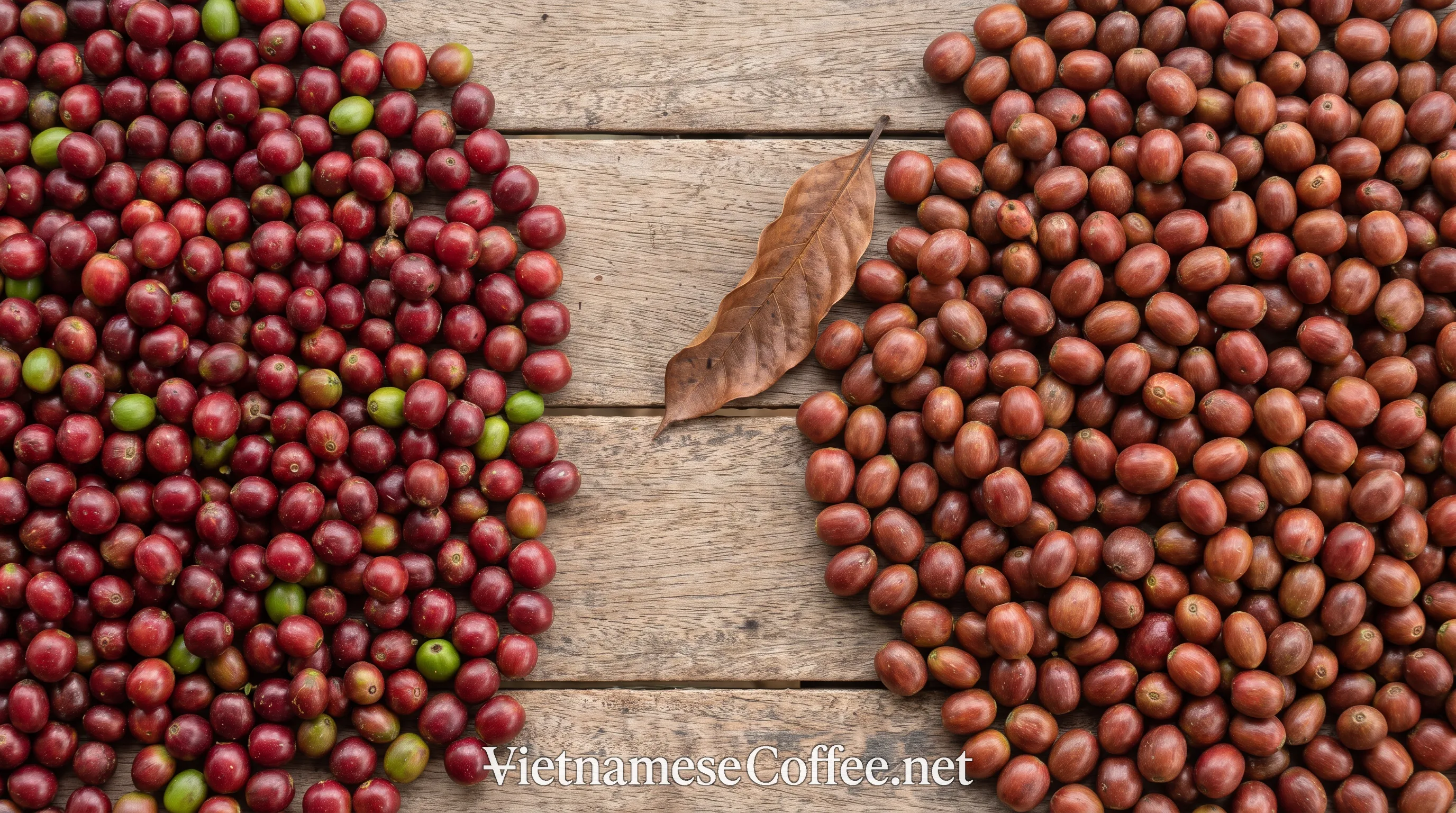
Vietnam and Colombia lean toward different processing traditions. Historical ICO documentation identifies dry, or natural, processing as Vietnam's most common Robusta post-harvest method. In natural processing, whole cherries dry in the sun before the bean is hulled. The method remains predominant, although honey processing also accounts for a meaningful share of some Vietnamese Robusta production. Published percentages vary by survey and year, so this page does not present one fixed national percentage as current fact.
Colombia's Arabica industry is closely associated with washed processing. InterAmerican Coffee describes a sequence in which the cherry skin and pulp are removed, beans ferment briefly to remove remaining mucilage, and the coffee is then washed and dried. This generally produces a cleaner cup with more distinct acidity. Natural processing leaves the bean in contact with the fruit for longer during drying and can produce a heavier, fruitier, or less clean profile depending on process control.
Neither method is inherently superior. Vietnam's continued reliance on natural and honey processing coexists with washed lots from some producers. Colombia's washed-coffee tradition also coexists with natural and honey-processed lots from some producers. The broad contrast remains useful, but neither country should be treated as using one method exclusively.
The difference is visible before coffee reaches the roaster. A natural Vietnamese Robusta retains the entire cherry while it dries. A washed Colombian Arabica has its skin and pulp removed early, then undergoes fermentation and washing before drying. Processing must be considered alongside species, roast, and origin when comparing the two cups.
Flavor profile
The resulting cups taste distinctly different, largely as a downstream effect of species and processing rather than any single isolated factor. Vietnamese Robusta, dry-processed and often dark-roasted, is generally described with notes of dark chocolate, roasted nuts, earth, and wood, alongside a heavy body and low acidity. Its pronounced bitterness is central to traditional preparations such as cà phê đen and cà phê sữa đá.
Colombian Arabica is frequently described by its growing region. Coffee Tweaks characterizes Nariño with bright, high-acid cups and lime or jasmine notes. Huila leans toward red fruit and caramel. Antioquia produces chocolate and nut flavors, built on an Arabica base rather than a Robusta one. These are useful regional examples, not a claim that all Colombian coffee shares one flavor profile.
Caffeine is one of the more measurable differences. Robusta generally contains a caffeine range roughly double Arabica by dry weight. A concentrated phin-brewed Vietnamese coffee can therefore deliver more caffeine than a similarly sized cup of Colombian Arabica. The finished caffeine level still depends on the dose, bean, and brewing method used.
Brewing traditions and coffee culture

Vietnamese coffee culture is closely associated with the phin filter, a small metal drip brewer that produces a slow, concentrated cup. It is frequently combined with sweetened condensed milk, which balances the intense Robusta base. This traditional method is a clear feature of Vietnamese cafe life, although Vietnamese coffee can also be made with other brewing equipment and bean types.
Colombia's everyday coffee culture includes tinto, a small, sweetened black coffee commonly served by street vendors and in offices. Coffee Balcony describes tinto as a daily domestic format that sits apart from Colombia's export reputation for washed Arabica. It is often made with coffee not intended for premium export channels.
Both countries therefore have everyday coffee habits that are worth separating from export statistics. The phin is a visible Vietnamese brewing tradition, while tinto is a practical Colombian daily serving style. These concrete practices offer a clearer comparison than broad claims about which national coffee culture is more refined, diverse, or authentic.
At a glance: Vietnamese coffee vs Colombian coffee
| Attribute | Vietnamese Coffee | Colombian Coffee |
|---|---|---|
| Dominant species | Robusta (Coffea canephora); ~97% in ICO reference period | Arabica (Coffea arabica) |
| MY2025/26 production forecast | ~30.8 million 60kg bags | ~13.8 million 60kg bags |
| Main growing landscape | Central Highlands; Robusta commonly 0-800m | Andean highlands; commonly 1,200-1,800m |
| Processing tradition | Natural/dry processing predominates | Washed processing predominates |
| Typical cup tendency | Heavy body, low acidity, chocolate, earth, wood | Brighter acidity and regional fruit, floral, caramel, chocolate, or nut notes |
| Caffeine tendency | Higher, because Robusta generally exceeds Arabica | Lower than Robusta on a dry-weight basis |
| Everyday serving example | Phin-brewed coffee, often with condensed milk | Tinto, a small sweetened black coffee |
| Farm-structure evidence used here | Smallholder-dominated; most holdings under 2 ha | Not compared directly in this article |