
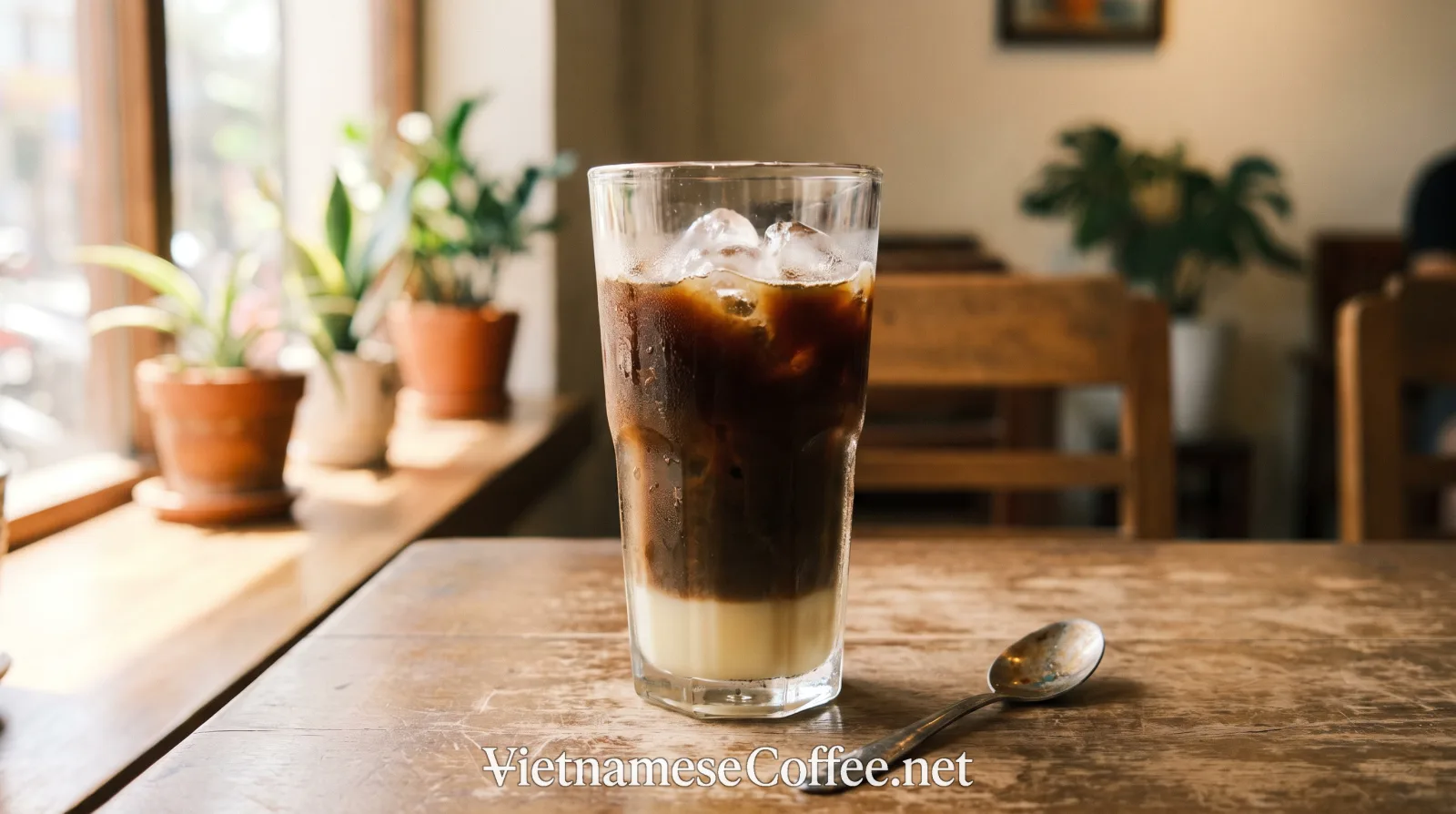
Cà phê sữa đá at a glance
| Type | Traditional Vietnamese iced coffee |
|---|---|
| Key ingredients | Dark-roast coffee, often robusta, sweetened condensed milk, ice |
| Traditional brewing method | Phin filter, hot-water drip |
| Region of origin | Sài Gòn, southern Vietnam, during the French colonial period |
| Serving style | Cold, stirred before drinking |
| Typical street price | About USD 1.00 to 1.50 per glass, per Exotrails reporting |
What the name means
Cà phê sữa đá is a phrase built from three simple Vietnamese words. Cà phê means coffee, sữa means milk, and đá means ice. Together, they describe the drink directly: coffee mixed with sweetened condensed milk and served cold. The English phrase "Vietnamese iced coffee" is useful, but it hides the specific milk ingredient that makes the drink taste the way it does.
That milk is sweetened condensed milk, not fresh milk. The choice matters because condensed milk is thick, shelf-stable, and easy to stir into hot coffee. It also adds sweetness and body at the same time. In practice, it changes the drink from a plain iced coffee into something richer and more dessert-like.
The naming pattern also marks regional differences in vocabulary. According to a word breakdown published by Heritage Line, southern Vietnamese speakers typically say sữa for milk coffee. Northern speakers commonly say nâu instead, so a northern order might be phrased as cà phê nâu đá rather than cà phê sữa đá.
This direct naming pattern is typical of Vietnamese coffee vocabulary. Drink names usually tell the drinker what is inside, how it is served, or how it tastes. Related drink names appear in the Vietnamese Coffee Glossary.
How it became a national drink
Coffee arrived in Vietnam through French colonization. According to Heritage Line, the first documented introduction was in 1857, when a French Catholic priest brought an arabica tree to northern Vietnam. Exotrails independently reports the same period, describing French missionaries introducing arabica coffee plants to northern Vietnam around 1857.
Fresh milk was scarce in Vietnam during this period. Heritage Line and Exotrails both connect condensed milk's rise to the lack of an established dairy industry and the difficulty of shipping fresh milk without spoilage. Sweetened condensed milk became the practical substitute for the fresh milk used in French café au lait.
Journalist Calvin Godfrey, writing for VnExpress International, cited food historian Erica Peters' account that colonial-era Sài Gòn developed a style of coffee brewed strong, sweetened with condensed milk, and served iced. That reporting ties the drink's early identity to southern Vietnamese city life under French rule.
The phin filter supported this shift by letting the drink be made cheaply and repeatedly with minimal equipment. Heritage Line describes the phin as reusable and machine-washable, sold inexpensively in Asian markets. For the brewer itself, see phin.
How it is made
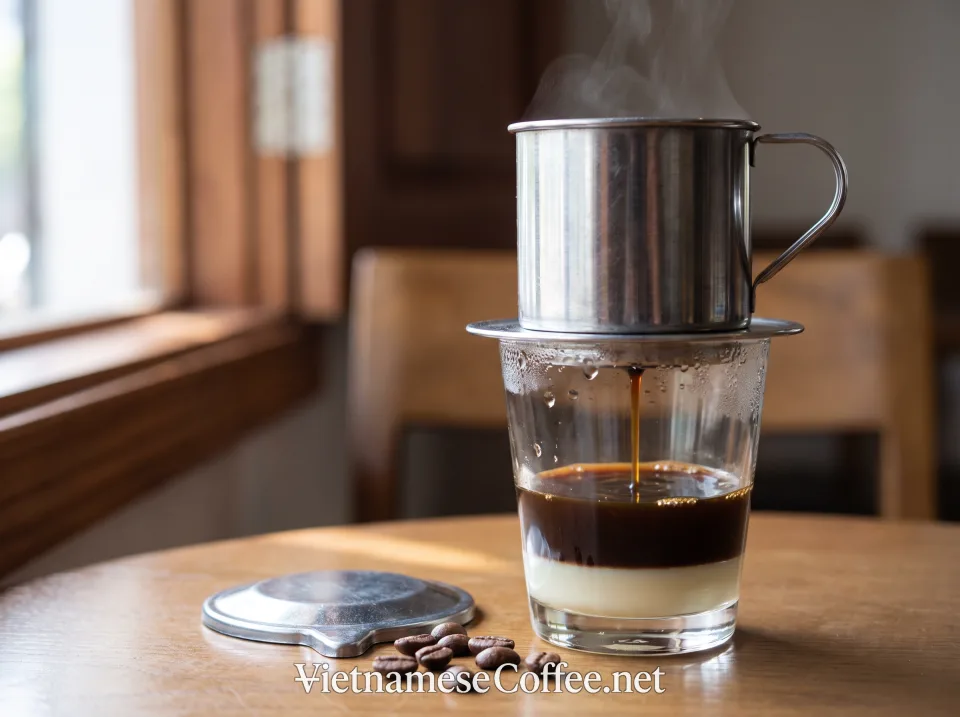
The classic method is straightforward, but each step matters. A glass is prepared with sweetened condensed milk at the bottom. A phin filter is then placed on top of the glass, and ground coffee is added to the chamber. Hot water is poured over the grounds, and the coffee begins to drip slowly into the milk below.
That first drip starts the blending process. As the hot coffee falls, it loosens the condensed milk and creates a dense, caramel-colored base. When the brew is finished, the mixture is stirred until smooth and then poured over ice. The result should be strong, sweet, and cold.
Heritage Line describes the full drip as taking several minutes, which matches how the phin is generally used in home and café settings. The slow pace is part of the method, not an inconvenience. It lets the condensed milk dissolve evenly instead of sitting as a separate layer at the bottom of the glass.
Heritage Line's published home method gives concrete quantities: about 2 tablespoons of coffee grounds, 1 to 2 tablespoons of condensed milk, and 150 to 250 milliliters of hot water. For a full process, see how to brew Vietnamese coffee.
Regional names and variants

Vietnamese coffee vocabulary changes by region, even when the underlying drink stays close to the same recipe. Cà phê sữa đá is the name most commonly used for iced coffee with condensed milk. In northern Vietnam, Heritage Line's regional word breakdown says nâu is the more common term for milk coffee.
The black iced version, without milk, is called cà phê đen. Menus aimed at visitors sometimes translate multiple drinks as Vietnamese iced coffee, which loses the specific distinctions among milk coffee, black coffee, and lower-coffee milk drinks.
Bạc xỉu is a related but distinct drink. According to the Michelin Guide, bạc xỉu was created by the Chinese community in Sài Gòn's Chinatown in the early 20th century. The recipe adjusted the coffee-to-milk ratio to make the drink milder for people unaccustomed to bitter coffee.
Cà phê sữa đá also sits near other condensed-milk drinks, but it is not the same as egg coffee or salt coffee. Those drinks share a base of strong Vietnamese coffee, yet they add separate textures, toppings, and regional origin stories.
Why it still defines Vietnamese coffee
Cà phê sữa đá holds a central place in Vietnamese coffee for reasons that are documented rather than assumed. The ingredients are inexpensive and the phin is reusable. Exotrails reports a typical street price of USD 1.00 to 1.50 per glass, a range that has kept the drink accessible across decades of economic change.
The drink also matches the social use of coffee in Vietnam. VnExpress International's reporting on Hồ Chí Minh City's coffee scene describes cà phê sữa đá as a fixture that persisted through a century of upheaval. That framing ties the drink to daily routine rather than to a single moment of popularity.
Multiple sources describe the drink's international visibility. The Michelin Guide calls Vietnamese iced milk coffee a staple offering of Vietnamese restaurants worldwide, while Heritage Line describes it as a favorite among international visitors to Vietnam. Together, these accounts support its role as an entry point into Vietnamese coffee culture.
The drink remains flexible enough to fit street stalls, homes, and specialty cafés without losing its identity. Some versions use more condensed milk, some use less. Some are served in tall glasses, others in short tumblers. The base structure of coffee, condensed milk, and ice stays constant.