
The sidewalk café as everyday ritual
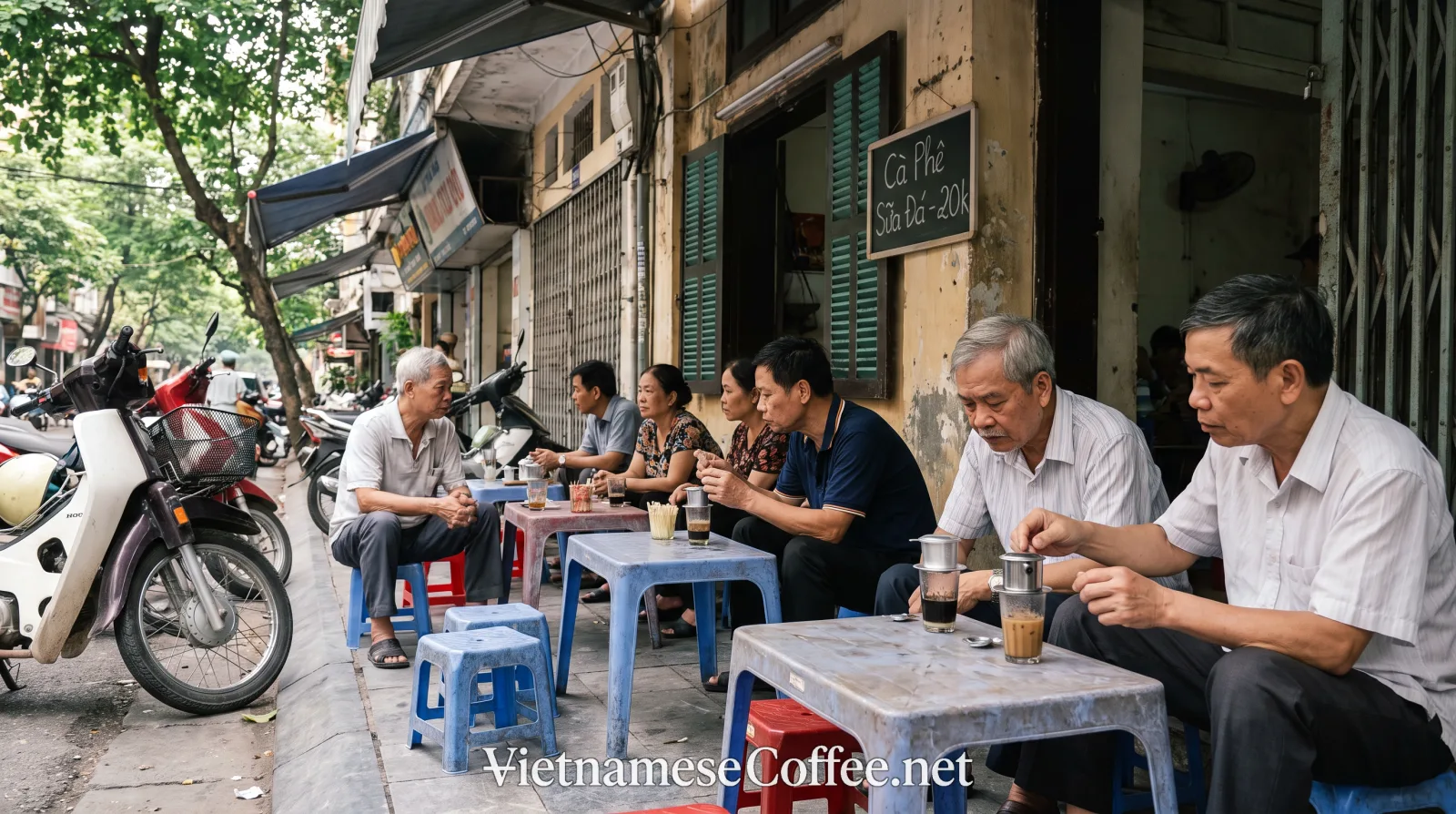
Cà phê vỉa hè, or sidewalk coffee, is the most common form of coffee drinking in Vietnam. Small plastic stools line the edge of a street, facing traffic, with a low table between them.
A vendor sets a phin filter on top of a glass and lets gravity do the work. The wait, usually five to ten minutes, is treated as part of the drink rather than a delay.
This style of café is often called cà phê cóc, a term that describes its cramped, improvised setup rather than any specific brand or chain. It can be a few stools outside a private home or a narrow storefront that opens only for a few hours each morning.
The slow drip forces a kind of enforced patience that regular customers describe as part of the appeal. Sitting at a cà phê cóc means watching motorbikes pass, greeting neighbors, and reading the morning news.
The phrase "đi cà phê không?" captures how central this ritual is to daily social life. It rarely signals actual thirst. Instead, it functions as an invitation to talk, catch up, or simply share space with another person for a while.
Hà Nội and Hồ Chí Minh City: two coffee cultures
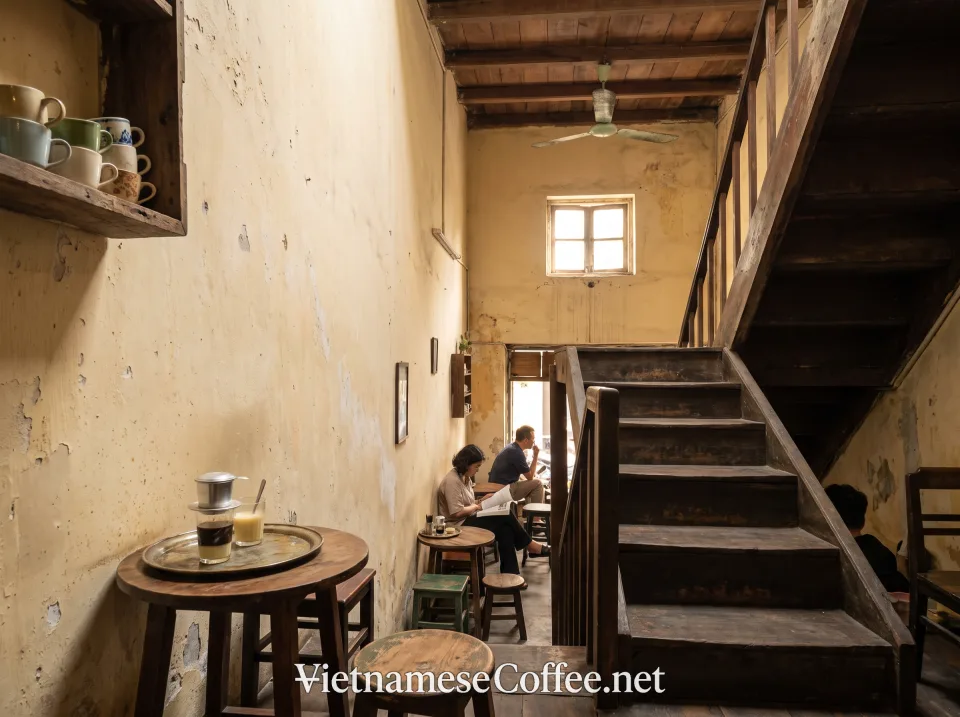
Vietnam's two largest cities have developed distinct coffee cultures, shaped by climate, history, and pace of life. In Hà Nội, coffee tends to be strong, dark-roasted, and served in small cups.
Locals often sip it slowly over an hour, treating the cafe as a place to linger rather than pass through. Hà Nội's iced coffee with condensed milk is typically less sweet than its southern counterpart.
Hồ Chí Minh City's coffee culture moves at a different speed. Coffee there is served sweeter, over more ice, and often in taller glasses that resemble a soft-drink cup.
Straws are common in the south, a detail rarely seen with traditional coffee service in the north. Hồ Chí Minh City has also absorbed more of Vietnam's specialty coffee wave.
These habits shape what visitors notice first. Hà Nội often feels stronger and slower. Hồ Chí Minh City often feels sweeter, colder, and faster.
Egg coffee and Hà Nội's culinary reinvention
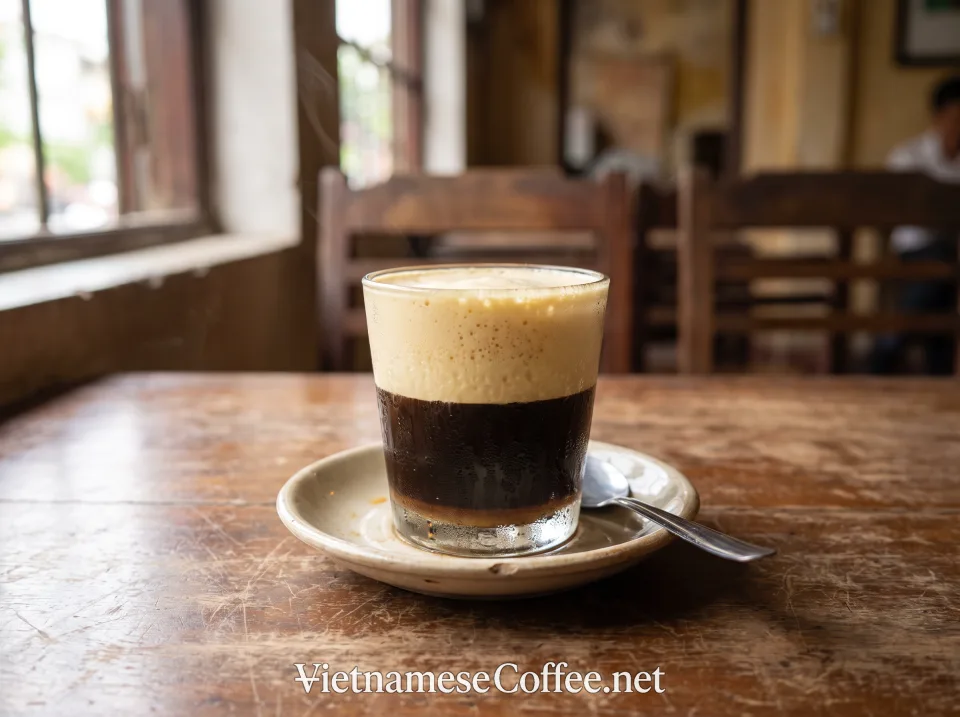
Vietnam's coffee culture has also produced its own inventions, born from scarcity rather than design. Egg coffee, or cà phê trung, was created in Hà Nội in 1946 by Nguyễn Văn Giang.
Giang was a bartender at the Sofitel Legend Metropole hotel. Milk was rationed during wartime, and he needed a substitute for the steamed milk his European guests expected in their coffee.
He whisked egg yolk with sugar into a foam and ladled it over strong Vietnamese coffee. The result mimicked the texture of a cappuccino without using any milk at all.
Giang later left the hotel and opened Cafe Giang on Nguyen Huu Huan Street in Hà Nội's Old Quarter. The cafe still operates today, run by his family.
Similar improvisation shows up in coconut coffee and yogurt coffee. These drinks came from home kitchens and small stalls adapting to what was available, then stayed popular after the original shortage ended.
Coffee as social currency
Coffee in Vietnam functions as a social scheduling tool as much as a beverage. Business meetings, casual catch-ups, and first dates commonly happen over a phin rather than a meal.
A cafe table doubles as an informal office for freelancers, students studying between classes, and retirees who treat a favorite spot as a daily fixture.
Older men have long dominated the classic sidewalk cafe scene, often arriving early and staying for hours. Younger Vietnamese customers increasingly use air-conditioned specialty cafés for the same social purpose.
Coffee shops also serve as informal news exchanges. Newspapers on tables, radio broadcasts, and word-of-mouth conversation make the sidewalk cafe a place where local information circulates.
Foreign visitors sometimes misread this pace as slowness. Locals generally see it the opposite way: a coffee break is treated as time well spent, not time lost.
A modern industry built on an old habit
Vietnam's coffee culture now supports a large commercial industry built directly on old habits. Data cited by Mibrand puts the number of coffee shops nationwide at more than 500,000.
The country's coffee cafe market was valued at roughly USD 510 million in 2024, according to industry estimates. That scale sits on top of a country where coffee was never niche.
| Cafe format | Typical setting | Signature drink style | Typical price range |
|---|---|---|---|
| Cà phê cóc | Plastic stools on a street corner or alley | Slow phin drip, black or with condensed milk | Under USD 1 |
| Traditional phin cafe | Narrow shophouse, simple tables and chairs | Strong iced or hot coffee | USD 1-2 |
| Heritage cafe | Fixed historic shop, multi-level seating | Egg coffee | USD 2-3 |
| Modern specialty cafe | Air-conditioned, branded interior | Espresso drinks, pour-over, latte art | USD 2-5 |
Government and tourism bodies have also started framing coffee culture as part of Vietnam's cultural heritage, alongside coffee-growing regions like Đắk Lắk.
None of these formats has fully replaced another. A single coffee drinker might visit a cà phê cóc on a work morning, a specialty cafe on a weekend, and a heritage shop with visitors.