
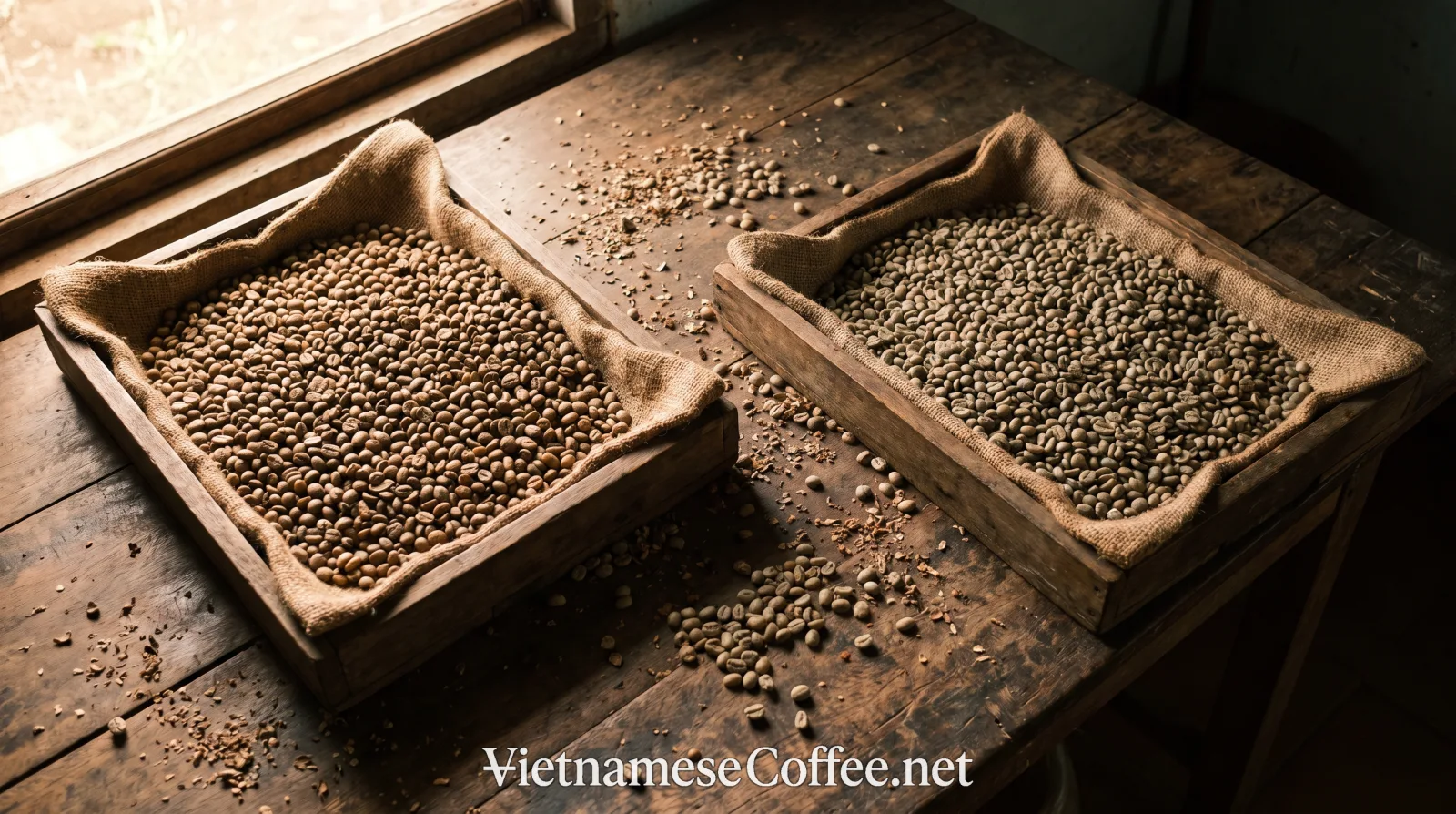
What separates robusta from arabica
Robusta (Coffea canephora) and arabica (Coffea arabica) are different coffee species, not just different roast styles. A data table published in a World Health Organization IARC monograph gives specific caffeine figures.
Green arabica seeds average about 1.2 percent caffeine by dry weight, while green robusta seeds average about 2.0 percent. The National Coffee Association describes this gap more simply: robusta generally produces about 50 to 60 percent more caffeine.
Robusta is also widely described as having a bolder, stronger flavor with bitter undertones, compared to arabica's generally milder, more aromatic cup. Robusta plants are generally hardier and more resistant to disease and pests.
Disease resistance is part of robusta's reputation, though the picture is more nuanced than a simple contrast. Leaf rust variants have shown increased ability to affect a wider range of coffee genotypes in Vietnam.
These species-level differences matter directly for Vietnam's principal coffee-growing provinces. A plant that tolerates heat, humidity, and lower elevation is a better fit for the Central Highlands. For a fuller definition, see What Is Robusta?
| Attribute | Robusta | Arabica |
|---|---|---|
| Species | Coffea canephora | Coffea arabica |
| Average caffeine content | About 2.0 percent dry basis | About 1.2 percent dry basis |
| Typical growing altitude | Sea level to about 800 meters | Generally higher, hilly areas |
| Ideal average temperature | 24 to 30 degrees Celsius | 15 to 24 degrees Celsius |
| Share of Vietnam 2025/26 forecast | About 30 million bags, roughly 96.8 percent | About 1 million bags, roughly 3.2 percent |
Climate and altitude decide the species
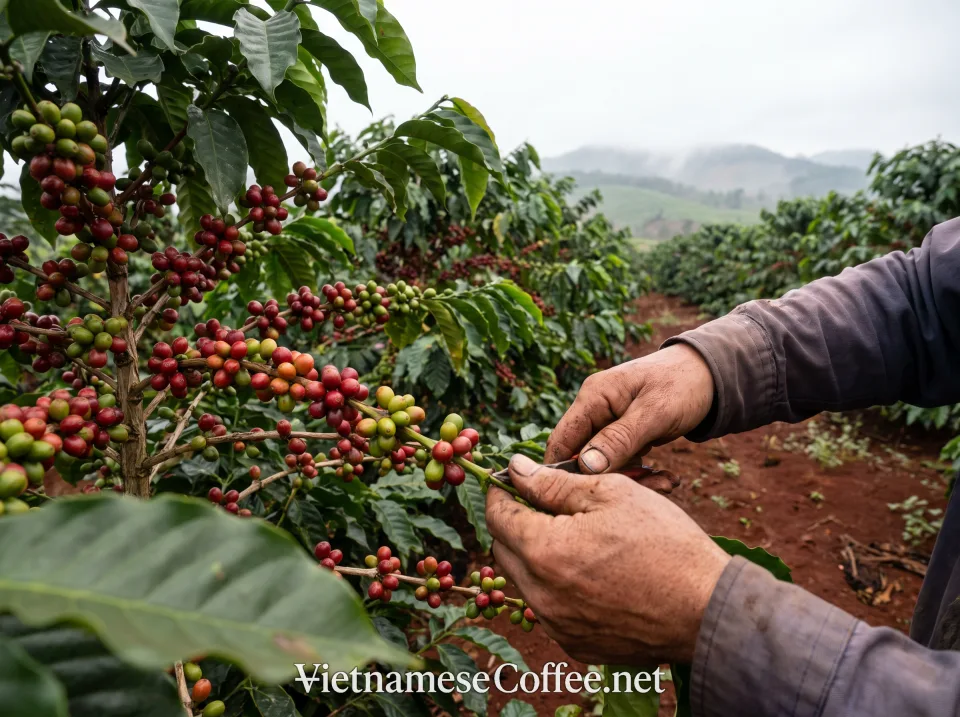
Altitude and climate are among the main reasons a country ends up growing one species over the other. FAO states that robusta can be grown from sea level up to about 800 meters.
Arabica generally does best at higher altitudes and is often grown in hilly areas. FAO also gives ideal average temperatures of 15 to 24 degrees Celsius for arabica, versus 24 to 30 degrees for robusta.
The Central Highlands' elevation, volcanic soil, and seasonal pattern create favorable conditions for robusta. USDA describes these factors as favorable for robusta specifically, without reducing the whole region to one altitude band.
Vietnam grows some arabica, but in much smaller volume and in higher, cooler pockets such as parts of Lâm Đồng province. See the Central Highlands growing regions for regional context.
USDA names five Central Highlands provinces: Đắk Lắk, Lam Dong, Đắk Nông, Gia Lai, and Kon Tum. Together, they account for about 92 percent of the country's coffee cultivation area.
How Vietnam became a robusta country
Coffee reached Vietnam through French colonization. Multiple sources date the introduction to 1857, when French missionaries brought arabica trees to northern Vietnam.
French colonists later pushed cultivation into the Central Highlands in the early 1900s. They recognized that the region's basalt soil and climate suited large-scale coffee farming better than the north did.
Robusta became the species of choice for expansion into terrain where arabica would have struggled. Heat, humidity, and a strong wet-dry seasonal pattern all favored the hardier species.
Vietnam's coffee industry scaled dramatically after 1986, when Doi Moi reforms opened the country to foreign trade and private enterprise. This transformed the Central Highlands into a robusta region of global scale.
Buôn Ma Thuột, the largest city in Đắk Lắk, later gained protected geographical indication status for its robusta. That status recognizes the link between Central Highlands terrain and the coffee it produces.
How much robusta Vietnam actually grows
Vietnam's robusta dominance shows clearly in production data. The USDA Foreign Agricultural Service forecasts Vietnam's 2025/26 coffee output at roughly 31 million 60-kilogram bags.
About 30 million of those bags are forecast to be robusta, and only about 1 million are forecast to be arabica. That means robusta accounts for approximately 96.8 percent of forecast output.
Globally, Vietnam's scale is just as significant. World Coffee Research states that Vietnam is the world's largest robusta producer, accounting for more than 40 percent of global robusta output.
Vietnam's coffee export sector is large in absolute terms. Reporting on customs figures described 2025 exports at roughly 1.6 million tons, worth close to USD 8.92 billion.
These figures shift with weather and global prices. But the underlying pattern, robusta as the overwhelming majority of Vietnam's output, has held across recent USDA reporting. For more, see Caffeine Content in Vietnamese Coffee Explained.
What this means for flavor and use
Robusta's flavor and cost profile are well documented in the wider coffee industry. The National Coffee Association describes robusta as having a bolder flavor with a pronounced aftertaste.
That profile is why robusta is commonly used in darker roasts and blends with arabica, including as a common component of Italian espresso blends.
Robusta's higher average caffeine content is about 2.0 percent by dry weight, versus arabica's roughly 1.2 percent. That gap is one documented reason the species is favored for a stronger cup.
The National Coffee Association also notes that robusta has historically been less expensive to grow than arabica, since the robusta tree is hardier and needs less specialized care.
None of this means arabica is absent from Vietnam or that robusta is objectively better coffee. It means terrain, history, and industry patterns all point in the same direction.