

What you need
Cà phê sữa đá requires only three core ingredients: dark-roasted robusta coffee, sweetened condensed milk, and ice. According to Saveur's recipe, a single serving uses about 10 grams of medium-finely ground coffee, roughly 84 grams of water total, and 18 grams of condensed milk. Other guides scale this up considerably. Celacoffee's version calls for 15 grams of coffee brewed with 90 milliliters of water, spooned over 20 milliliters of condensed milk. Roast & Roast's recipe instead uses 20 grams of coffee and 2 to 3 tablespoons of condensed milk for a larger glass.
This spread in quantities is normal for a drink with no single fixed recipe, and it mirrors the same variation found in general phin brewing guides. What stays consistent across nearly every source is the basic proportion. Enough condensed milk should visibly coat the bottom of the glass, and enough coffee should produce a genuinely strong, concentrated brew rather than a diluted one.
Beyond the core three ingredients, only basic equipment is needed: a phin filter, hot water, a tall glass, and a spoon. A kitchen scale helps with consistency, though traditional recipes are typically measured by tablespoon rather than by gram. For a full breakdown of phin equipment and technique, see the site's dedicated phin filter guide, which this recipe builds on directly.
Step-by-step recipe

This method follows the sequence used by Celacoffee and the Coffee Guide, both of which brew directly on top of the condensed milk rather than mixing it in afterward. Quantities can be adjusted up or down; the ratios below scale easily for a stronger or milder cup.
Step 1: Add condensed milk to the glass
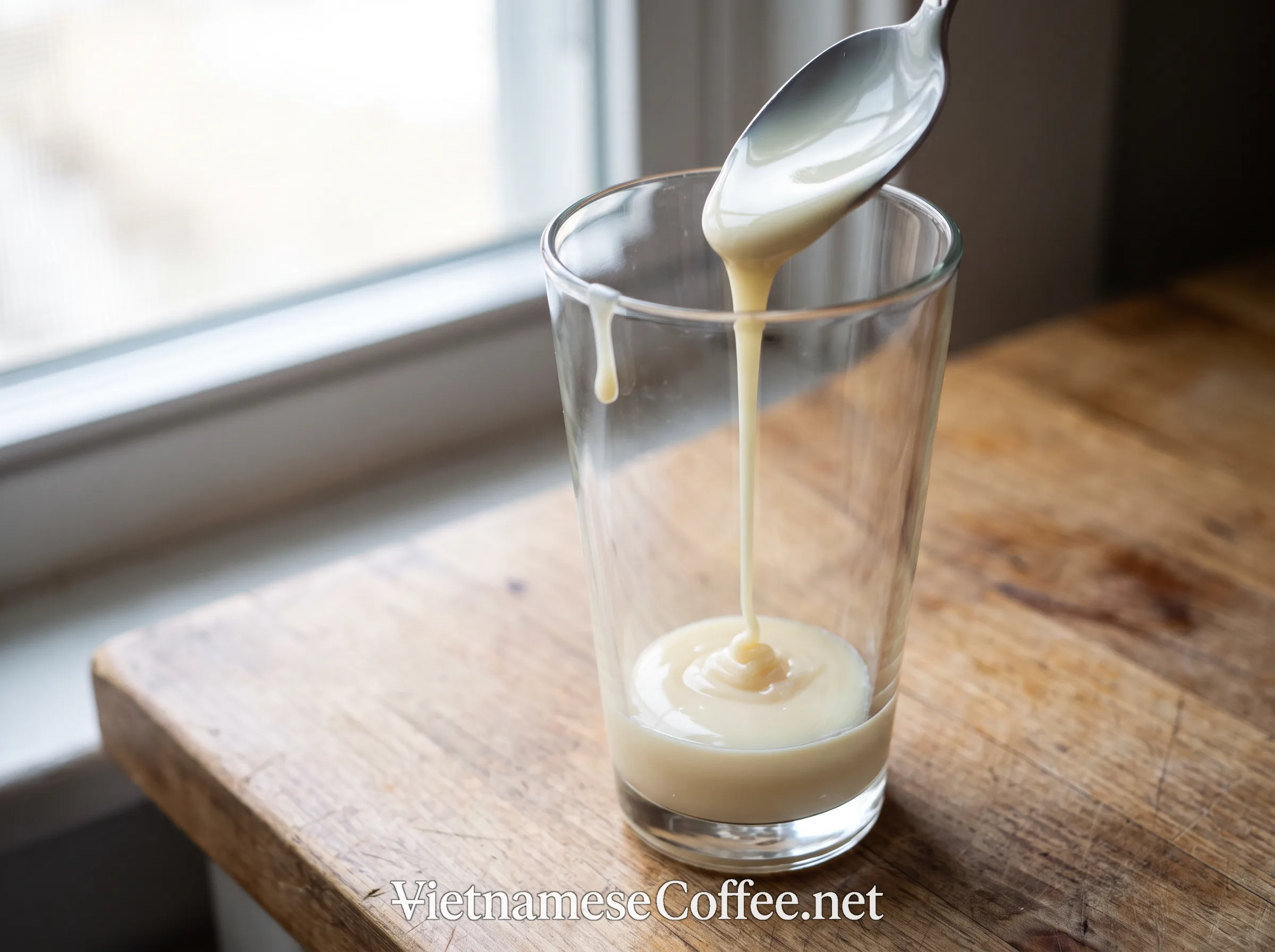
Spoon 20 to 30 milliliters of sweetened condensed milk into the bottom of a tall, heatproof glass. Celacoffee's recipe uses 20 milliliters as a standard single serving, while the Coffee Guide recommends 30 to 40 milliliters for a sweeter result. Set the glass aside; the condensed milk will stay at the bottom while the coffee brews directly on top of it.
Step 2: Set up the phin filter
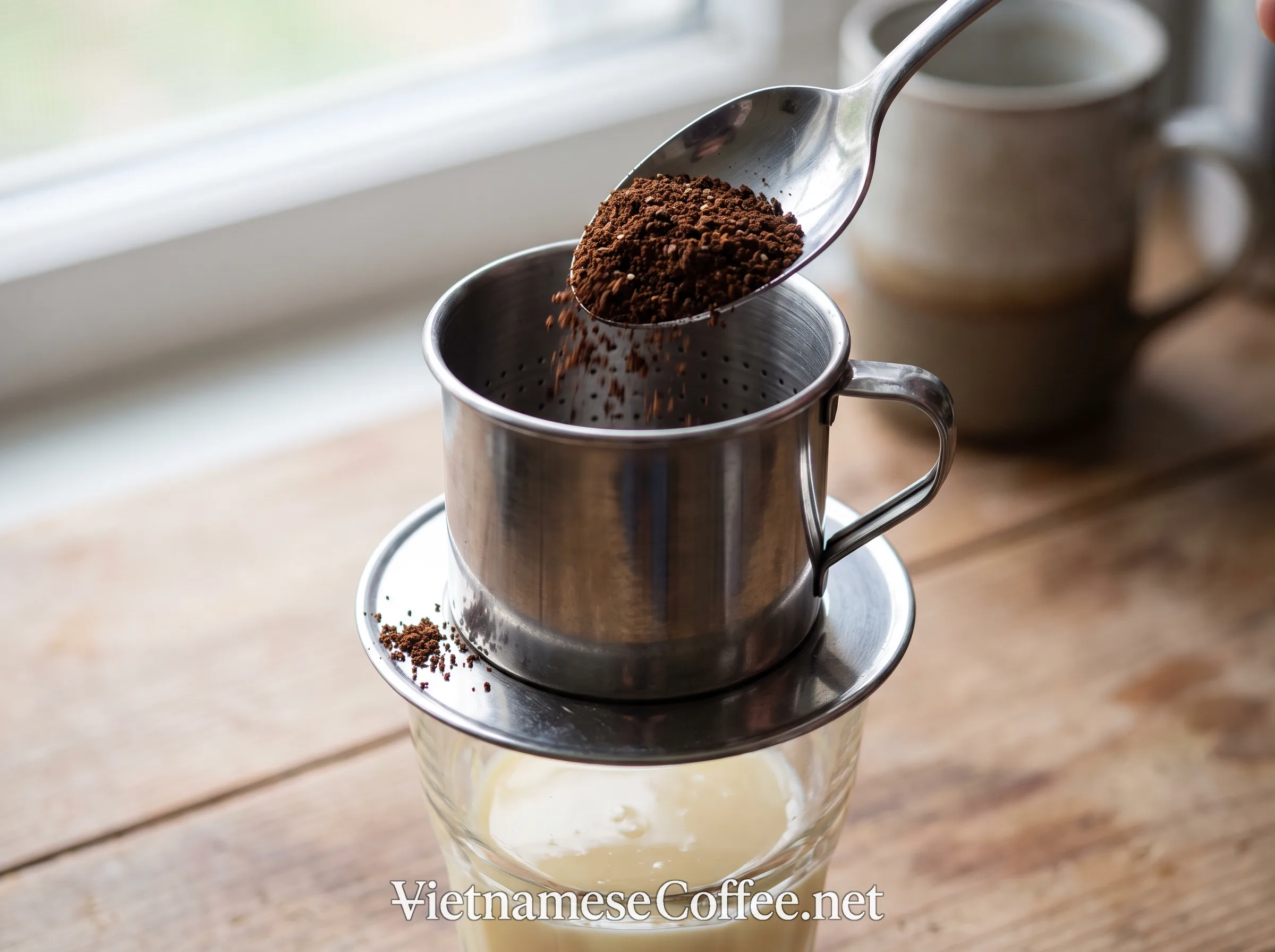
Place a phin filter on top of the glass and add 15 to 20 grams of medium to medium-coarse ground robusta into the chamber. The Coffee Guide recommends dark-roasted robusta or a robusta-forward blend specifically, since its bitterness is what balances the condensed milk's sweetness. For full instructions on assembling and leveling the phin, see the site's separate phin brewing guide.
Step 3: Brew directly over the milk
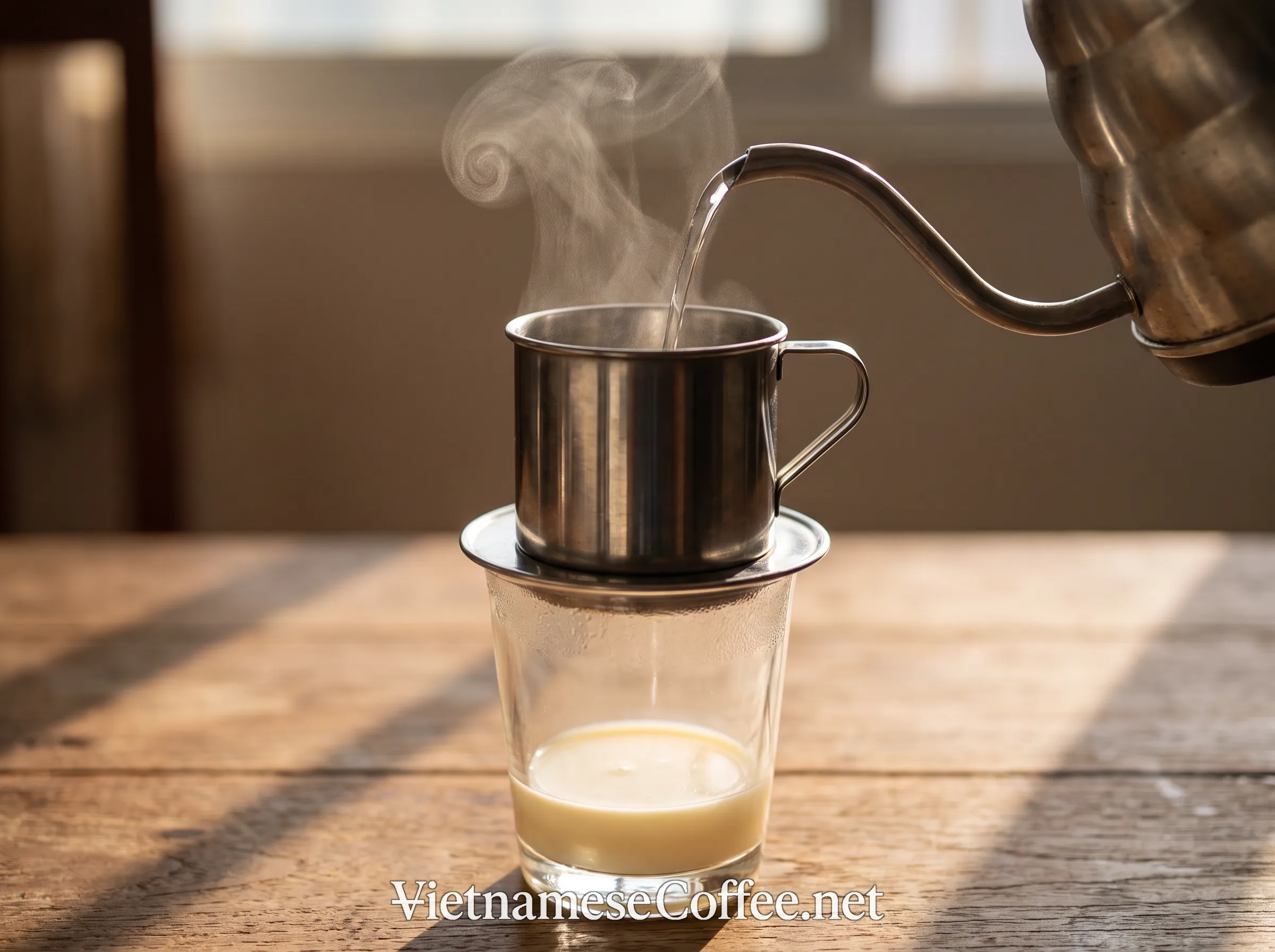
Pour hot water, roughly 90 to 100 milliliters at 92 to 96 degrees Celsius, through the phin in the same bloom-then-fill sequence used for any phin brew. Brewing directly on top of the condensed milk, rather than mixing the milk in after, lets the two liquids blend more evenly once dripping finishes, according to Celacoffee's preparation notes.
Step 4: Wait for the drip to finish

Let the coffee drip fully, which typically takes about 5 minutes according to Celacoffee, though total time can vary with grind size and phin design. Do not disturb the glass while it drips. The dark coffee should pool on top of the pale condensed milk in a visible layer, a sign the two have not yet mixed.
Step 5: Stir until uniform

Once dripping stops, remove the phin and stir the coffee and condensed milk together thoroughly. Celacoffee's instructions specify stirring until the mixture reaches one uniform color, since the two liquids do not combine on their own even after brewing. The result should be a smooth, medium-brown liquid with no visible streaks of white milk remaining.
Step 6: Fill with ice and serve

Fill the glass the rest of the way with ice, using a generous amount rather than just a few cubes. Celacoffee's recipe specifically calls for filling the glass with a lot of ice, then stirring again once more to chill the drink quickly. Add a straw and drink promptly, since the ice will continue diluting the coffee the longer it sits.
Why quantities vary so much between recipes
Coffee-to-milk-to-water ratios for cà phê sữa đá vary considerably across published recipes, and this is worth explaining honestly rather than presenting one figure as the single correct version. Saveur's recipe uses a relatively light 10 grams of coffee and 18 grams of condensed milk for a smaller, more delicate cup. It calls for about a 60-second bloom and roughly a 5-minute total drip. Celacoffee scales this up to 15 grams of coffee and 20 milliliters of milk.
The Coffee Guide recommends 15 to 20 grams of coffee and 90 to 100 milliliters of water at 92 to 96 degrees Celsius. It adds a notably sweeter 30 to 40 milliliters of condensed milk, with a shorter 30-second bloom and a 4 to 6-minute drip. Roast & Roast's recipe uses a larger-format 20 grams of coffee, 200 milliliters of water, and 2 to 3 tablespoons of condensed milk.
Much of this spread comes down to serving size and personal taste for sweetness. A recipe intended for a smaller glass naturally uses less of everything. A recipe aimed at a stronger, more assertive cup instead uses proportionally more coffee relative to milk and water. Ice will dilute the finished drink regardless of the ratio used to brew it. Some recipes account for this by brewing slightly stronger than they would for a hot, undiluted cup.
For a first attempt, starting near 15 to 20 grams of coffee and 20 to 30 milliliters of condensed milk per serving is a reasonable middle ground. From there, adjust the milk up or down to taste. Because condensed milk brands vary in sweetness and thickness, the correct amount ultimately depends on the specific product used and the drinker's own preference. Ông Thọ, produced by Vinamilk since 1976, is Vietnam's best-known sweetened condensed milk brand and a common choice in Vietnamese coffee recipes, though any sweetened condensed milk will work.
Regional names and common variations
Cà phê sữa đá is not the only way Vietnamese coffee drinkers combine coffee, milk, and ice, and naming conventions differ by region in ways that reflect real differences in proportion, not just dialect. Vietnamese-language sources describe a version called cà phê nâu as characteristic of the north, particularly Hanoi. According to K Coffee's regional coffee culture guide, cà phê nâu uses a higher proportion of coffee to condensed milk than the drink typically served in the south.
In the south, particularly Saigon, K Coffee and The Green Coffee both describe cà phê sữa đá and bạc xỉu as using less coffee and more condensed milk. The result is a sweeter, milder, less bitter cup. Vietnamese Wikipedia's entry on cà phê sữa also notes that the hot version of this milk coffee is sometimes called nâu nóng. This term is particularly common in the north during colder weather.
Bạc xỉu takes the southern, milk-forward style further still. According to Tuoi Tre News's coverage of Saigon coffee culture, bạc xỉu is explicitly described as an upside-down version of cà phê sữa đá. In this version, condensed milk substantially outweighs the coffee rather than the other way around. Someone who finds standard cà phê sữa đá too bitter, or wants a milder introduction to Vietnamese coffee, may prefer starting with bạc xỉu instead.
Why condensed milk became the standard
Cà phê sữa đá's defining ingredient exists because of a practical supply problem, not a deliberate flavor choice. Coffee cultivation arrived in Vietnam under French colonial rule in the 19th century, and colonists initially wanted to drink coffee with fresh milk, as they did at home. Fresh dairy was difficult to source and store reliably in Vietnam's tropical climate during this period.
Sweetened condensed milk solved this problem directly. Hanoi Drip's history notes that condensed milk kept well without refrigeration, thanks to its high sugar content, at a time when refrigeration was limited across French Indochina. This made it a practical, shelf-stable substitute for fresh dairy, regardless of the exact supply chain details behind any specific shipment of milk.
What began as a substitution for a missing ingredient became the drink's defining characteristic. The specific pairing of dark, bitter robusta and thick, sweet condensed milk, poured over ice, evolved gradually into cà phê sữa đá as it is known today. It was not designed that way from the start. This same condensed-milk pairing also appears in several other Vietnamese coffee drinks covered elsewhere on this site.
Caffeine and calories: what to expect, without invented precision
Because cà phê sữa đá is brewed from concentrated robusta rather than diluted drip coffee, it delivers a noticeably higher caffeine dose than many Western coffee drinks of a similar size. Peer-reviewed research on coffee chemistry, including a review published in the journal Molecules, confirms that green robusta beans generally contain more caffeine than arabica beans. The exact caffeine content of a finished glass depends heavily on the specific coffee dose, bean composition, and extraction time used.
The condensed milk contributes essentially all of the sugar and fat in the finished drink, since the underlying coffee itself is unsweetened and dairy-free. A recipe using more condensed milk, such as the Coffee Guide's 30 to 40 milliliter range, will contain more sugar and fat. A lighter-milk version closer to Saveur's 18-gram serving will contain less. No single, independently verified nutrition analysis of this specific drink was found during research for this page.