
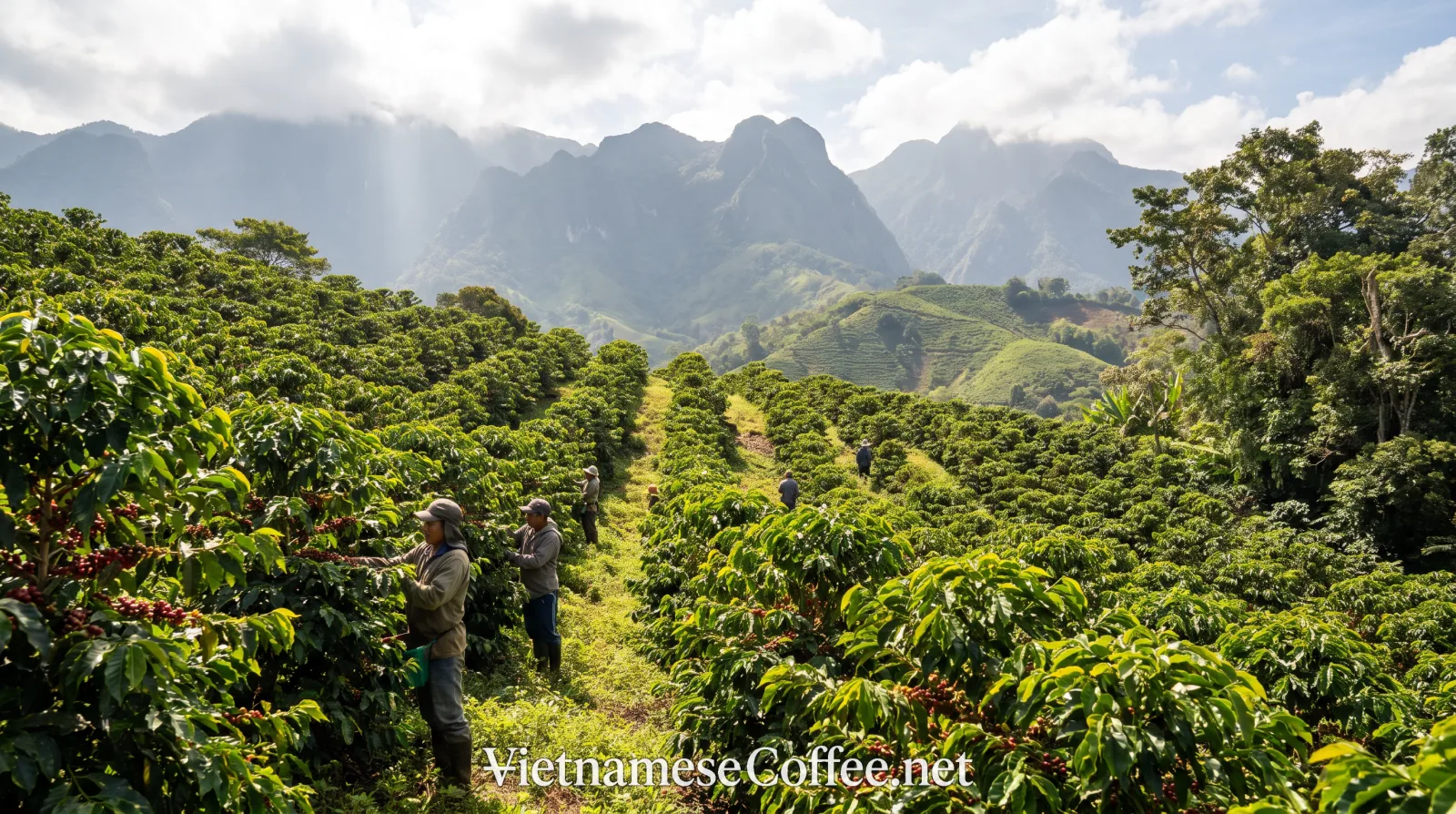
Water: the industry's central vulnerability
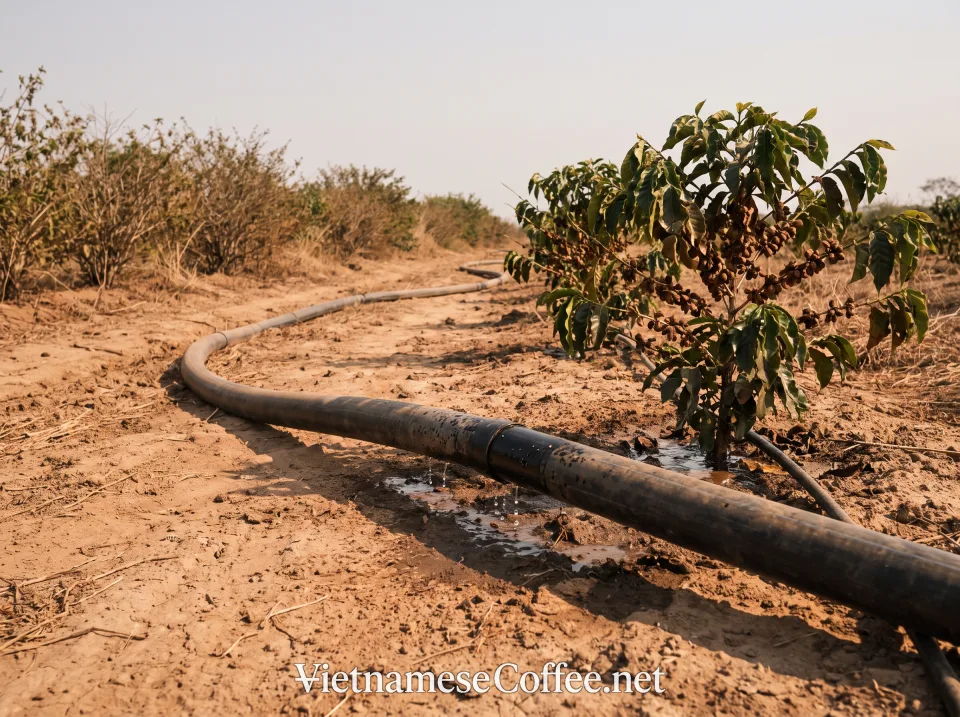
Nearly every source reviewed for this page identifies water, not climate warming in the abstract, as the most immediate sustainability pressure on Vietnamese coffee. The Central Highlands, where most Vietnamese robusta grows, receives a substantial 1,800-3,000 mm of rain annually, but roughly two-thirds of it falls during the May-October monsoon, leaving a four-month dry stretch that lands directly on the crop's fruit-ripening and harvest period. To cover that gap, an estimated 90% of the region's coffee area relies on irrigation, and multiple sources describe that irrigation as heavily groundwater-dependent, with cited shares ranging from roughly 57% to 95% of total coffee irrigation water coming from groundwater reserves, drawn from wells that are, according to more recent reporting, showing signs of long-term depletion after decades of intensive pumping.
This dependence turns ordinary weather variability into a structural risk. The Alliance of Bioversity International and CIAT describes the 2015-2016 drought, the region's most prolonged in 90 years, as leaving roughly 400,000 households without sufficient water for both household use and irrigation. More recent reporting describes a similar pattern recurring: one 2026 industry report cited rainfall from January through mid-April running 10 to 40% below historical averages, with river flows, reservoir levels, and groundwater tables all declining in the same period. Vietnam's own research institutions are actively working on this problem from the supply side; WASI has developed drought-tolerant robusta clonal lines able to withstand roughly 43 days without watering, compared with about 30 days for a standard variety, an approach estimated to reduce irrigation needs by 25 to 30% if adopted at scale.
Climate change and the long-term outlook
Beyond immediate drought cycles, several sources model a more structural, longer-term shift in where robusta can even be grown profitably in Vietnam. Projections vary depending on methodology and climate scenario, but they consistently point in the same direction: less suitable land, not more. One widely cited estimate, from CIAT research reported by Mongabay, projects Vietnam could lose up to roughly 50% of its currently robusta-suitable growing area by 2050. Other sources cite steeper reductions under specific scenarios, up to 60% across Southeast Asia's currently suitable regions in one study, and as much as 80% suitability loss across most Central Highlands coffee areas in another CIAT-linked estimate. These are modeled projections under differing assumptions, not a single agreed figure, but the range as a whole represents a serious, multiply-corroborated concern rather than an outlier claim from any one study.
A related concern documented across several sources is the historical link between coffee expansion and deforestation in the Central Highlands: production intensification, heavy fertilizer use, and the spread of coffee monoculture have been connected to forest loss in past decades, which is now colliding directly with new international rules aimed at breaking that link going forward.
Smallholder farmers and new EU rules
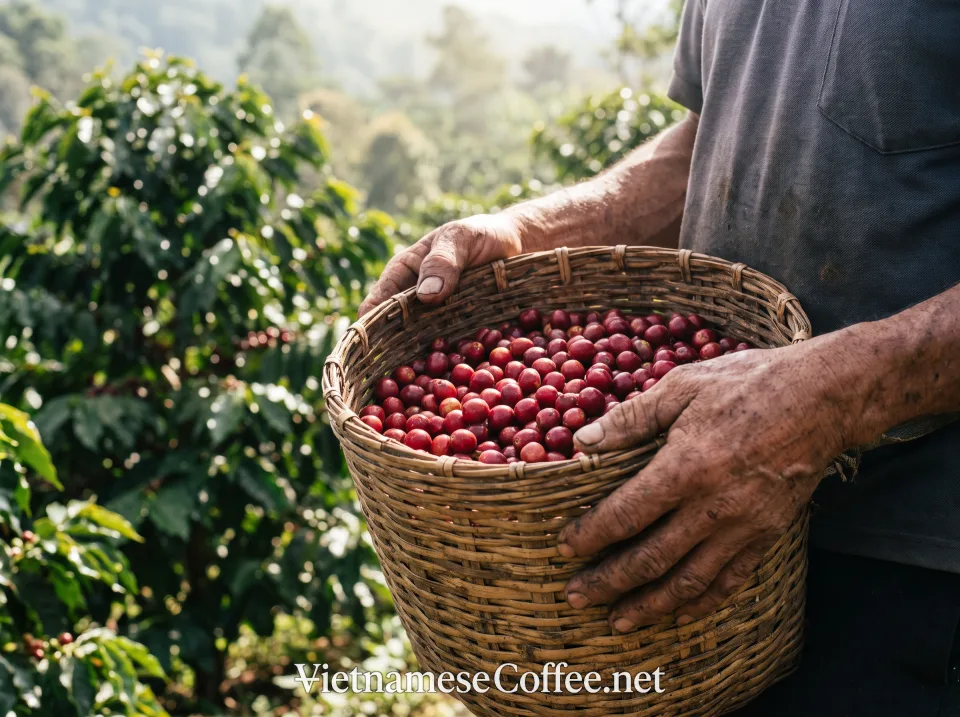
Vietnam's coffee sector remains structurally dominated by small farms. One recent industry analysis cites roughly 650,000 coffee farms operating nationwide, most under one hectare in size, a scale that shapes how the industry can realistically respond to new sustainability requirements. As of a 2024 USDA report, roughly 30% of Vietnam's coffee-growing area held some form of sustainability certification (including 4C, Rainforest Alliance, UTZ, Fairtrade, VietGAP, GlobalGAP, and Organic), leaving a majority of area uncertified at that point.
The most significant recent regulatory shift is the EU Deforestation Regulation (EUDR), which entered into force in mid-2023 and, following prior postponements, now applies from 30 December 2026 for large and medium operators and traders, and from 30 June 2027 for micro and small enterprises, per the European Commission's own current guidance. The regulation requires coffee sold into the EU to be traceable to specific land parcels, proven deforestation-free after a fixed cutoff date, and legally produced. Its geolocation requirement is specific: at least one latitude/longitude coordinate accurate to six decimal places for every production plot, with a full perimeter polygon required for any non-cattle plot larger than 4 hectares.
Separately from that technical geolocation standard, a peer-reviewed 2025 study of Vietnamese smallholders found that land use rights certificates (LURCs), the documents proving legal land ownership needed to satisfy EUDR's broader "legally produced" requirement, were a genuine practical barrier for many farmers it surveyed, particularly ethnic minority farmers, who were more likely to hold multiple smaller, fragmented land parcels that complicate mapping. One industry analysis estimates 15 to 20% of Vietnam's coffee-growing area may lack these certificates altogether.
Vietnam has responded at a national level: a Forest and Coffee Growing Areas Database launched in December 2024, with the Vietnam Coffee and Cocoa Association (VICOFA) reporting roughly 137,000 hectares mapped and a goal of expanding to 462,000 hectares, covering an estimated 80% of Central Highlands coffee area. One source citing this effort states it has already reduced EU inspection rates to roughly 1% of Vietnamese coffee shipments, though this figure comes from a single analysis rather than being independently corroborated elsewhere in this research.
What this means in practice
Taken together, these pressures point toward a coffee industry under real, active strain rather than a settled sustainability success story or an unmanageable crisis. Water scarcity and groundwater depletion are documented, ongoing problems with technical responses (drought-tolerant varieties, more efficient irrigation) already in development but not yet universally adopted. Long-range climate projections vary in severity but consistently point toward shrinking suitable growing area unless adaptation measures scale up meaningfully. And smallholder farmers, who make up the large majority of Vietnam's coffee-growing base, face a genuinely difficult compliance timeline under EUDR, now confirmed for December 2026 and June 2027, that national-level tracing systems are only partially able to offset, particularly for farmers lacking clear land documentation.