
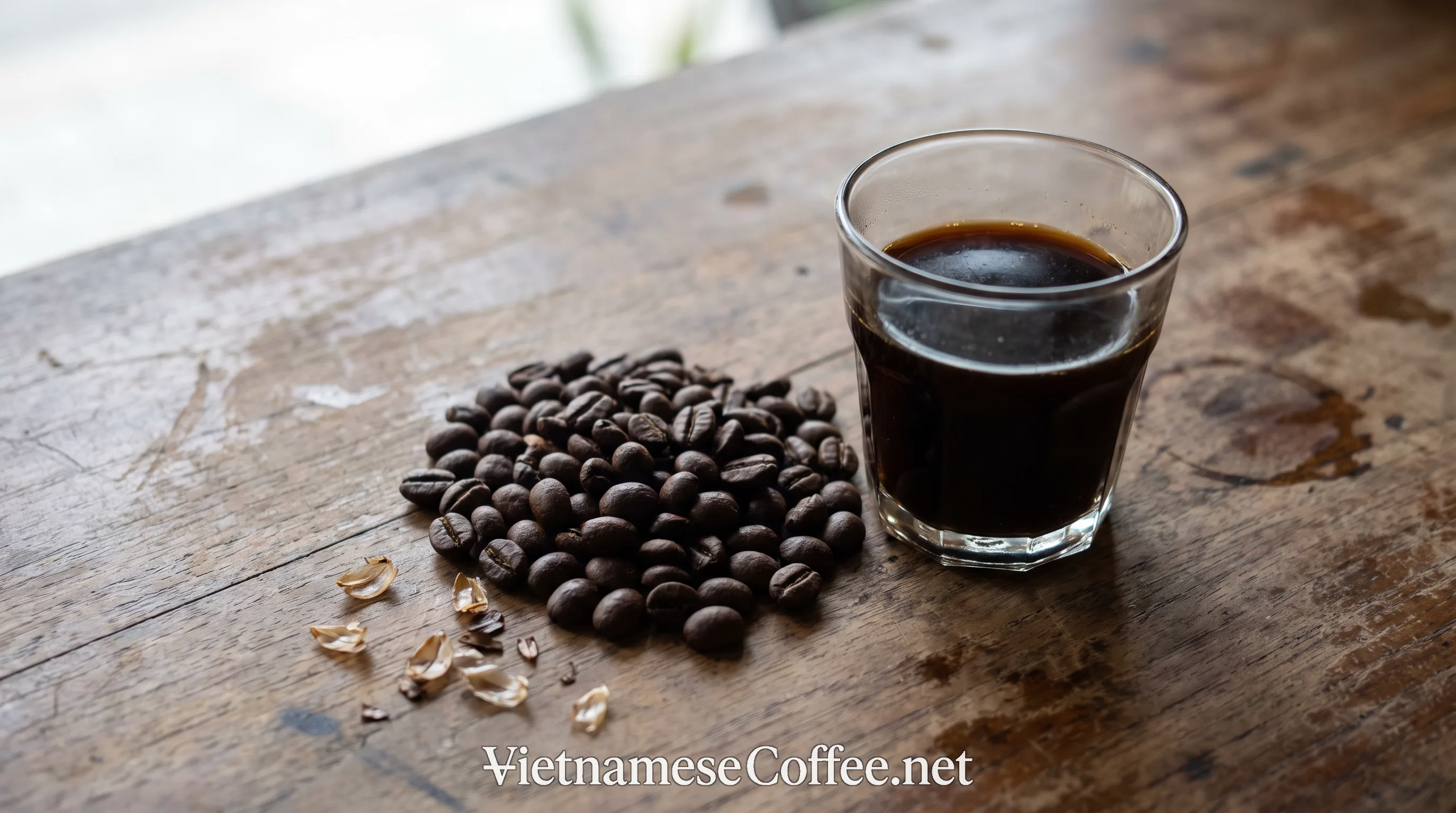
Robusta Culi at a glance
| Coffee species | Coffea canephora (robusta) |
|---|---|
| Bean form | Culi / peaberry, single round seed |
| Vietnamese positioning | Specialty robusta category for phin, black coffee, and blends |
| Common seller flavor descriptions | Chocolate, roasted nuts, earth, malt, wood, low acidity |
| Caffeine positioning | High; robusta generally contains more caffeine than arabica |
| Brewing use | Dark roast, phin, black coffee, or condensed-milk drinks |
| Commercial example | Trung Nguyen Creative 1: 100% Culi Robusta |
What the label means
On a Vietnamese coffee package, Robusta Culi, Culi Robusta, and peaberry robusta all indicate the same basic commercial proposition: coffee from robusta trees sold in its rounded peaberry form. The word culi does not indicate a new coffee species, a specific farm, or a quality grade by itself.
The full biological explanation belongs to What Is Culi Bean?. That page explains why a culi bean has a single seed and why it is shaped differently from ordinary flat beans. For a buyer or coffee drinker, the relevant point here is narrower.
Robusta Culi is the robusta-specific expression of that bean form, positioned in Vietnam as a distinctive commercial coffee category. GreenTech Export lists Robusta Culi separately from standard robusta grades in its Vietnamese export guide.
This indicates that sellers and buyers treat the product as a recognizably different commercial category. However, the label alone does not guarantee superior quality. A Robusta Culi coffee can still vary widely according to origin, harvest selection, processing, storage, and roast quality.
Common flavor descriptions
Robusta Culi retains the core character generally associated with Vietnamese robusta. Product descriptions vary between sellers, so these notes should be read as common commercial descriptions rather than inherent sensory consequences of the peaberry form.
Commonly listed notes include dark chocolate, roasted nuts, raw earth, malt, and wood. These products are often presented with low acidity, a dense body, and a lingering bitter finish. Helena Coffee and MP Coffee use overlapping language around bitterness, sweetness, dark roast character, and a full-bodied cup.
The key buying signal is therefore stylistic, not absolute. Buyers choosing Robusta Culi are usually seeking a dark, low-acid robusta profile that remains clear in a concentrated brew.
It should not be assumed that the culi form automatically makes every lot stronger, more concentrated, or better than standard robusta. Product quality still depends on sourcing, processing, freshness, and roast execution.
Caffeine positioning
Robusta is generally a higher-caffeine coffee species than arabica. A peer-reviewed review in Molecules reports that arabica green beans average roughly 0.9 to 1.5 percent caffeine by dry weight, while robusta green beans range from about 1.2 to 2.4 percent.
Robusta Culi should therefore be understood as a high-caffeine robusta product, rather than a coffee with one fixed universal caffeine percentage. Brewing method, roast, variety, and dose all affect the final caffeine delivered in a cup.
Product labels may state their own figures. For example, Trung Nguyen Europe lists 2 percent caffeine for its Creative 1 product, made with 100 percent Culi Robusta. This product-specific figure should not be generalized to every Robusta Culi coffee.
For consumers, the practical point is simple: Robusta Culi is more suitable for those seeking the fuller-bodied, more bitter, generally higher-caffeine character of robusta. It is not the natural choice for drinkers who want a low-caffeine or bright arabica-style cup.
Phin brewing and Vietnamese drinks
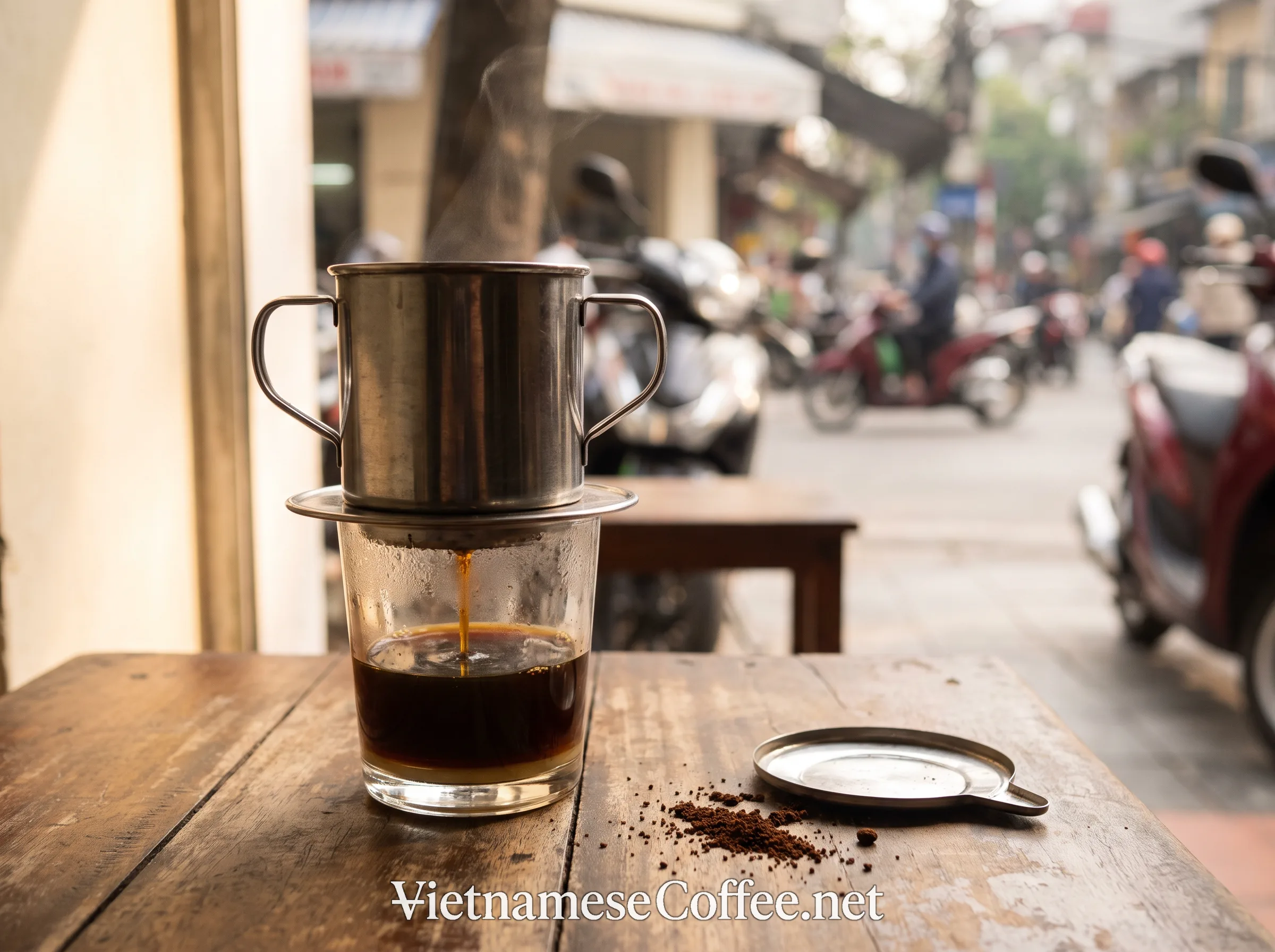
Robusta Culi is closely associated with the traditional metal phin filter. GreenTech Export identifies the specialty category as suitable for Vietnamese phin brewing. The slow gravity drip produces a short, concentrated coffee whose dark-roast profile remains clear even after it is served over ice.
The coffee can be served black as cà phê đen. In this format, the dark roast, earthy, and woody descriptions are most visible. It can also form the coffee base for cà phê sữa đá, where the sweetness and thickness of condensed milk are balanced against the darker robusta profile.
The brewing application is one reason Robusta Culi has value beyond its rounded shape. A coffee made for phin use must retain a clear flavor identity after dark roasting and slow extraction.
Robusta Culi is frequently marketed to meet that preference: a strong, low-acid, concentrated Vietnamese coffee rather than a light specialty brew.
Blends, products, and buying context
Robusta Culi appears both as a standalone coffee and as a blend component. The official Trung Nguyen Europe listing identifies Creative 1 as containing 100 percent Culi Robusta. It lists the product as dark, strong, and full-bodied, making it a useful example for buyers looking specifically for a fully robusta-based Culi experience.
Mr. Viet provides a contrasting commercial example. Its Culi coffee product is listed as an 80 percent arabica / 20 percent robusta composition, with malt and wood aromas in its product description.
The source identifies the product as Culi coffee, but it does not establish that the 20 percent robusta component alone is Robusta Culi. This product is therefore best understood as an example of how Culi-branded coffees can be marketed in an arabica-robusta blend.
When shopping, buyers should distinguish product identity from a quality verdict. "Robusta Culi" tells the buyer that the coffee is a robusta peaberry form. It may signal a dark, full-bodied, low-acid cup, but it does not automatically mean the product is better than standard robusta, arabica, or a blended coffee.