
Cà phê đen at a glance
| Primary coffee bean | Robusta |
|---|---|
| Brewing method | Phin filter gravity drip |
| Typical caffeine content | 150 to 250 milligrams per serving, depending on preparation |
| Typical caloric range | 2 to 5 calories without sugar |
| Common variations | Cà phê đen nóng and cà phê đen đá |
| Tasting notes | Intense bitterness, dark chocolate, roasted nuts |
History and cultural origin
Cà phê đen is the plain black form of Vietnamese coffee and one of the clearest ways to taste the country's robusta tradition. Coffee was introduced to Vietnam in the French colonial period. The Vietnam Coffee - Cocoa Association dates the first introduction of coffee to 1857 and notes that robusta was introduced in 1908.
After coffee moved into commercial cultivation, Vietnam's coffee economy shifted heavily toward the Central Highlands. The climate and basaltic soils in that region suited robusta, a hardier coffee species that could support large-scale production. That botanical shift is central to why cà phê đen tastes so different from black coffees built around milder arabica beans.
The name cà phê đen translates directly as black coffee. It describes the drink without decoration: coffee served without milk. That matters in Vietnamese coffee vocabulary because milked drinks such as cà phê sữa đá have separate names and separate expectations.
Historically, black coffee also carried a practical role. It was strong, compact, and easy to prepare with reusable equipment. Local accounts of Vietnamese coffee culture often connect this plain style to everyday street-side drinking, where the coffee is sipped slowly rather than treated as a quick takeaway beverage.
The phin filter and robusta beans
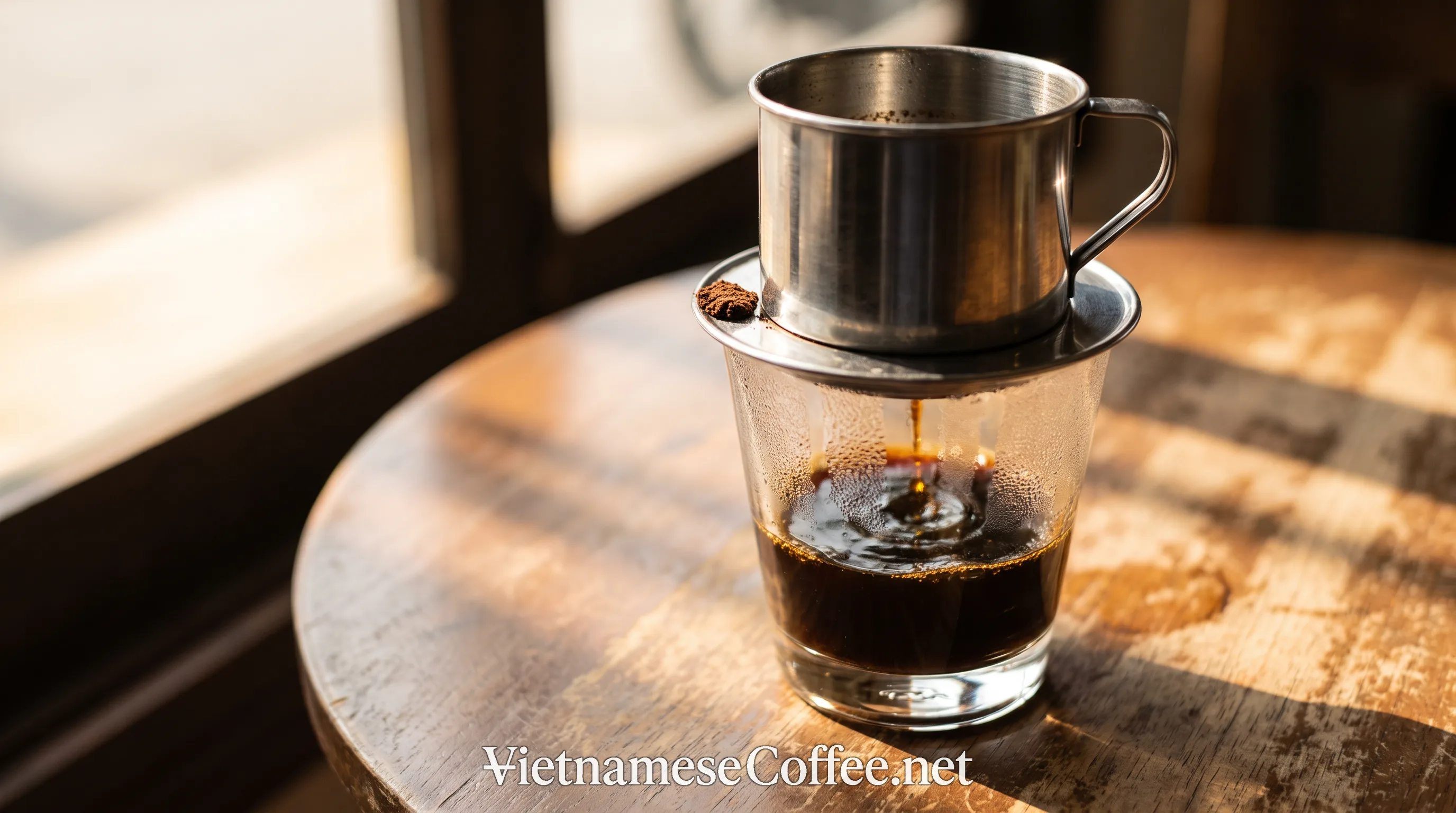
The defining tool for cà phê đen is the phin filter. A phin is a small metal drip brewer that sits directly on the cup. It usually includes a perforated base plate, a brewing chamber, a gravity press, and a lid. The method is slow, unpressurized, and designed for one concentrated serving at a time.
The phin works well with Vietnamese robusta because it keeps hot water in contact with coarse grounds for several minutes. That long extraction pulls dense oils and bitter compounds into the cup. The result is more concentrated than a standard American drip coffee, but it is not espresso because no pump pressure is used.
Robusta is equally important to the identity of the drink. GreenTech describes Vietnam as the world's leading robusta producer, and Vietnamese coffee culture is built largely around that species. Compared with arabica, robusta usually tastes bolder, earthier, and more bitter.
Dark roasting pushes those traits further. A typical cup of cà phê đen can taste like dark chocolate, roasted nuts, smoke, or charred wood. That intensity is the point of the drink. Without condensed milk, sugar, or cream, there is little to soften the robusta profile.
Nutritional profile and caffeine content
Plain cà phê đen is a very low-calorie beverage because it is served without milk, dairy substitutes, or heavy syrups. Art de Vivre Coffee estimates that pure black Vietnamese coffee contains only trace calories, often around 2 to 5 calories for a serving.
The low calorie count does not mean the drink is mild. Robusta beans naturally contain more caffeine than arabica beans. Art de Vivre Coffee gives a broad comparison of 2.2 to 2.7 percent caffeine by weight for robusta, versus 1.2 to 1.5 percent for arabica.
Published serving estimates vary because phin recipes use different amounts of coffee and water. Local Beans Roastery estimates roughly 150 to 200 milligrams of caffeine from a 20-gram robusta brew, while Art de Vivre Coffee gives a higher range of about 200 to 250 milligrams for a six-ounce serving.
Many drinkers add a small amount of granulated sugar to soften the bitterness. That changes the nutrition profile, but it still keeps the drink much lighter than condensed-milk coffee. The base drink remains black, strong, and direct.
How to brew hot cà phê đen
The hot version is commonly called cà phê đen nóng. DailyPhin's method uses 20 grams of medium-coarse Vietnamese robusta coffee, a small bloom pour, and a slow final extraction. The goal is a restricted drip that finishes in about five to seven minutes.
Start by rinsing the phin and serving glass with hot water. Add the coffee grounds to the chamber, level the bed, and place the gravity press on top. Pour about 30 milliliters of hot water over the grounds and let the coffee bloom for roughly 40 seconds.
After the bloom, add the remaining hot water and cover the phin with its lid. The coffee should drip slowly into the cup. If it races through, the grind is likely too coarse or the press is too loose. If it stalls for too long, the grind may be too fine.
Once the drip stops, remove the phin and serve the coffee hot. Some drinkers stir in sugar, while others drink it completely plain. For the brewer itself, see the phin glossary entry.
How to brew iced cà phê đen đá
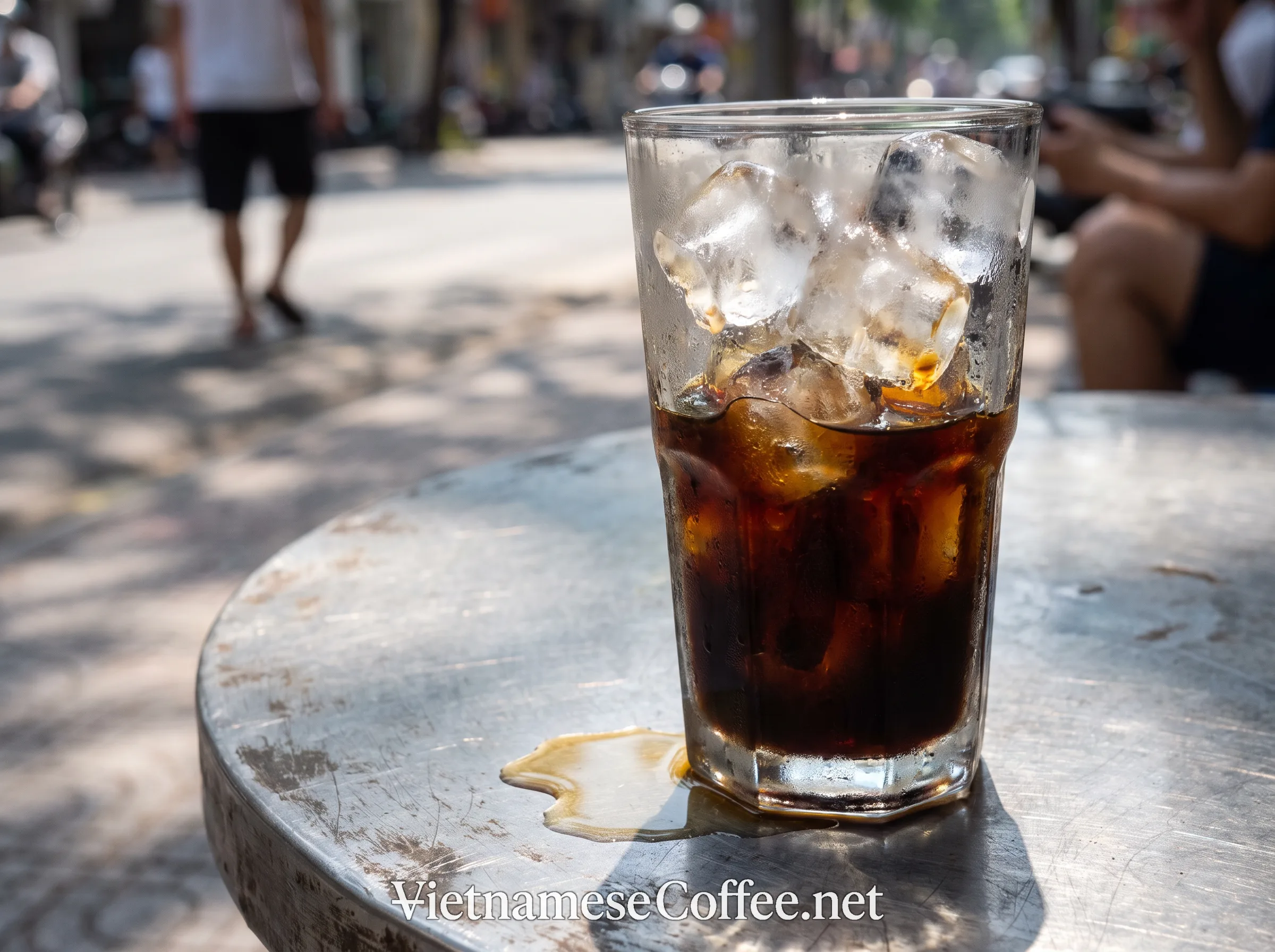
The iced version is called cà phê đen đá. Brew the same strong black coffee concentrate first, then pour it over a full glass of large ice cubes. The ice chills the coffee quickly and dilutes it enough to make the drink refreshing without removing its bitter robusta core.
If sugar is used, stir it into the hot coffee before adding ice. Granulated sugar dissolves poorly once the drink is cold. Large, solid cubes are better than crushed ice because they melt more slowly and keep the drink from becoming watery too fast.
Cà phê đen đá is especially common in hot weather and in street-side cafés. It keeps the direct flavor of black robusta but makes the serving colder, longer, and easier to sip slowly.