
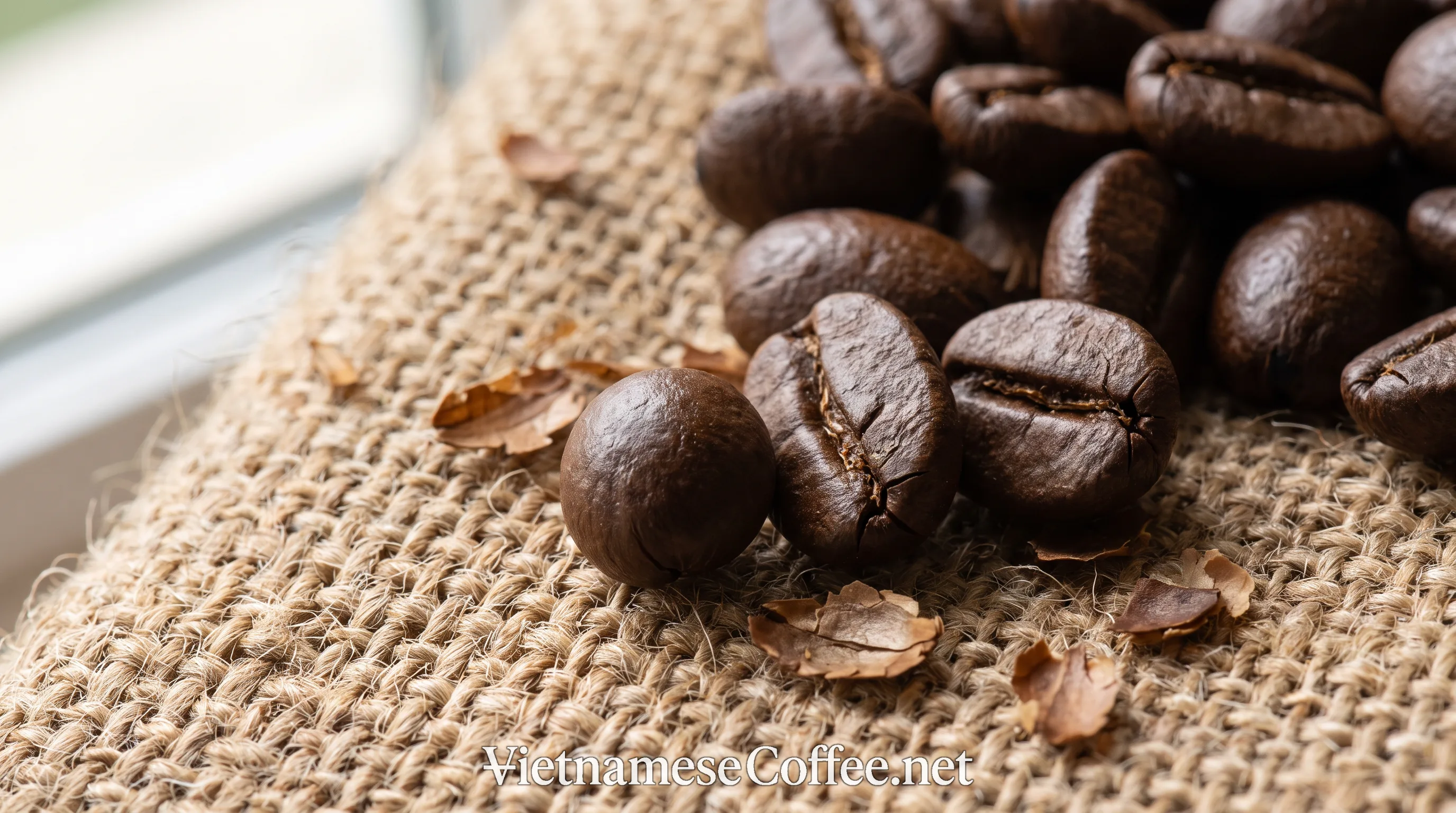
Culi bean at a glance
| Coffee species | Occurs in both Coffea canephora and Coffea arabica |
|---|---|
| Common names | Culi, Peaberry, Caracol |
| Harvest percentage | Approximately five percent of a total crop |
| Physical shape | Small, dense, distinctly round pea shape |
| Culi Robusta caffeine | Up to 3.5 to 4.0 percent by dry weight |
| Flavor profile | Heavy body, intense concentration, elevated bitterness |
| Brewing application | Ideal for traditional phin filter extraction |
Biological origins and development
Coffee cherries usually develop two seeds. As the seeds grow side by side, they press against each other and form the familiar flat-sided coffee bean shape. A culi bean, known internationally as a peaberry, forms when only one seed develops inside the cherry.
Jefferson Digital Commons describes peaberry as a developmental anomaly rather than a breedable genetic mutation. One ovule fails or aborts early, leaving a single seed to fill the fruit cavity. Without a twin bean pressing against it, the seed becomes rounder, denser, and more pea-like.
This can happen in both Coffea canephora and Coffea arabica. Farmers cannot plant a dedicated culi tree. Instead, culi beans appear randomly within otherwise normal coffee crops and must be separated after processing.
Helena Coffee and Jefferson Digital Commons both place peaberry occurrence around a small share of harvests, commonly near five percent. That rarity is one reason culi coffee is marketed as a distinct premium selection rather than as ordinary coffee.
Harvesting and commercial sorting
Culi beans are picked at the same time as standard beans because the outside of the coffee cherry does not reveal the shape of the seed inside. Sorting happens later, after cherries are pulped, dried, and processed into green coffee.
The sorting step matters because peaberries are physically different. They are smaller, denser, and rounder than standard flat beans. If they are roasted in the same batch as flat beans, their different shape and size can affect roast uniformity.
Helena Coffee notes that the round shape can promote more even roasting, but only when culi beans are managed as their own batch. Separation lets roasters adjust heat application for the distinct physical behavior of the peaberry.
Because culi beans are rare and require extra sorting, pure culi lots often command higher prices. In Vietnam, that value is most visible in culi robusta products designed for drinkers who want a stronger and heavier cup.
Culi robusta vs culi arabica
Culi beans can come from either robusta or arabica plants, but Vietnam is especially associated with culi robusta. That is because Vietnam's national coffee economy is built around robusta, so a meaningful share of the country's peaberry output also comes from robusta farms.
CoffeeCherry.vn describes Culi Robusta as especially intense, with heavy body and strong dark flavors. The cup is often marked by dark chocolate, wood, malt, earth, and elevated bitterness. It is designed for impact rather than delicate acidity.
Culi Robusta can also carry very high caffeine. CoffeeCherry.vn reports figures reaching 3.5 to 4.0 percent by dry weight, above the usual robusta range. That makes it one of the strongest coffee forms used in Vietnamese-style brewing.
Culi Arabica is different. CoffeeCherry.vn describes it as sweeter and more aromatic, with fruit, caramel, and honey notes. It has a moderate body, lighter acidity, and lower caffeine than Culi Robusta, which makes it closer to specialty arabica profiles.
Roasting culi beans
Shape changes how a coffee bean takes heat. Standard beans have broad flat faces and edges. Culi beans are rounder, so they roll differently in a roasting drum and expose their surface to heat in a different way.
Helena Coffee connects the rounded culi shape with more even roasting. That does not mean culi can simply be mixed into any batch. It means separated culi lots give roasters a better chance to manage the bean's shape, density, and heat behavior together.
This is why post-harvest separation matters commercially. A pure culi batch lets roasters build a dedicated roast curve for the peaberry. Mixed batches are harder to control because standard flat beans and culi beans do not respond identically.
In Vietnamese coffee, culi robusta is usually roasted dark enough to emphasize body, bitterness, and aromatic intensity. The goal is a dense coffee base that can survive milk, ice, sugar, and slow phin extraction.
Role in traditional Vietnamese brewing
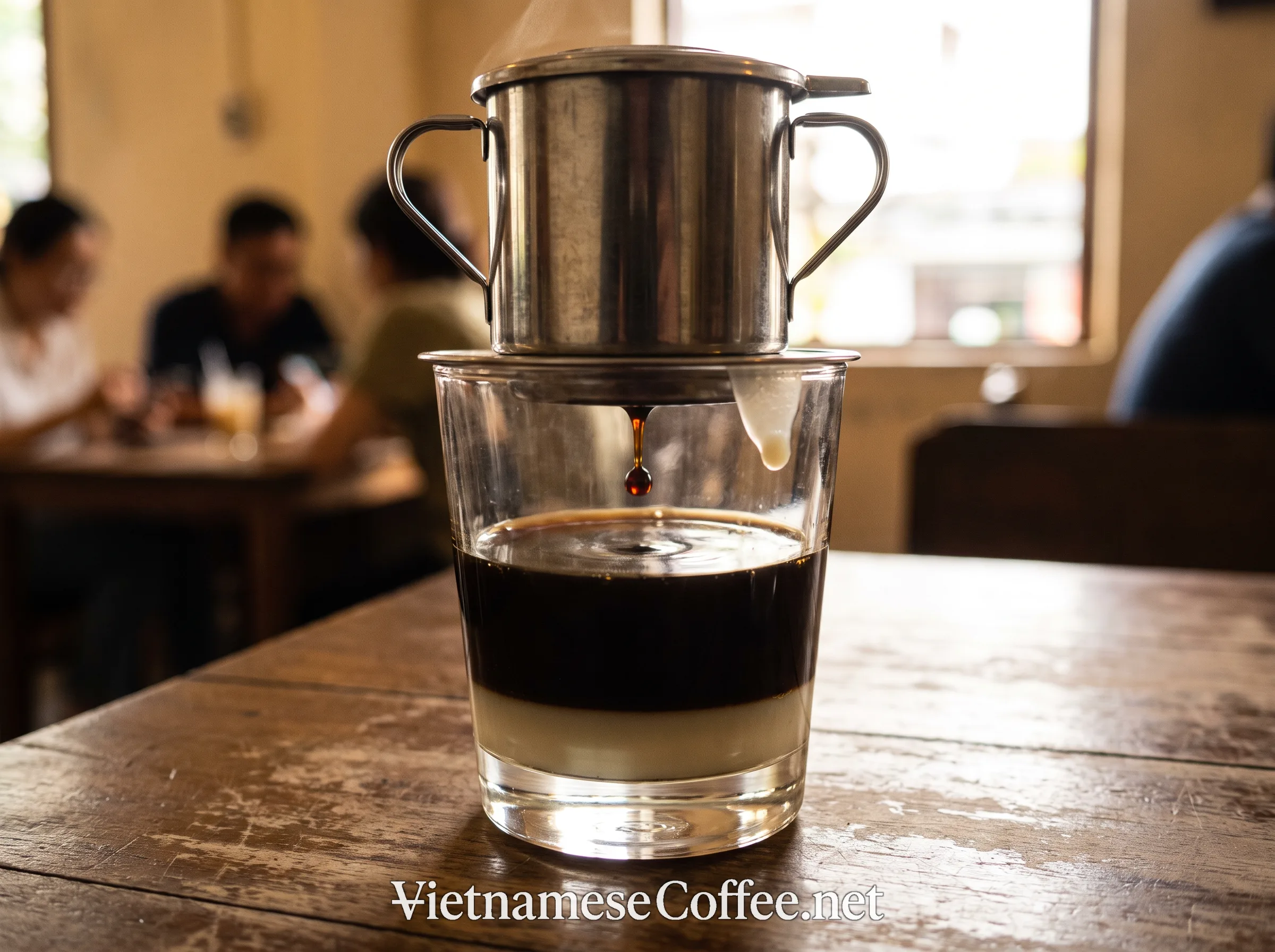
Culi Robusta is well suited to the metal phin filter because the brewing method favors dense, dark, concentrated coffee. The slow gravity drip extracts a compact cup that can be served black or poured over condensed milk.
In cà phê sữa đá, bitter culi robusta can balance the sweetness of condensed milk. The bean brings enough body and intensity to remain visible after stirring, icing, and dilution.
Commercial Vietnamese brands also use culi beans for strength and identity. Drip Roast notes that Trung Nguyen Creative 1 is made from 100 percent Culi Robusta. Mr. Viet uses a blend with 80 percent arabica and 20 percent Culi Robusta to add malt and wood aroma.
For drinkers, the main idea is simple: culi is not a separate coffee species. It is a rare bean shape that concentrates the traits of its parent plant. In Vietnam, that most often means a round, dense, powerful robusta peaberry.