
Cà phê muối at a glance
| Vietnamese name | Cà phê muối |
|---|---|
| English translation | Salt coffee |
| Origin city | Huế, central Vietnam |
| Approximate founding year | 2010 to 2012 |
| Credited inventors | Trần Nguyễn Hữu Phong and Hồ Thị Thanh Hương |
| Core ingredients | Robusta coffee, condensed milk, salted whipped cream |
| Typical price in Huế | 15,000 to 30,000 VND per cup |
Origin story in Huế
Unlike many Vietnamese coffee terms with murky, disputed, or centuries-old origins, cà phê muối has a specific, well-documented, and recent birthplace. According to reporting from CNN Travel and Chowhound, the drink is widely credited to a small cafe in Huế, the historic former imperial capital located in central Vietnam.
The cafe's owners, Trần Nguyễn Hữu Phong and Hồ Thị Thanh Hương, are generally recognized as the drink's inventors. Chowhound's coverage places the drink's creation around 2012, while Mikha Eats cites 2010 as the founding year, indicating some variation across sources regarding the exact date.
What the sources agree on is the underlying motivation. According to Chowhound, the couple invented the sweet-and-salty coffee specifically as a strategy to attract more customers to their modest shop. This distinguished it from the standard condensed-milk coffee already sold throughout Vietnam.
The cafe itself, often referred to simply as Cà Phê Muối, still operates in Huế and has become something of a pilgrimage site for coffee tourists. According to UFO Coffee's account, the original location on Nguyen Luong Bang Street now welcomes hundreds of international visitors daily.
Why salt was added to coffee
The addition of salt to coffee is not simply a novelty flavor pairing. It serves a specific, chemically grounded purpose tied to Vietnam's dominant coffee bean. According to Vietnam Wayfarer, Huế's cafes historically relied on cheap, lower-grade robusta beans that produced an unusually astringent cup on their own.
According to UFO Coffee's explanation of the drink's chemistry, sodium chloride reduces the perception of bitterness caused by chlorogenic acids, compounds naturally abundant in robusta coffee. At the same time, a small quantity of salt can amplify perceived sweetness and subtle acidity already present in the drink.
This chemistry explains why cà phê muối is not simply salty coffee. When properly prepared, the salt functions primarily as a flavor enhancer and bitterness suppressor working in the background. This allows the condensed milk's sweetness and the coffee's inherent flavor to come through more clearly.
Multiple recipe sources, including Textual Chef and Online Coffee Guide, caution against adding too much salt. Excess salt overwhelms the balance and produces an unpleasantly salty drink rather than the intended smooth, rounded flavor.
Preparation and the salted cream topping

Cà phê muối begins with the same core brewing method found throughout Vietnamese coffee culture. Dark-roasted robusta coffee is brewed through a metal phin filter. According to My Viet Kitchen's recipe, hot water is poured over the grounds in stages: first a small bloom pour, then the remaining water.
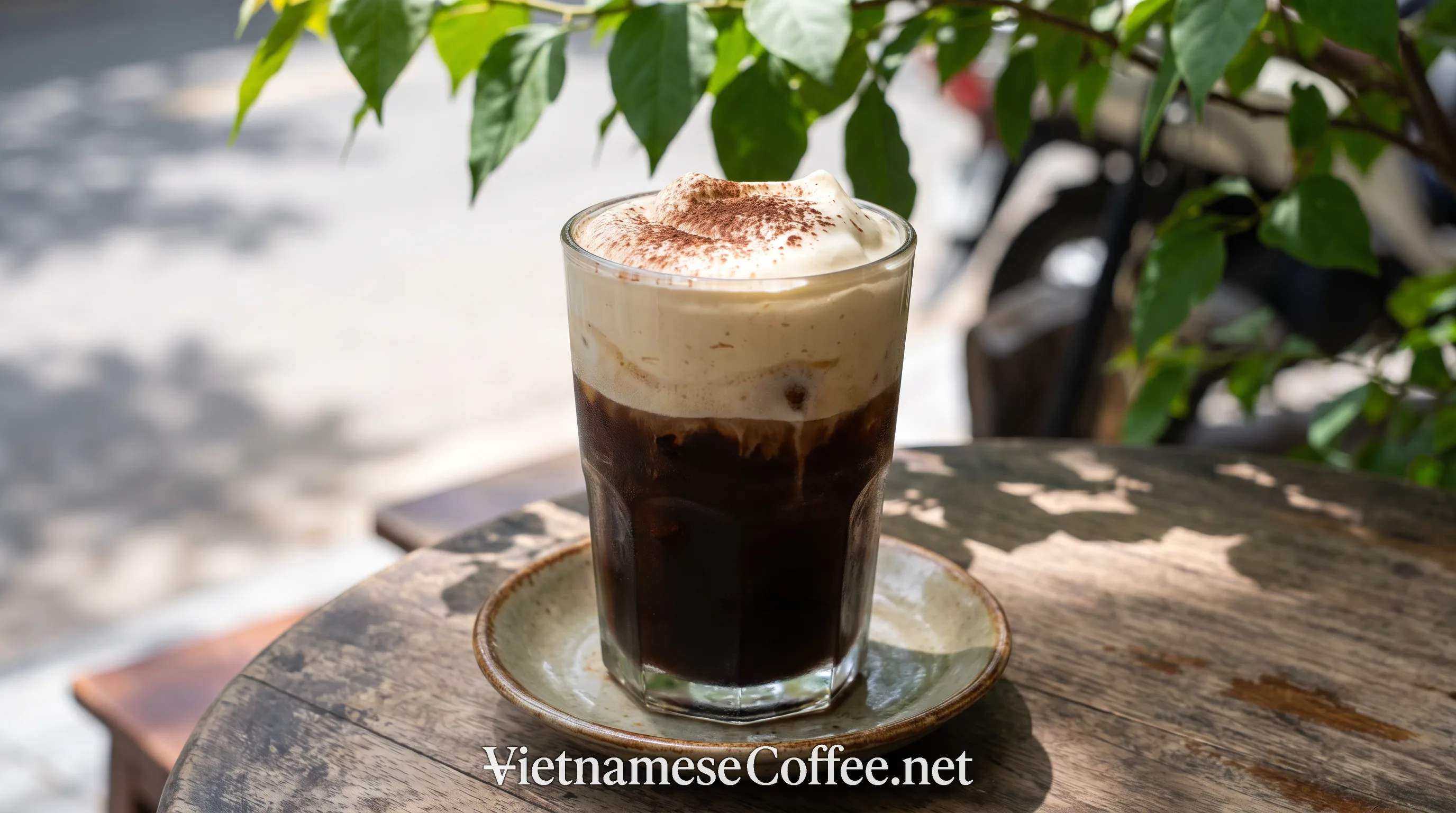
The drink's signature element is its salted cream topping, prepared separately from the coffee itself. According to Nom's by Nancy, this topping combines cold heavy cream, condensed milk, and a precisely measured pinch of sea salt, whipped together until thick.
It is typically whipped with an electric mixer or handheld frother until it thickens into soft, pourable peaks, distinctly thicker than milk but not as stiff as traditional whipped cream. Once the coffee and condensed milk base is brewed and stirred, the finished drink is typically poured over ice.
The whipped salted cream is then spooned or poured gently on top, where it floats rather than fully mixing into the coffee below. According to Online Coffee Guide, the intended drinking method involves sipping the cold coffee directly through the salted cream layer without stirring.
Flavor profile and tasting experience
According to UFO Coffee's detailed tasting description, cà phê muối delivers its flavors in a distinct, layered sequence. It is not a single blended taste. A gentle saltiness registers first on the tongue, followed by creamy sweetness from the condensed milk and whipped cream.
The drink then finishes with the lingering, familiar bitterness of the underlying robusta coffee. International visitors quoted in UFO Coffee's coverage frequently compare the drink to salted caramel beverages already familiar in Western cafes.
CNN Travel similarly reports that many first-time tourists find the concept of salt in coffee initially strange, but are quickly won over once they taste the finished, carefully balanced result.
The drink's growing global recognition accelerated sharply through social media exposure. According to UFO Coffee, videos demonstrating the drink's preparation and taste went viral on platforms including TikTok and Instagram beginning in 2024.
Cultural status and modern popularity
What began as a single cafe's customer-attraction strategy in Huế has since grown into a broader symbol of culinary creativity within Vietnam's coffee culture. According to UFO Coffee, cà phê muối is now regarded as a specialty distinctly associated with Huế itself.
Pricing data compiled by UFO Coffee places a typical cup of authentic salt coffee in Huế at roughly 15,000 to 30,000 Vietnamese dong. This makes it an accessible, everyday specialty rather than an expensive tourist novelty.
This affordability has helped the drink spread rapidly beyond Huế to cafes across the rest of Vietnam, and increasingly, to Vietnamese coffee shops operating internationally. According to UFO Coffee, brands including Elys Coffee have begun exporting salt coffee products to markets across Asia and Europe.
What started as a workaround for harsh, low-grade robusta beans in one small Huế cafe has become much larger. Within roughly a decade, it grew into one of the most widely recognized modern additions to Vietnam's coffee culture.