
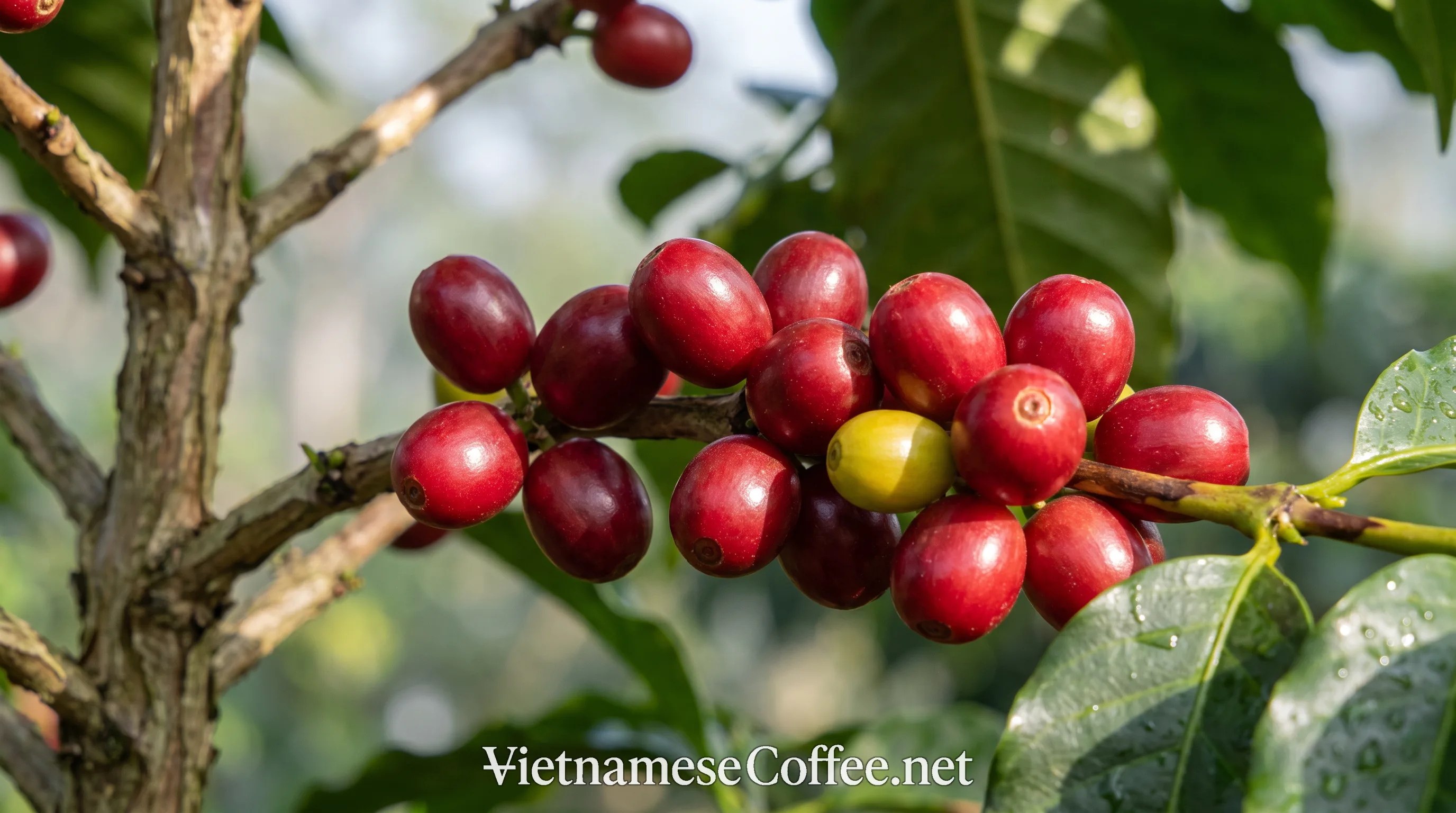
Arabica at a glance
| Scientific name | Coffea arabica |
|---|---|
| Historical origin | Highlands of Ethiopia |
| Year introduced to Vietnam | 1857, per VICOFA |
| Typical altitude | 1,000 to 1,700 meters in Vietnam |
| Caffeine content | 1.2 to 1.5 percent by dry weight |
| Sugar content | 6 to 9 percent sucrose |
| Primary Vietnamese variety | Catimor |
| Tasting notes | High sweetness, bright acidity, floral and fruit notes |
History and introduction to Vietnam
Coffea arabica is the oldest and most globally consumed commercial coffee species. Its botanical origin is usually traced to the highlands of Ethiopia, while early commercial cultivation spread through Yemen and later through colonial trade routes.
Arabica was also the beginning of Vietnam's modern coffee history. The Vietnam Coffee - Cocoa Association says French Catholic missionaries introduced coffee to Vietnam in 1857. Early trials focused on northern and central provinces, including Ninh Binh, Thanh Hoa, Nghe An, and Ha Tinh.
Those early plantings struggled. Arabica is sensitive to heat, pests, and leaf rust, and the lowland coastal climate was not a natural fit. French colonial agriculture eventually shifted coffee toward cooler highland zones and later introduced robusta in 1908.
Robusta went on to dominate Vietnam's national coffee output, but arabica remained important in cooler mountain areas. Today, the species is most closely associated with Da Lat, Son La, Dien Bien, and several smaller highland micro-regions.
Agronomic requirements and growing regions
Arabica is more demanding to grow than robusta. It prefers cool, stable temperatures and high elevations. In Vietnam, suitable arabica zones are therefore limited to elevated provinces where heat and humidity are moderated by altitude.
Helena Coffee identifies Lam Dong province, especially Cau Dat in Da Lat, as Vietnam's leading arabica hub. Cau Dat sits around 1,500 to 1,650 meters above sea level, which gives arabica the cooler conditions it needs for slower cherry development.
Northern provinces also matter. Son La and Dien Bien produce arabica in cooler mountainous areas, often around 1,000 to 1,200 meters. These regions support Catimor and other arabica plantings that fit Vietnam's rugged upland terrain.
A smaller arabica zone also exists around Khe Sanh in Quang Tri. The geography is different from Da Lat, but the region remains part of Vietnam's specialized arabica map. For regional context, see Da Lat and Son La.
Chemical composition and flavor profile
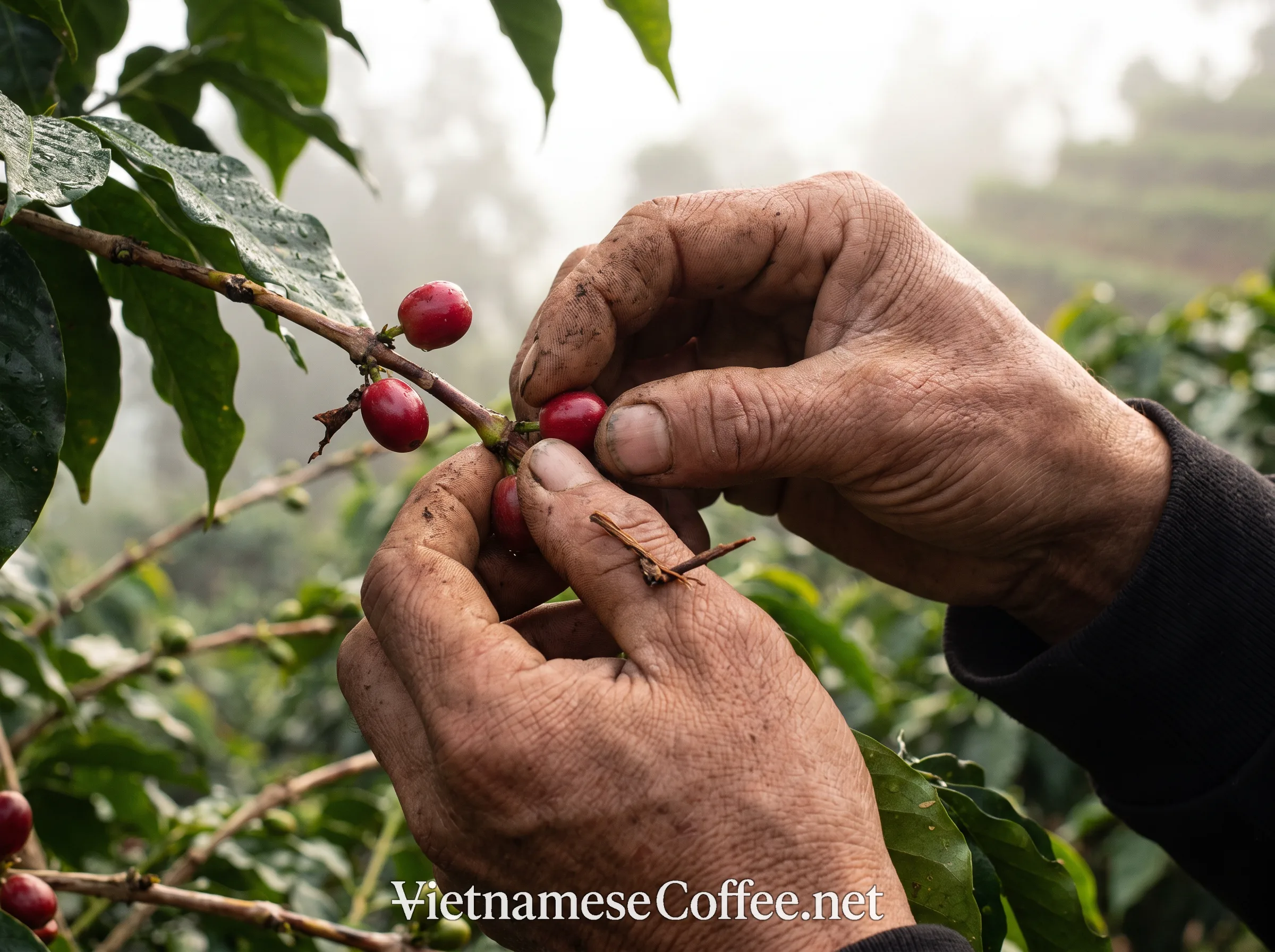
Arabica tastes different from robusta because its chemistry is different. CoffeeBot reports that arabica contains about 6 to 9 percent sucrose, compared with about 3 to 7 percent in robusta. More sugar gives arabica greater potential sweetness after roasting.
Arabica also contains more lipids. CoffeeBot gives a range of 15 to 17 percent lipids for arabica, compared with about 10 to 11.5 percent for robusta. Those oils help carry aromatic compounds that create floral, fruit, and citrus-like impressions in the cup.
The caffeine difference is just as important. Art de Vivre Coffee lists arabica at about 1.2 to 1.5 percent caffeine by dry weight, while robusta is much higher. Less caffeine usually means less bitterness and a smoother sensory profile.
These traits make arabica central to specialty coffee. When grown at high altitude and processed carefully, Vietnamese arabica can show bright acidity, sweetness, floral aromas, and fruit-like notes that contrast strongly with traditional dark robusta.
Primary varieties cultivated in Vietnam
Vietnam's arabica sector is dominated by Catimor. Helena Coffee traces Catimor to Portugal in 1959, where it was created by crossing Caturra with the Timor Hybrid. Because the Timor Hybrid carries robusta genetics, Catimor has stronger leaf-rust resistance than many older arabica varieties.
Catimor fits Vietnam because it can deliver higher yields and better resilience in difficult growing environments. Its cup quality is often considered less delicate than older pure arabica lines, but careful farming and processing can improve its clarity and sweetness.
Typica is also present in Vietnam, especially as a heritage variety in parts of Cau Dat. Saigon Ritual notes that Typica has low yield and high disease susceptibility, which limits its commercial footprint despite its historical value.
Bourbon and SL28 appear in smaller or experimental plantings. These varieties are associated with specialty coffee quality but remain tiny compared with Catimor and the country's much larger robusta economy.
Role in Vietnam's coffee economy
Arabica is a minority crop in Vietnam. Daytrips Vietnam reports that robusta accounts for roughly 96 percent of national output, leaving arabica at about four percent. That makes arabica small by volume but important for specialty positioning.
The crop gives Vietnam access to buyers who want higher-acidity, high-altitude coffees rather than the country's usual robusta profile. Lam Dong producers, especially around Cau Dat, Da Lat, and Nam Ban, are increasingly associated with washed, honey, natural, and anaerobic processing.
Arabica has also given Vietnam more visibility in global specialty coffee. Starbucks released Starbucks Reserve Vietnam Da Lat in 2015, describing it as the company's first single-origin coffee from Vietnam. That release helped show international buyers a different side of the country's coffee sector.
Climate pressure on traditional arabica origins may make Vietnam's carefully managed highland zones more important over time. The challenge is land: arabica needs suitable elevation, and Vietnam has far less of that terrain than robusta-friendly plateau land.