
| Area | Sơn La province, Vietnam's northwest |
|---|---|
| Registered GI altitude | 600 to 800 meters; broader cultivation cited at 900 to 1,200 meters |
| Latitude | 20 degrees 39 minutes to 22 degrees 02 minutes North |
| Primary variety | Arabica; Vietnam's leading arabica-growing province |
| Coffee area, 2017 | 12,696 hectares |
| Coffee area, 2025 | 24,300 hectares, provincial portal baseline |
| Coffee area, 2026 | More than 33,600 hectares across 48 communes |
| Output, 2025 | About 37,724 tonnes |
| Geographical indication status | Sơn La GI, Certificate No. 00056, July 5, 2017 |
| Origin era | 1945 official GI narrative; separate reports cite French-era planting |
Geography and terrain
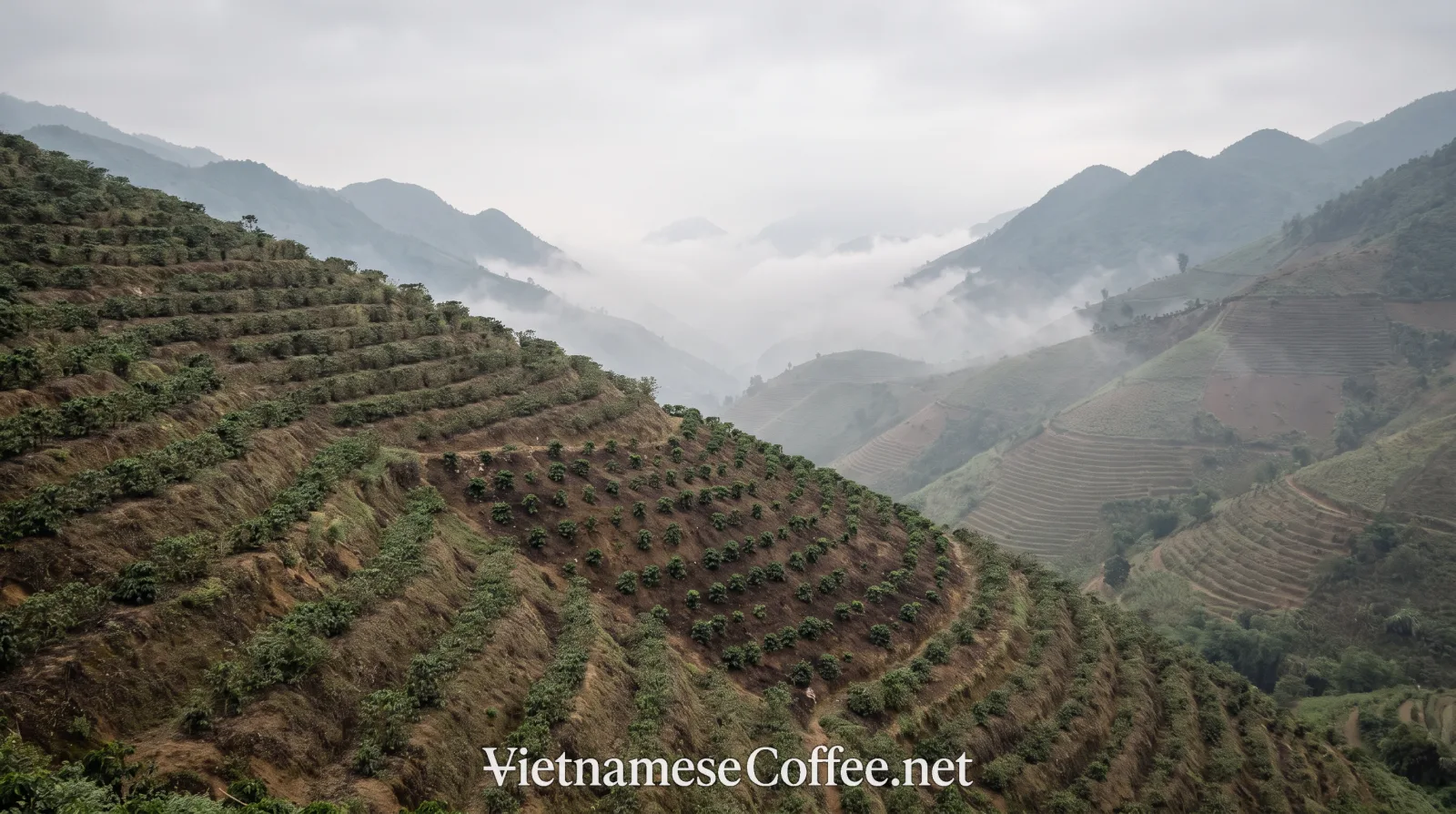
Sơn La is a mountainous province in Vietnam's northwest, well outside the Central Highlands where robusta provinces like Đắk Lắk are concentrated. It is profiled on the Vietnam's Coffee Growing Regions hub.
The National Office of Intellectual Property describes the registered Sơn La coffee area as a high mountainous zone with steep slopes. Its altitude is 600 to 800 meters.
The official GI record notes this altitude is not ideal for arabica by typical standards. It credits Sơn La's high latitude, from 20 degrees 39 minutes to 22 degrees 02 minutes North, as a compensating factor.
Separate Vietnam Agriculture News reporting describes a broader cultivation range of 900 to 1,200 meters. That wider range describes provincial cultivation, not the legal GI zone alone.
The GI record also describes ferralitic soil, including brown-red soil on magma rock and limestone, plus a rainy summer and drier winter.
History and origins
Two origin stories appear in the reviewed sources. The official GI record traces Sơn La coffee to 1945, when a local resident began growing coffee trees in his home garden.
From that point, the GI record says, cultivation gradually expanded and moved from home gardens onto hillsides. This is the province's official smallholder origin narrative.
Separately, a VietnamPlus report describes French colonialists beginning coffee planting in Sơn La and other northern provinces in the late 19th and early 20th centuries.
These accounts need not conflict. The earlier French-era planting may describe separate colonial estates, while the 1945 narrative centers a documented local origin story.
A major expansion began in 1995, when the provincial committee approved a project to plant 3,000 hectares of coffee trees.
Scale, growth, and export value
Sơn La's coffee area has grown substantially since the 12,696 hectares reported for September 2017. Vietnam Agriculture News cited about 18,000 hectares by 2021.
A 2025 Sơn La provincial portal report gives a larger recent figure: more than 24,300 hectares under coffee, with estimated output of 37,724 tonnes.
That report states this area represents about 50 percent of Vietnam's total arabica-growing area and 43.5 percent of national arabica output.
A later VietnamPlus report gives an even larger current figure: more than 33,600 hectares across 48 communes, up from 278 hectares in the 1980s.
In the first half of 2025, the provincial portal reported about 17,800 tonnes of coffee exports, generating roughly 70 million US dollars.
The Sơn La geographical indication
Sơn La coffee is protected by its own geographical indication, separate from Đà Lạt's Lâm Đồng GI and Đắk Lắk's Buôn Ma Thuột GI.
Vietnam's Ministry of Science and Technology identifies Certificate No. 00056, dated July 5, 2017, for the public announcement of the GI.
The GI record describes the registered growing area as concentrated in Sơn La City and Mai Son, Thuan Chau, and Sop Cop districts.
It also sets quality specifications for registered coffee. Green beans must exceed 4.75 millimeters, with documented caffeine, protein, and sugar ranges.
The Ministry report frames coffee as Sơn La's third geographical indication, after Moc Chau Shan Tuyet tea and Yen Chau round mango.
Certification and specialty-coffee push
Sơn La's provincial government has pushed certification alongside raw area and output growth. Its portal states that more than 23,000 hectares now carry standards including Rainforest Alliance, 4C, VietGAP, or organic farming.
VietnamPlus reports similar efforts and cites Rainforest Alliance, UTZ, and 4C standards. These certifications apply to specific farms, products, or supply chains, not every lot from the province.
The province is also expanding a specialty-coffee segment. The provincial portal states Sơn La currently has about 1,120 hectares of specialty coffee, with a 5,950-hectare target by 2030.
The same report sets a 9,800-hectare replanting target by 2030, aimed at renewing aging coffee trees rather than only expanding new area.
VietnamPlus adds that five Sơn La coffee products hold OCOP certification, including one rated five stars.
Flavor, chemistry, and harvest practice
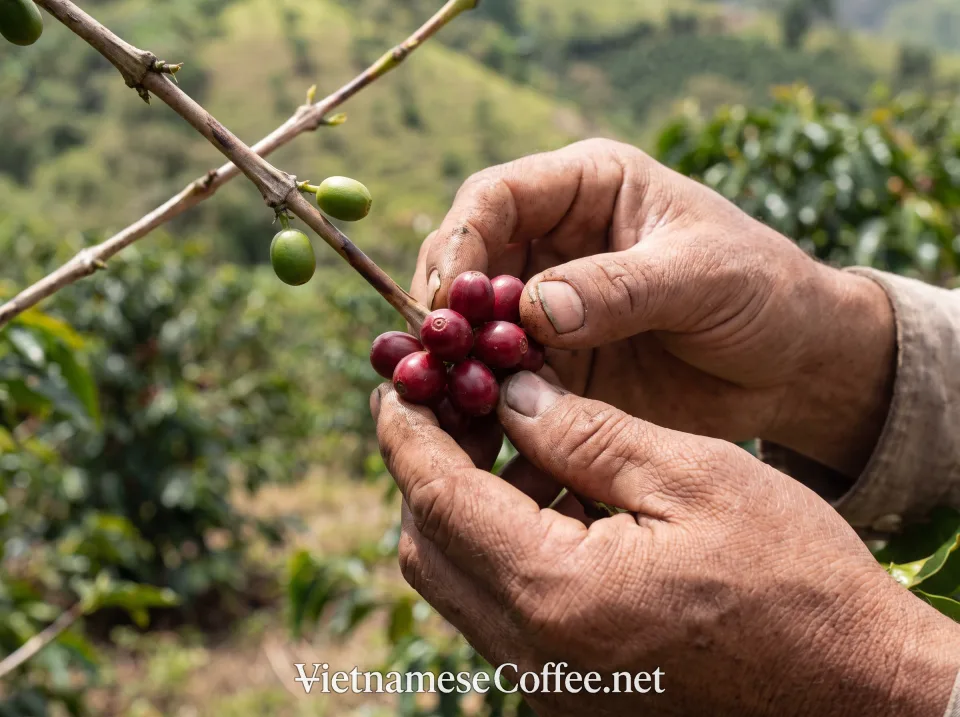
The GI record documents harvest practices tied specifically to Sơn La registered coffee. It describes hand-picking as standard, with only ripe fruit selected at harvest.
After picking, the record describes natural sun-drying as the traditional processing method used in the region, rather than industrial mechanical drying.
The record gives measurable green- and roasted-bean characteristics instead of a separate tasting-note list. Green beans show caffeine of 0.8 to 1.28 percent.
Roasted beans show caffeine of 1.0 to 1.6 percent and protein of 11.6 to 13.2 percent. This profile reports those documented values rather than inventing flavor language.
For species context, see Robusta vs Arabica: Why Vietnam Grows Robusta.