
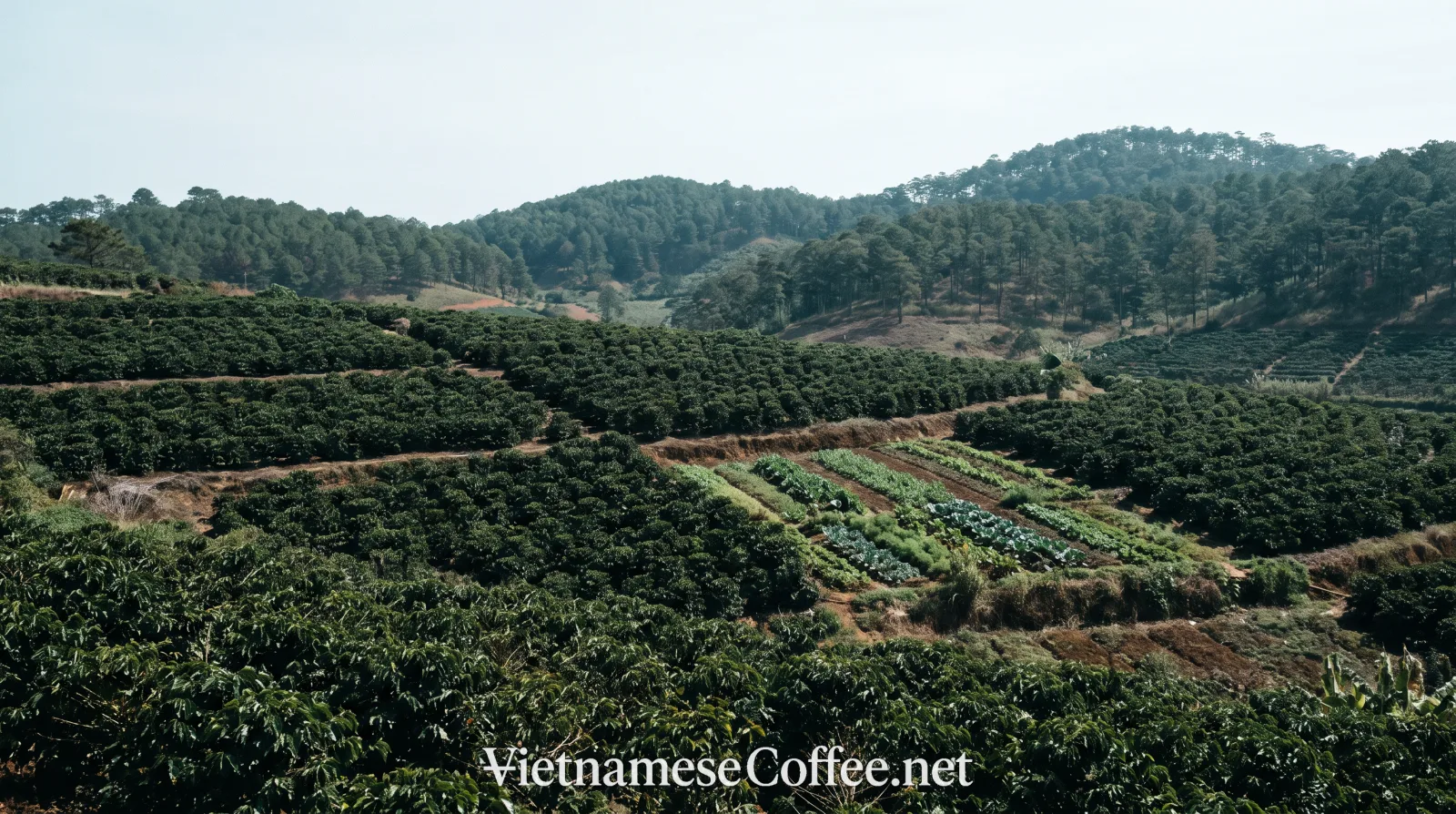
| Area | Đà Lạt City, Lâm Đồng province, Central Highlands |
|---|---|
| Key arabica zone | Cầu Đất plateau, approx. 1,500 meters |
| Coffee growing altitude | Arabica 1,200 to over 2,200 meters; robusta 700 to 850 meters |
| Primary variety | Arabica specialty; small registered robusta zone also exists |
| Historic Cầu Đất arabica core area | 3,000+ hectares, 2017 VNA figure |
| Lâm Đồng coffee area, 2022 | About 175,916 hectares total; about 16,972 hectares arabica |
| Lâm Đồng output, 2022 | About 532,374 tonnes |
| Geographical indication status | Lâm Đồng GI, Certificate No. 00147, issued October 10, 2025 |
| Global recognition | Starbucks Reserve Vietnam Đà Lạt, first sold January 2016 |
Geography and terrain
Đà Lạt is a city in Lâm Đồng province, in Vietnam's Central Highlands, and it is the country's best-known specialty arabica area. It sits within the broader Vietnam's Coffee Growing Regions map.
The city's most cited arabica zone is the Cầu Đất plateau. A 2017 Vietnam News Agency report describes Cầu Đất as sitting at an altitude of about 1,500 meters.
That report describes Cầu Đất's coffee area as covering more than 3,000 hectares. It spans Xuan Truong and Tram Hanh communes, plus part of Xuân Thọ commune, all within Đà Lạt City.
A more recent province-wide altitude range comes from Vietnam's National Office of Intellectual Property. It states that Lam Dong's arabica grows from 1,200 meters to over 2,200 meters.
Robusta in Lâm Đồng is registered lower, at 700 to 850 meters. That altitude split explains why Đà Lạt and Cầu Đất are associated with arabica rather than robusta.
Scale, and a shrinking specialty zone
Precise current hectare and output figures for Đà Lạt City or Cau Dat alone were not found in the sources reviewed. The most detailed recent figures come from Lâm Đồng province as a whole.
The 2025 geographical indication filing states that in 2022 Lam Dong had about 175,916 hectares of coffee. Arabica accounted for about 16,972 hectares, or 10.2 percent of total coffee land.
Historical VNA reporting described a provincial plan to expand arabica cultivation to 30,000 hectares by 2020. The sources reviewed here do not confirm whether that target was reached.
The 2022 figure of roughly 16,972 arabica hectares suggests the target was not met at province level by that year. Arabica remains concentrated around Đà Lạt and Cầu Đất.
In November 2025, former Lâm Đồng Vice Chairman Phạm S described the specialty arabica area, especially around Cầu Đất, as not developing proportionally and in some places shrinking.
The Lâm Đồng geographical indication
Coffee grown in and around Đà Lạt is now covered by a formal geographical indication. Vietnam's National Office of Intellectual Property issued Decision No. 636/QD-SHTT on October 10, 2025.
That decision granted Geographical Indication Registration Certificate No. 00147 for Lâm Đồng coffee products. It is a province-wide GI, distinct from the Buôn Ma Thuột GI that covers Đắk Lắk.
The registered arabica zone includes six wards of Đà Lạt City: Wards 3, 4, 5, 7, 10, and 11. It also covers Xuân Thọ, Ta Nung, Tram Hanh, and Xuan Truong communes.
The GI also includes parts of Lạc Dương, Đơn Dương, Lâm Hà, and Dam Rong districts. A separate, smaller registered robusta zone covers Ward 5 and Ta Nung commune.
This GI was only granted in October 2025, after much of the earlier reporting on Đà Lạt and Cầu Đất coffee. Its long-term effect on farming and marketing is not yet clear.
Flavor and international recognition
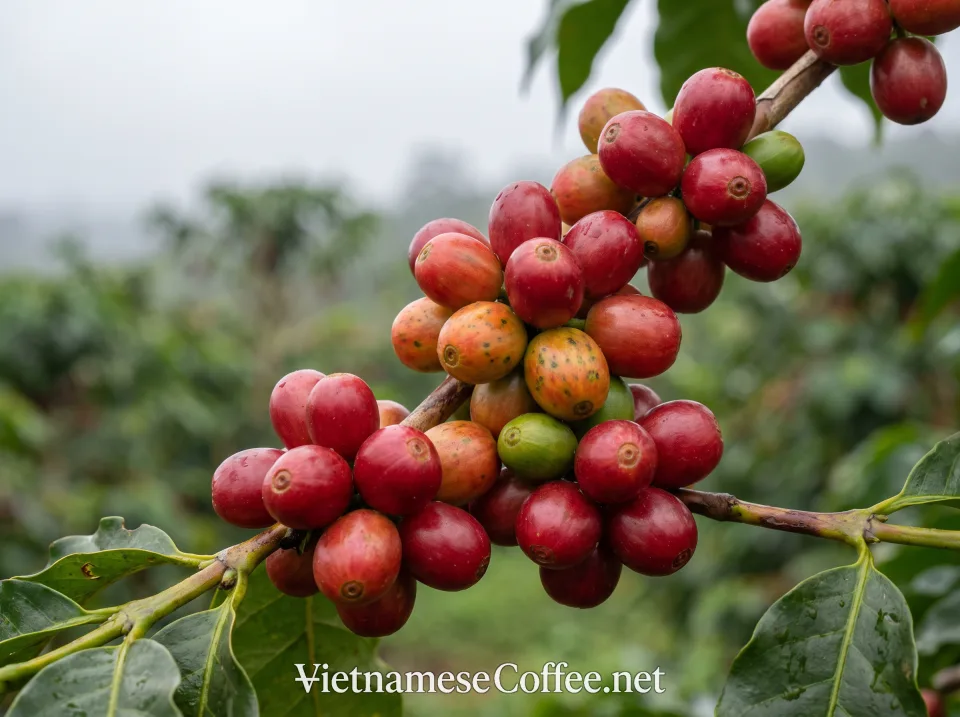
Đà Lạt arabica has a sensory profile tied directly to the new Lam Dong geographical indication. The GI record lists notes including apricot, lemon, peach, orange, lime, green apple, almond, brown sugar, chocolate, rose tea, and honey.
That level of named flavor description is unusual among Vietnamese coffee GIs. It reflects arabica's generally more complex acidity and aromatics compared with robusta.
For general species context, see Robusta vs Arabica: Why Vietnam Grows Robusta. For caffeine specifics, see Caffeine Content in Vietnamese Coffee Explained.
Đà Lạt coffee's international reputation has also been built through retail partnerships. Starbucks first introduced coffee grown in Cầu Đất, Đà Lạt, as a Starbucks Reserve offering in Vietnam in January 2016.
Vietnam News reported the coffee's return to Vietnamese Starbucks stores in January 2019, describing it as available for a third consecutive year at that point.
Quality benchmarks and cooperatives
The Lâm Đồng GI record sets quantitative quality benchmarks. For roasted arabica, it specifies caffeine content of at least 1.77 percent and crude protein content between 15.44 and 15.64 percent.
The same record attributes the region's caffeine and protein levels partly to soil chemistry. It describes Lâm Đồng's coffee-growing soil as rich in available potassium and nitrogen.
Quality recognition also appears in competition results cited by the GI record. In 2022, Lâm Đồng had three robusta and five arabica samples win specialty coffee awards.
At farm level, Cầu Đất Coffee Cooperative joined the World Fairtrade coffee network in 2015 with 30 members, according to 2017 VNA reporting.
That same report quotes the cooperative's director describing arabica cultivation as requiring heavy investment, because trees are vulnerable to disease and cold weather.