
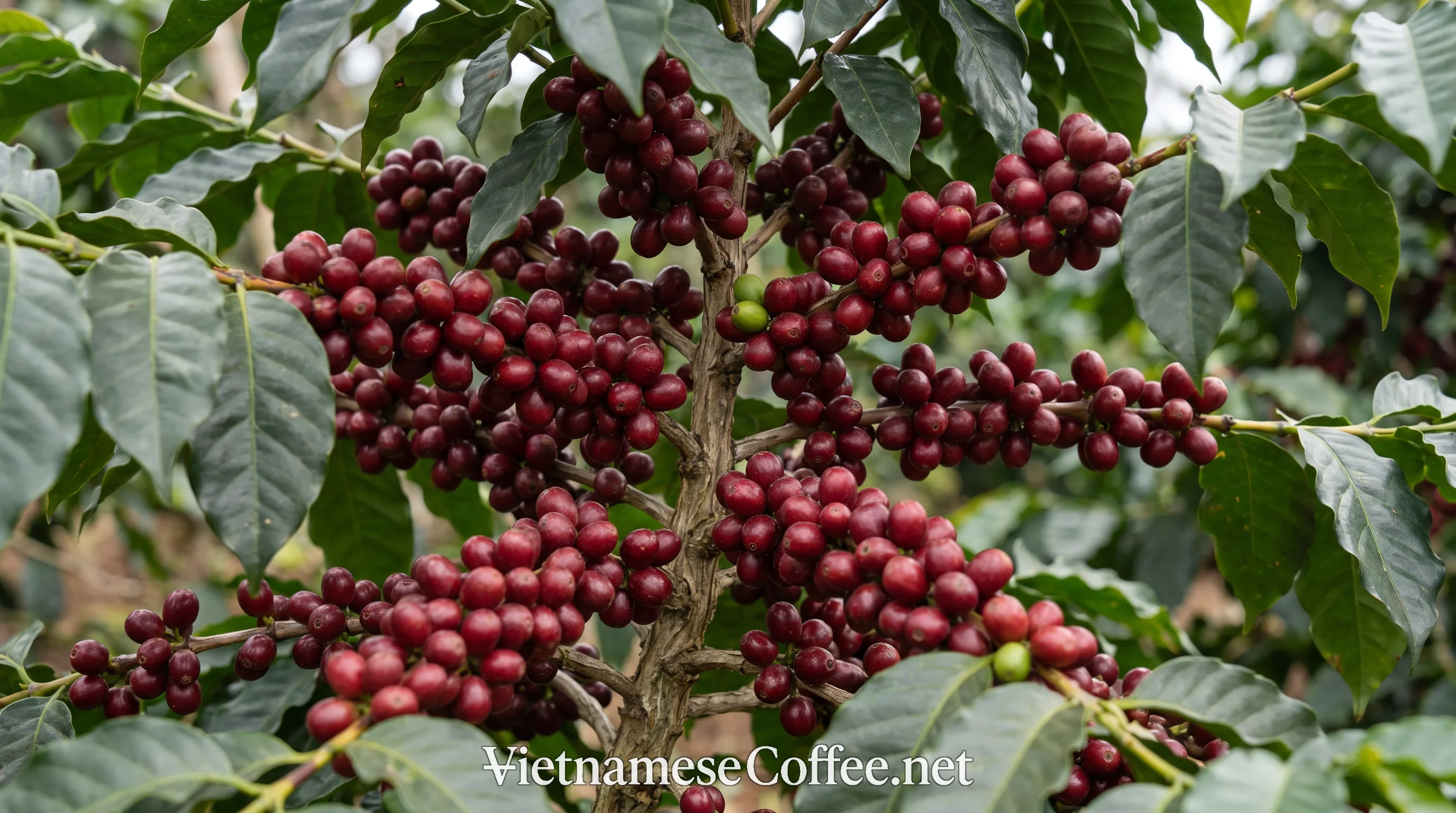
Arabica Catimor at a glance
| Type | Introgressed Arabica cultivar group |
|---|---|
| Parent lines | Caturra and Timor Hybrid |
| Development timeline | Timor Hybrid seed arrived circa 1958-1959; original crosses made in 1967 |
| Where developed | CIFC, Oeiras, Portugal |
| Disease resistance | Strong leaf rust resistance; variable coffee berry disease resistance |
| Cup-quality trend | Often improves at higher elevation; reported examples above roughly 1,100-1,200 meters |
| Vietnam status | Most widely planted Arabica cultivar group |
| Key Vietnamese regions | Cầu Đất, Đà Lạt, Lâm Đồng, Sơn La, Điện Biên |
Origin: a rust-resistance breeding project
Catimor was not a single naturally occurring coffee variety. It is a family of related Arabica cultivars, deliberately bred to solve a specific agricultural crisis. According to World Coffee Research's variety catalog, the Coffee Rust Research Center in Oeiras, Portugal, received a batch of Timor Hybrid seed from the island of Timor. This arrived around 1958 to 1959. The Timor Hybrid is a naturally occurring cross between Coffea arabica and Coffea canephora, or robusta, that had developed on Timor decades earlier.
Receiving the Timor Hybrid seed was only the first step. According to both World Coffee Research and Ozone Coffee's variety profile, CIFC breeders did not make the actual crosses right away. The Caturra x Timor Hybrid crosses that produced the original Catimor lines were made only in 1967. Specific parent selections, including CIFC accessions 832/1 and 832/2 of Timor Hybrid, were crossed with Red Caturra, a compact, high-yielding natural mutation of Bourbon arabica discovered in Brazil.
The genetic logic behind the cross was straightforward. Timor Hybrid contributed disease resistance inherited from its partial robusta ancestry. Caturra contributed a short, compact plant structure and high productivity. Acquired Coffee's variety overview describes the goal explicitly: combining Timor's resilience with Caturra's dwarf stature and yield potential. Breeders repeated similar crosses using different Timor Hybrid and Caturra parent lines over subsequent decades.
Disease resistance and agronomic trade-offs
Catimor's defining agricultural trait, across the group, is resistance to coffee leaf rust, inherited through its partial robusta lineage. According to Coffee Tower's varietal comparison, this resistance stems directly from functional resistance genes carried over from the Timor Hybrid parent. This made early Catimor lines highly resistant to the races of leaf rust known at the time of their development.
Beyond rust resistance, Catimor cultivars offer practical advantages that made them attractive to smallholder farmers. Their compact, dwarf growth habit, inherited from Caturra, allows denser planting per hectare, and Catimor types generally reach productive maturity faster than many traditional arabica cultivars. However, Coffee About's variety guide notes an important limitation: Catimor trees typically show declining yields after roughly ten years, a shorter productive lifespan than some older arabica varieties.
Disease resistance is not absolute or uniform across the whole Catimor group. Green Coffee Collective's variety glossary notes that some Catimor populations show variable resistance to coffee berry disease, a separate fungal threat. A working paper hosted by the UK government's international development research archive documents a directly relevant field trial in Malawi. It found that tested Catimor populations resisted local coffee leaf rust races, but were generally susceptible to coffee berry disease.
Cup quality: variable, and shaped by altitude and processing

Catimor's relationship with cup quality is genuinely contested within the coffee industry. The honest answer depends heavily on which line, region, and growing conditions are being discussed. Green Coffee Collective describes Catimor as a broad family of cultivars that are tough and productive. However, they carry robusta genetics capable of producing flatness, woodiness, or astringency under poorer or lower-altitude growing conditions.
Higher elevation and careful processing can shift this picture substantially, according to several sources covering specific lots. Volcana Coffee's variety profile reports that some Catimor lots grown above roughly 1,100 meters show markedly improved cups. Megawatt Coffee's overview describes a similar pattern for lots grown above approximately 1,200 meters and carefully processed. These lots can show a bright, clean cup with chocolate, nut, and soft fruit notes.
These altitude thresholds should be read as examples reported for specific lots and regions, not as a single universal cutoff for the entire Catimor group. World Coffee Research's authoritative variety catalog treats optimal growing altitude as dependent on latitude and local climate rather than fixed at one elevation worldwide. In practice, a high-altitude, carefully processed Catimor lot and a low-altitude, poorly processed one can taste dramatically different.
Catimor in Vietnam
Catimor is, by a wide margin, Vietnam's most widely planted Arabica cultivar group. According to Tam Trinh Coffee's overview of Vietnamese arabica varieties, Catimor is currently the most popular Arabica type in the country. It is favored for its adaptability to local climate conditions and its stronger resistance to pests and diseases compared with older, more delicate arabica varieties like Typica and Bourbon.
Tam Trinh Coffee's variety comparison table describes Vietnamese Catimor as having high productivity, high disease resistance, and an easy cultivation profile. Its beans are medium-sized and relatively uniform, commonly grading to Screen 16-18 with a low defect rate. The same source reports that commercial Catimor lots typically achieve cupping scores of roughly 80 to 83 points on the SCA scale. Lots from Cầu Đất or elevations above 1,500 meters, selectively harvested at full ripeness, can reach 84 to 86 points.
Vietnamese Catimor's flavor and elevation profile also varies meaningfully by region. GreenTech Export's specialty sourcing guide places Catimor, alongside Bourbon and Typica, in the Đà Lạt highlands around Cầu Đất. This area sits at elevations of roughly 1,450 to 1,650 meters, with a cupping profile of citrus acidity, jasmine floral notes, a dark chocolate body, and a caramel finish. The same guide separately places Catimor in the Sơn La and Điện Biên highlands of northern Vietnam, at lower elevations of roughly 1,000 to 1,200 meters.
For the broader context of arabica's introduction to Vietnam and its position relative to robusta, see What Is Arabica?. This page instead focuses specifically on Catimor's genetics, agronomy, and role as Vietnam's dominant Arabica cultivar group.