

Quick comparison
| Feature | Vietnamese coffee | Turkish coffee |
|---|---|---|
| Grind size | Varies by recipe and filter; published guidance ranges from fine to medium-coarse | Powder-fine, finer than espresso |
| Filtration | Metal mesh filter (phin) | None; grounds settle in the cup |
| Water | Hot (90-96 degrees C), poured over grounds | Cold, combined with grounds from the start |
| Heat source | None applied after pouring; gravity does the extraction | Direct stovetop heat, low or medium depending on source |
| Sweetening | Condensed milk, added after brewing | Sugar, added into the pot before brewing |
| Pour/pour count | Can be a single pour or involve a bloom plus a second pour, depending on recipe | Coffee, water, and sugar combined once at the start |
| Cultural extra | None specific to the brew itself | Fortune-telling from the settled grounds (tasseography) |
Grind, water, and mechanism
The two methods approach grind very differently, though Vietnamese phin grind size specifically isn't as settled as it might seem. Nguyen Coffee Supply, a Vietnamese-coffee specialist source, recommends a fine, "like sand" grind in its primary guides, while other sources describe medium-coarse or medium-fine instead; published phin grind recommendations genuinely vary depending on the specific recipe, filter design, and brewer, rather than converging on one standard. Turkish coffee, by contrast, is unambiguous on this point: UNESCO's own description states beans are ground to a fine powder, and Wikipedia specifies at least 7 grams of powder-fine grounds per cup, a texture several sources describe as finer than espresso, since the grounds are never filtered out at all and instead settle to the bottom of the finished cup.
Water temperature at the start of brewing also differs completely. The phin uses hot water (90-96 degrees C) poured over the grounds. Turkish coffee, by contrast, starts with cold water: UNESCO, Wikipedia, Story of Coffee, and CoffeeWiki all describe grounds, sugar, and cold water combined together in the cezve before any heat is applied at all, then brought slowly to a near-boil on the stove.
How each is brewed
Vietnamese phin coffee relies entirely on gravity, with no applied mechanical pressure and no continued heat source once water is poured, but that doesn't mean every phin recipe is a single, fully passive pour. Nguyen Coffee Supply's current brewing guide, for example, describes an initial small bloom pour, a brief wait, then filling the chamber with the remaining water, and explicitly allows for a second pour if the first finishes dripping before enough coffee has extracted, meaning some phin methods involve active attention and more than one pour rather than "pour once and walk away."
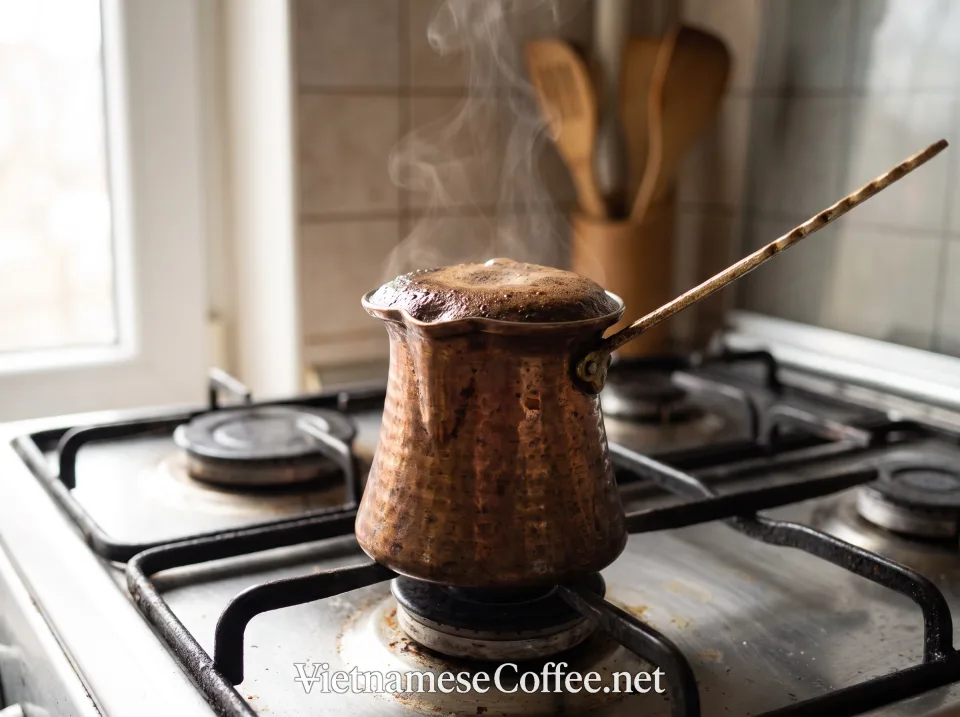
Turkish coffee's process is actively watched and heated on the stove throughout. Sources broadly agree on the sequence: dissolve sugar and grounds into the cold water, heat gently, watch for a foam called kaimaki forming as the mixture approaches boiling, remove the pot from heat just before it boils over, sometimes spoon a little foam into each cup, and often return the pot briefly for a second heating pass to build more foam before the final pour. Exactly how much heat to use is one point where sources genuinely disagree: Story of Coffee, CoffeeWiki, and Online Coffee Guide all specifically recommend low, slow heat, with CoffeeWiki explicitly warning that a full rolling boil kills the foam and turns the coffee bitter, while Foolproof Living and The Fabled Alchemist both describe medium heat over a similar 3-to-4-minute window. This page treats both as valid documented approaches rather than picking one as definitively correct. Whichever heat level is used, the finished coffee is poured slowly, foam first, and left to sit for a minute or two so the grounds settle; the thick sediment at the bottom is deliberately left undrunk.
Ritual and culture
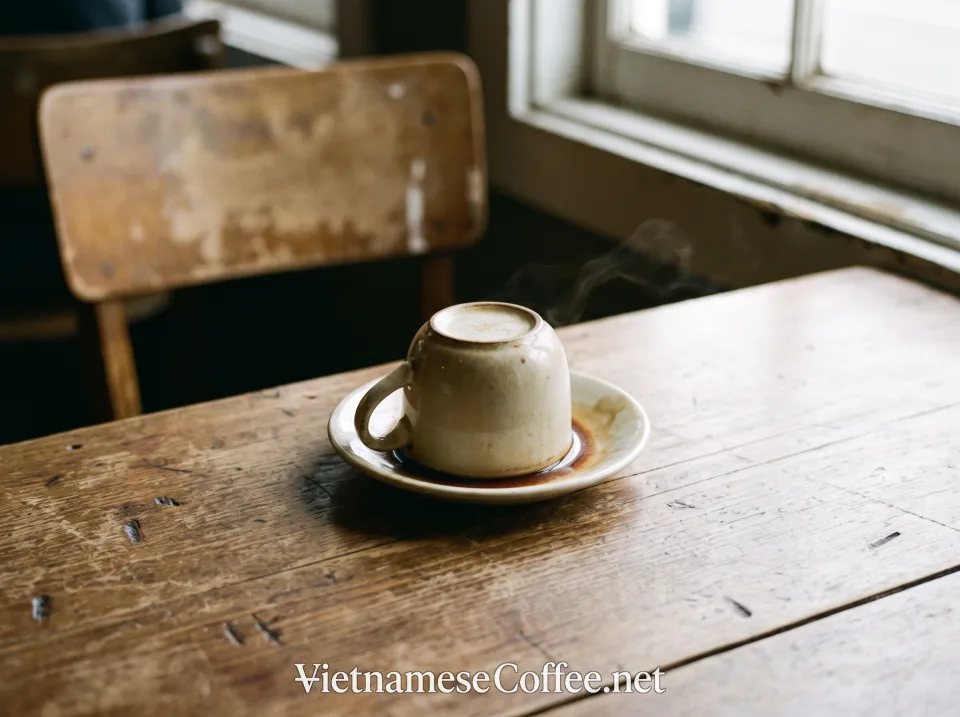
Both coffees carry cultural weight, but in different forms. Vietnamese coffee's ritual centers on the drink itself and its pairing with condensed milk, an everyday pleasure rather than a formal ceremony. Turkish coffee carries an additional, distinct cultural practice built around what's left behind after drinking: UNESCO notes the grounds left in an empty cup are often used to tell a person's fortune, a practice UNESCO recognized as part of Turkish coffee culture and tradition when it inscribed the tradition on its Representative List of the Intangible Cultural Heritage of Humanity in 2013. How far back this specific fortune-telling custom dates is less officially settled than the brewing tradition itself; the BBC's own reporting places it at least 500 years back, reportedly introduced to the Ottoman court by a 16th-century governor, though this specific chronology comes from that outlet's historical account rather than UNESCO's own documentation.
The shared core of the fortune-telling ritual is consistent across sources: finish the coffee slowly, leave the sediment behind, place the saucer over the cup, make a wish, invert the cup so the grounds settle inside, and wait for it to cool before a reader interprets the resulting patterns. Specific procedural details vary somewhat by source, though, such as how many times and in which direction the cup might be turned before inverting it, which likely reflects genuine regional or family variation rather than one single fixed nationwide procedure.