

Quick comparison
| Feature | Vietnamese coffee | Laotian coffee |
|---|---|---|
| Dominant species | Predominantly robusta | Majority robusta, with a meaningful and growing arabica minority |
| Growing region | Nationwide, especially the Central Highlands | Large majority on or around the Bolaven Plateau; expanding into northern provinces |
| Colonial history | French introduced coffee cultivation in the 1850s-1880s | French introduced coffee in the 1910s-1920s, initially all arabica |
| Species shift | Robusta became dominant over time | Gradual post-1950 shift after conflict disruption, frost, and leaf rust pressure |
| Traditional filter | Phin, a metal gravity filter | Cloth sock filter |
| Typical serving | Hot or iced, with condensed milk | Iced or hot, typically with condensed and/or evaporated milk |
| Similarity noted by sources | Reference point for phin-brewed condensed-milk coffee | Multiple sources describe Lao iced coffee preparation as similar to Vietnamese coffee |
Species and history
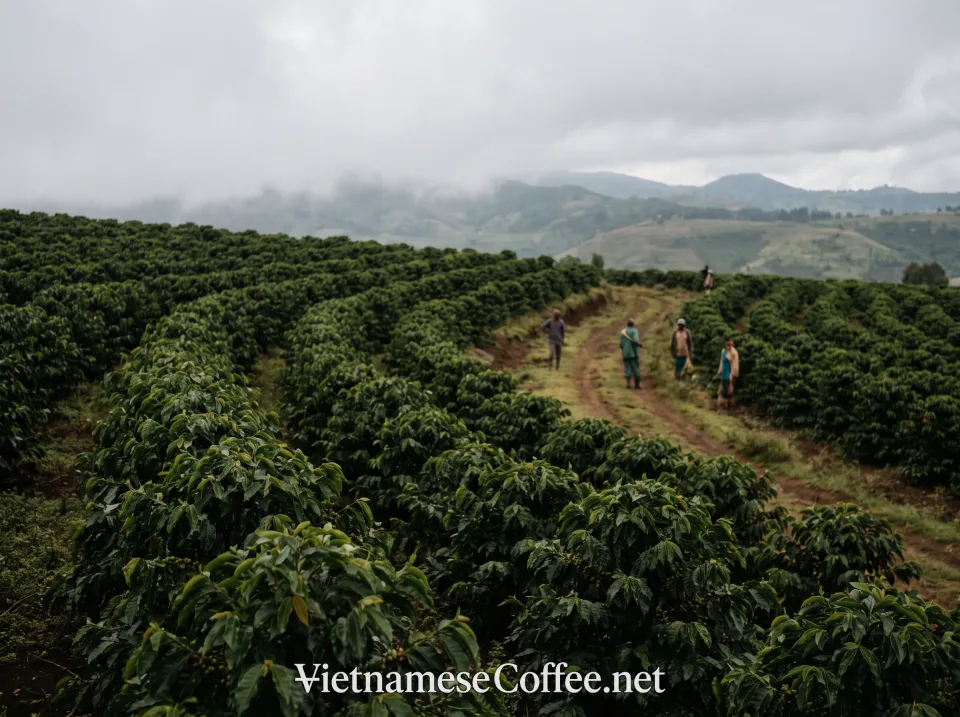
Both countries owe their coffee industries to French colonization, but the timeline and species story differ. Coffee arrived in Vietnam in the 1850s, and while it moved toward the robusta- dominant profile the country is known for today, Laos's story ran through a more dramatic and more gradual species transition. The Lao Coffee Association describes French settlers establishing Bourbon and Typica arabica plantations on the Bolaven Plateau starting around 1920, initially exporting high-quality arabica.
That arabica dominance eroded gradually rather than switching abruptly. Starting around 1950, recurrent regional conflict disrupted the broader coffee sector, while frost and especially leaf rust disease directly damaged arabica plantings over the following decades. Farmers progressively replaced arabica with hardier robusta and later with Catimor, a rust-resistant Coffea arabica cultivar with canephora introgression through its Timor Hybrid parentage.
Today, Laos remains majority-robusta, though sources disagree on the exact current split: the Lao Coffee Association's 2001 figure puts it at 88% robusta and 12% arabica, Coffeeness's 2022 export tonnage suggests roughly 75% and 25%, and Homegrounds estimates closer to 67% and 33%. Regardless of the precise number, arabica remains a meaningful and apparently growing minority in Laos, a genuine point of difference from Vietnam, where robusta dominates far more overwhelmingly nationwide. Geographically, Laotian coffee production remains heavily concentrated on the Bolaven Plateau, while production has documented expansion into northern provinces like Phongsaly, Luang Prabang, and Xieng Khouang.
How each is brewed
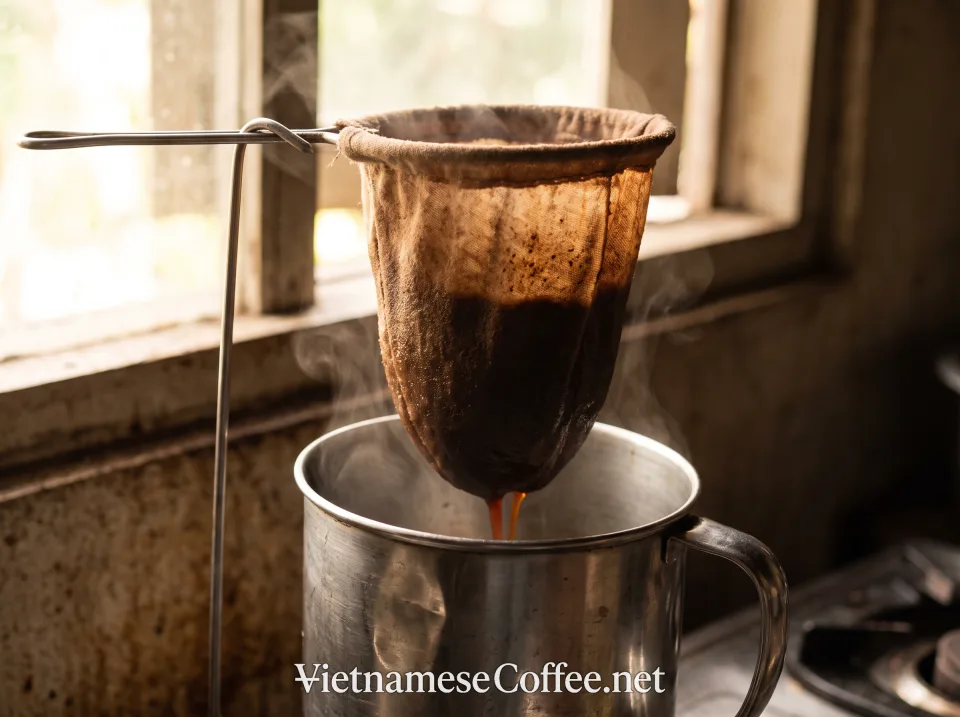
This is where the two traditions converge more than most cross-country comparisons on this site. Vietnamese coffee's phin uses a metal gravity filter, with hot water poured over ground robusta and left to drip for roughly 5 to 8 minutes. Laotian coffee's traditional method is strikingly similar in spirit but uses a different filter material: multiple sources describe a large cloth filter resembling a sock, through which hot water passes over grounds by gravity, brewed deliberately strong.
Several sources go further and explicitly note the resemblance to Vietnamese coffee. Barista Magazine states that Laotians typically brew with a cloth filter and mix the coffee with condensed milk and ice, similar to Vietnamese coffee. Travelfish and Love 2 Drink Coffee both describe Lao drinkers rarely taking their coffee black, instead diffusing a deliberately strong base with powdered milk, evaporated milk, and sweetened condensed milk, very close in spirit to Vietnamese cà phê sữa đá, though built on cloth rather than metal filtration.
Flavor
Vietnamese coffee's flavor leans heavily on dark-roast robusta itself: high in body, concentrated through the phin, and traditionally balanced with sweetened condensed milk. Laotian café lao is similarly robusta-forward, strong and bold enough that many drinkers find it needs condensed milk or a full iced-milk treatment to be approachable, echoing the same "brew it strong, then sweeten and dilute" logic found in Vietnamese iced coffee.
Where Laos's specialty segment differs is in its Bolaven Plateau and increasingly northern-province arabica, grown for higher- quality, specialty-focused coffee rather than everyday sock- brewed café lao. That gives Laos a dual identity: everyday strong robusta on one hand, emerging specialty arabica on the other. The comparison with Vietnam is therefore unusually close at the serving level, but still different in growing geography, filter material, and arabica's role in the national coffee story.