
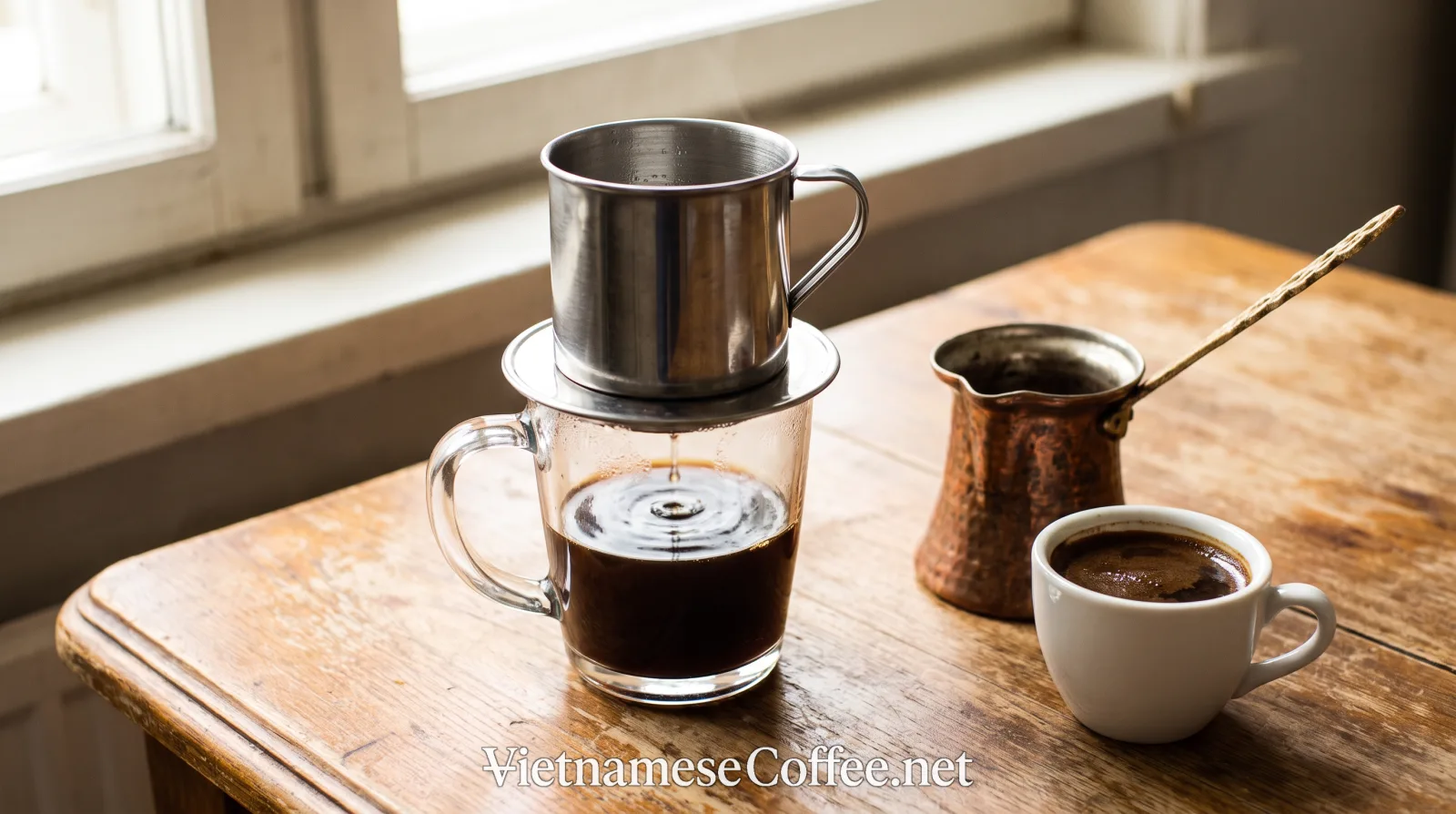
Quick comparison
| Feature | Vietnamese coffee | Greek coffee |
|---|---|---|
| Coffee grown domestically | Yes; Vietnam is a top global producer | No; Greece has no commercial coffee cultivation |
| Dominant species | Predominantly robusta | Imported beans; often arabica, but robusta-inclusive blends are also sold |
| Traditional device | Phin, a metal gravity filter | Briki, a small long-handled pot |
| Brewing force | Gravity only | Direct low heat, watched closely |
| Filtration | Metal mesh filter | None; grounds settle in the cup |
| Sweetening | Condensed milk, added after brewing | Sugar, added before brewing, specified by named sweetness level |
| Serving custom | No specific water service built into the drink | Commonly served with a glass of cold water |
Beans, growing origin, and grind
This comparison starts with an unusually stark structural difference: Vietnam is one of the world's largest coffee-producing and exporting countries, while Greece has no commercial coffee cultivation at all. Every bean used for ellinikos kafes is imported and roasted domestically.
It is worth being precise about bean composition. Ellinikos kafes is often assumed to be strictly arabica, but current commercial products contradict treating that as a defining rule. Coffee Island, a major Greek coffee retailer, sells Greek-coffee blends labeled 80% arabica and 20% robusta, and 70% arabica and 30% robusta. Some Greek coffee products are 100% arabica, but robusta-inclusive blends are a real, currently marketed part of the category.
Vietnamese coffee, by contrast, is commonly built on domestically grown robusta, with traditional natural processing and dark roasting contributing to its heavy, bold cup. The grind itself differs too: Vietnamese phin coffee typically uses a coarser grind than Greek coffee's powder-fine standard, because the phin relies on gravity passing water through a loose bed of grounds while Greek coffee's grounds stay in the finished drink.
How each is brewed
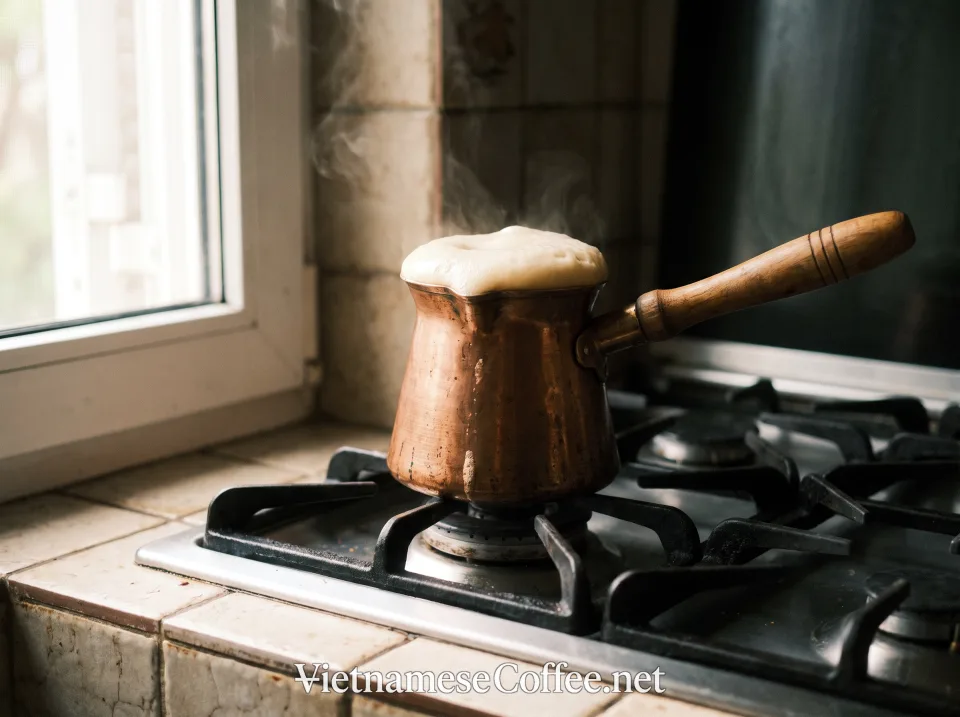
Vietnamese coffee's phin brews entirely by gravity: hot water poured over grounds and left to drip unassisted for 5 to 8 minutes. Greek coffee's briki method works completely differently, as an actively watched, direct-heat process similar in principle to Turkish coffee.
The core sequence is water measured into the briki, coffee and sugar added if desired, one stir, then slow heating without further stirring while kaimaki foam rises. Sources differ on exactly how the heating should proceed. Many recommend avoiding a full rolling boil because it can break the foam and taste harsher. Others describe a deliberate two-rise method as normal or preferred: lifting the briki off heat once foam rises, then returning it briefly for a second, shorter rise. This page treats "avoid a full rolling boil" as a common recommendation, not a universal rule.
Sweetness levels and serving

Vietnamese coffee's sweetness comes from condensed milk, added after brewing and mixed in or layered on top. Greek coffee handles sweetness differently: sugar is added before brewing, directly into the briki alongside the coffee and water, and the amount is specified by name when ordering.
The core terms are sketo, with no sugar; metrio, usually treated as medium sweetness and the most common order; and glykos, sweet. Some sources describe a more granular four-level system, and definitions of "medium" can vary, so this page presents the three-term framework as the practical core vocabulary rather than a fixed universal recipe. Greek coffee is also commonly served with a glass of cold water, a traditional custom rather than an invariant rule in every setting.