

Quick comparison
| Feature | Vietnamese coffee | Cuban coffee |
|---|---|---|
| Dominant species | Predominantly robusta | Traditionally/predominantly arabica, with a growing robusta share |
| Brewing force | Gravity only | Pressure, usually moka pot or espresso machine |
| Traditional device | Phin, a metal gravity filter | Moka pot and espresso machine both commonly documented |
| Sweetening method | Condensed milk poured into the finished coffee | Sugar whipped into the first drops to form espuma foam |
| Brew time | 5 to 8 minutes | A few minutes with a moka pot, or seconds with espresso |
| Serving family | Hot or iced, cà phê sữa đá being the signature iced version | Cafecito, cortadito with steamed milk, or colada for sharing |
| Espuma specifics | No espuma technique | Sugar type, quantity, and whip time vary by recipe |
Beans and brewing force
Vietnamese coffee is commonly built on robusta, and Roast.cafe describes traditional natural processing and dark roasting as central to the heavy, bold character of a phin-brewed cup. Cuban coffee has traditionally been arabica-associated, and CubaCoffee.co.uk describes arabica as historically the main species grown, better suited than robusta to Cuba's higher- elevation growing regions.
Current sourcing makes clear this is not an exclusively arabica picture. Perfect Daily Grind cites roughly a 60/40 arabica-to- robusta split based on 2022 figures, and Global Coffee Report documents robusta's share of Cuban production climbing sharply in recent years, from roughly 14% to 43%, with further growth possible as climate pressures shift growing conditions. FAO's 2026 investment planning for Cuba's coffee sector also addresses rehabilitating both arabica and robusta plantations.
The brewing force differs sharply regardless of species mix. The phin relies entirely on gravity, with hot water poured over grounds and left to drip unassisted for 5 to 8 minutes. Cuban coffee, by contrast, is built on pressure: the moka pot generates steam pressure and the espresso machine uses much higher pressure. Both are meaningfully different from the phin's zero-pressure gravity drip, and also different from each other.
How each is brewed

Vietnamese coffee's phin is a metal gravity filter. It brews slowly, with the coffee dripping into the cup below without pump pressure or steam pressure. That slow drip is part of the drink's texture and ritual, especially when the brewed coffee lands on a layer of sweetened condensed milk.
Cuban coffee is most often described through the moka pot and the espresso machine. A moka pot pushes hot water upward through ground coffee using steam pressure, while an espresso machine produces a shorter, higher-pressure shot. This page keeps those methods separate rather than treating all pressure brewers as equivalent: both differ from the phin, but a moka pot and an espresso machine do not operate at the same pressure.
How each is sweetened
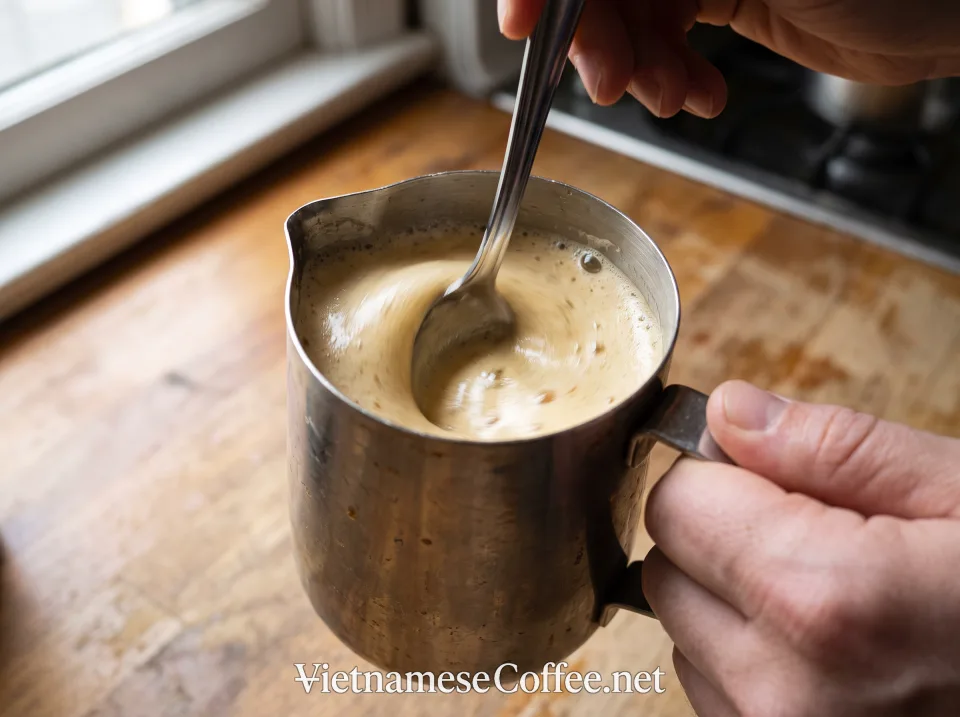
This is the single biggest difference between the two traditions, and it is mechanical, not just a matter of taste. Vietnamese coffee is sweetened by pouring sweetened condensed milk directly into the glass, letting it dissolve and blend with the finished, already- brewed coffee, whether stirred together for a hot cup or layered underneath for the iced version.
Cuban coffee's espuma technique works differently, and happens during brewing rather than after. Barista Magazine describes the defining move directly: the first drops of coffee, from a moka pot or espresso machine, are vigorously beaten into sugar until a stable foam forms. Beyond that shared core principle, specific recipes vary meaningfully: sources differ on sugar type, sugar quantity, and whipping time, so this page treats those details as recipe examples rather than one universal standard.
Serving styles and culture
Vietnamese coffee's most iconic form is cà phê sữa đá, condensed- milk coffee poured over ice, alongside hot cà phê sữa nóng and black versions without milk. Cuban coffee has its own recognized family of related drinks: a plain cafecito, or café cubano, is the sweetened, espuma-topped single shot itself; a cortadito cuts that same sweetened coffee with an equal pour of steamed milk; and a colada is a larger, shared serving of sweetened Cuban coffee poured into several small cups for a group.