
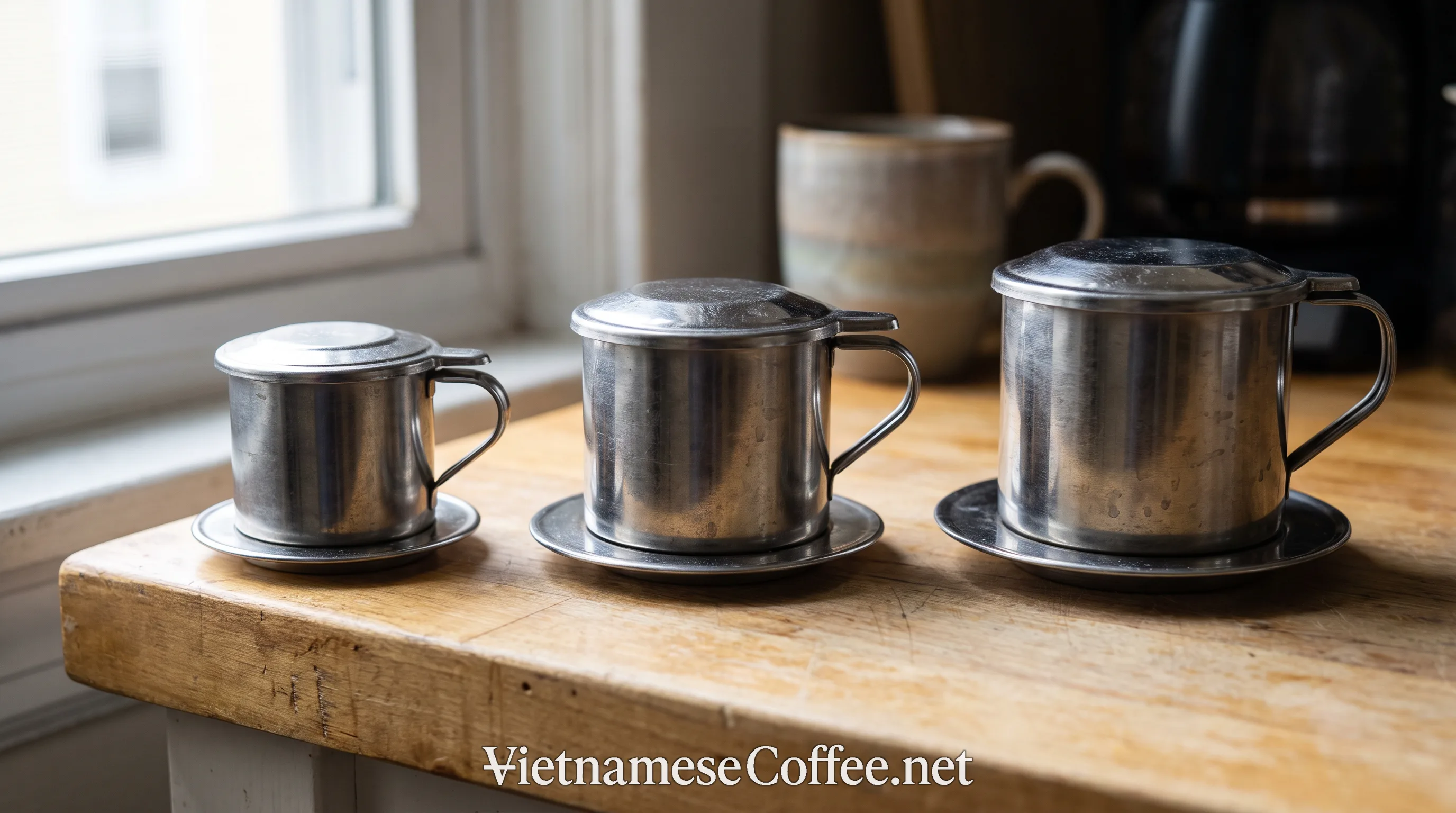
Sizes you'll actually find for sale
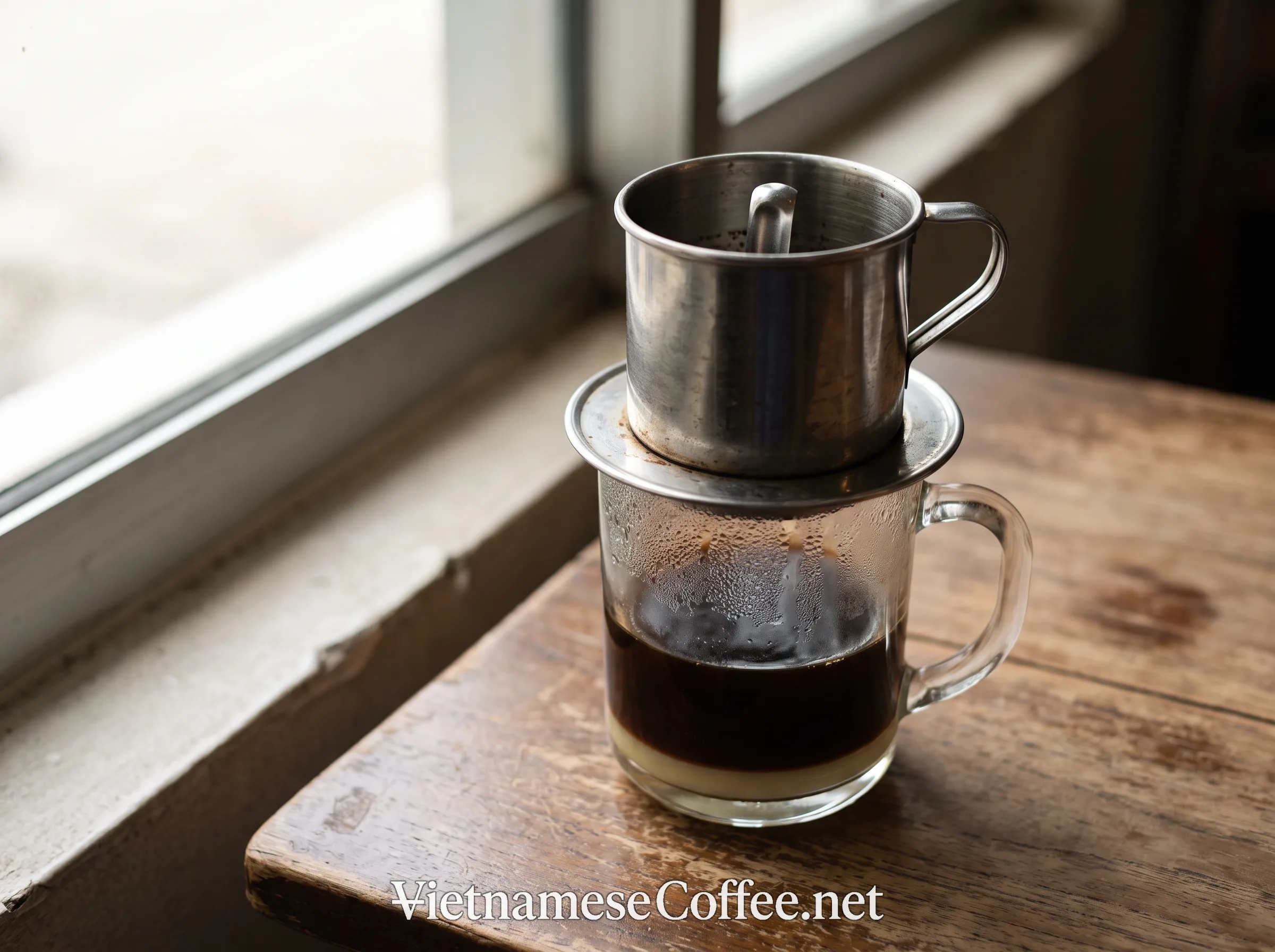
Nguyen Coffee Supply and Phin Ratio both describe 4 oz, about 120 ml, as commonly sold for a single serving, and this is the one point of solid agreement across sources reviewed for this page. Beyond that starting point, sizing diverges by brand rather than following a fixed system. Thang Long's own product lineup spans 4, 6, 8, 11, and 15 oz filters, while Cafely's lineup spans roughly 4 to 24 oz, with 6 oz positioned as that brand's own standard for one to two cups.
An 8 oz phin is a useful example of how inconsistent size-to-serving descriptions really are. Nguyen Coffee Supply describes 8 oz as working for either a heavy single serve or a double serve, without treating it as a guaranteed stand-in for two individual brews. Coffee Balcony instead frames 8 oz as a larger single cup or an iced-coffee base. The Glitter in My Tea groups 6-8 oz together as suited to a solo drinker wanting a strong, concentrated cup.
Capacity labels can also be misleading in a more literal sense. Cafely's own product listing for one of its filters states a capacity of "6oz total / 4oz practical (loaded with coffee)," meaning the filter's stated size and the water it can actually hold once grounds are added inside are two different numbers.
Example recipe starting points
The figures below are example starting points from Coffee Balcony's published recipes for each size label, not universal properties that a phin of that size guarantees. Cafely's own published recipe for similarly labeled sizes uses noticeably different numbers: 14 g coffee with 120 ml water for its 4 oz filter, 21 g with 180 ml for 6 oz, and 28 g with 240 ml for 8 oz.
| Size label | Example dose (Coffee Balcony) | Example water (Coffee Balcony) | Described use |
|---|---|---|---|
| 4oz | 12-15 g | 70-120 ml | Small, concentrated single serving, condensed-milk coffee |
| 6oz | 15-18 g | 100-170 ml | Everyday hot or iced single cup |
| 8oz | 18-24 g | 150-230 ml | Larger single cup or iced-coffee base |
| 11oz+ | Scales up further, per source | Scales up further, per source | Sharing or batch brewing, per sources like The Sweet and Simple Kitchen |
Treat this table as one published recipe set's starting point, useful for a first attempt with a given size, and adjust dose and water based on your own filter's actual capacity and your taste, rather than assuming these numbers apply to every filter sold under the same size label.
How to actually choose
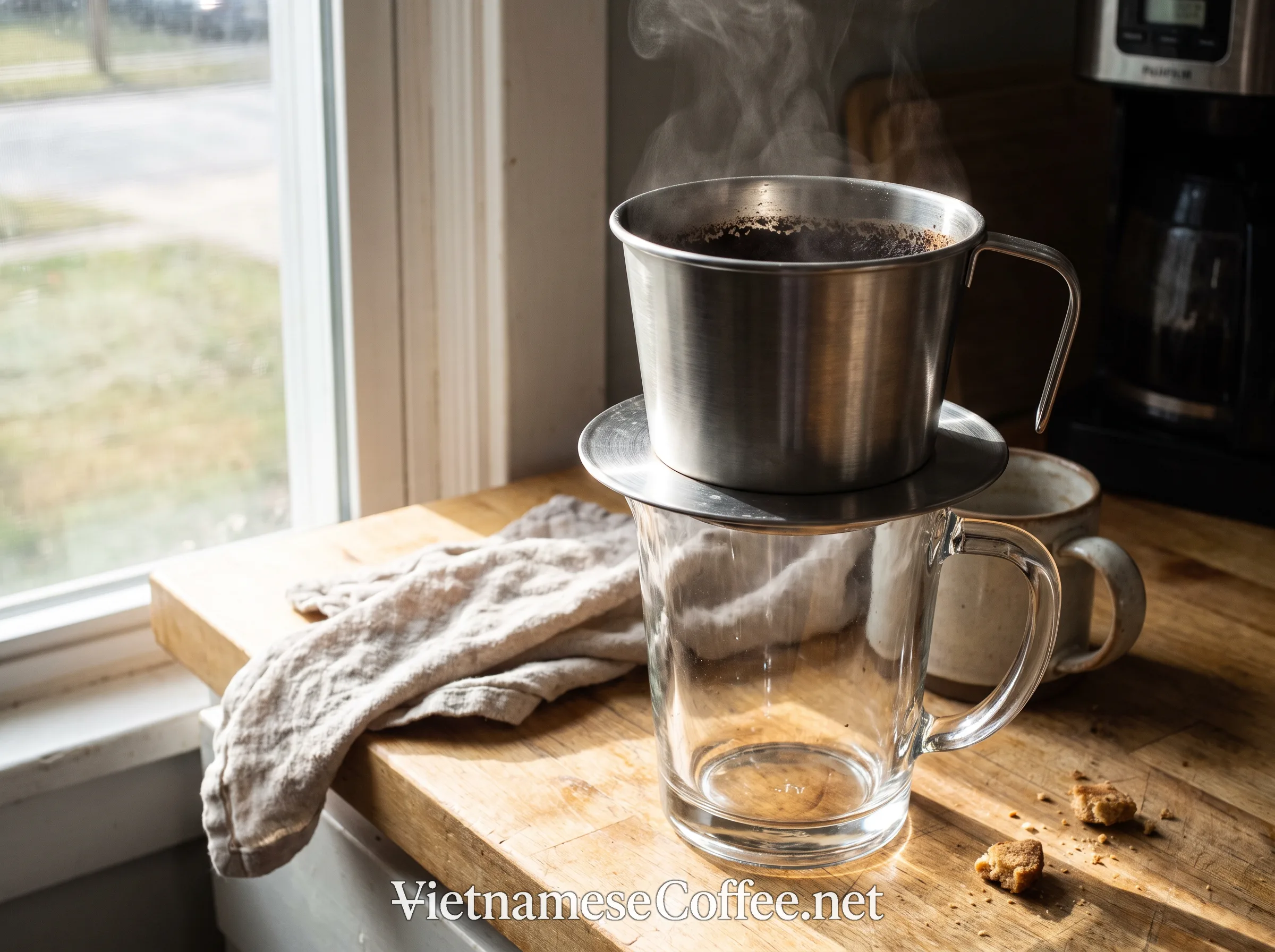
If you mainly want a small, concentrated drink like traditional condensed-milk coffee, a filter sold around 4 oz is a reasonable starting point, since it is the one size description that is broadly consistent across sources as a single serving. If you want more flexibility for a regular hot or iced cup without thinking too hard about dose, a 6 oz filter is commonly positioned that way by multiple sources, though check the specific product's practical loaded capacity rather than assuming the label alone tells you enough.
For brewing more volume at once, whether that is a larger single serving, two smaller ones, or a shared pitcher-style batch, look at what the specific manufacturer says that size is meant to produce. The most reliable approach is to decide how much brewed coffee you actually want to end up with, then check a specific filter's practical loaded capacity and its maker's own recommended dose, rather than picking a size purely from a general "one person" or "for sharing" label.