
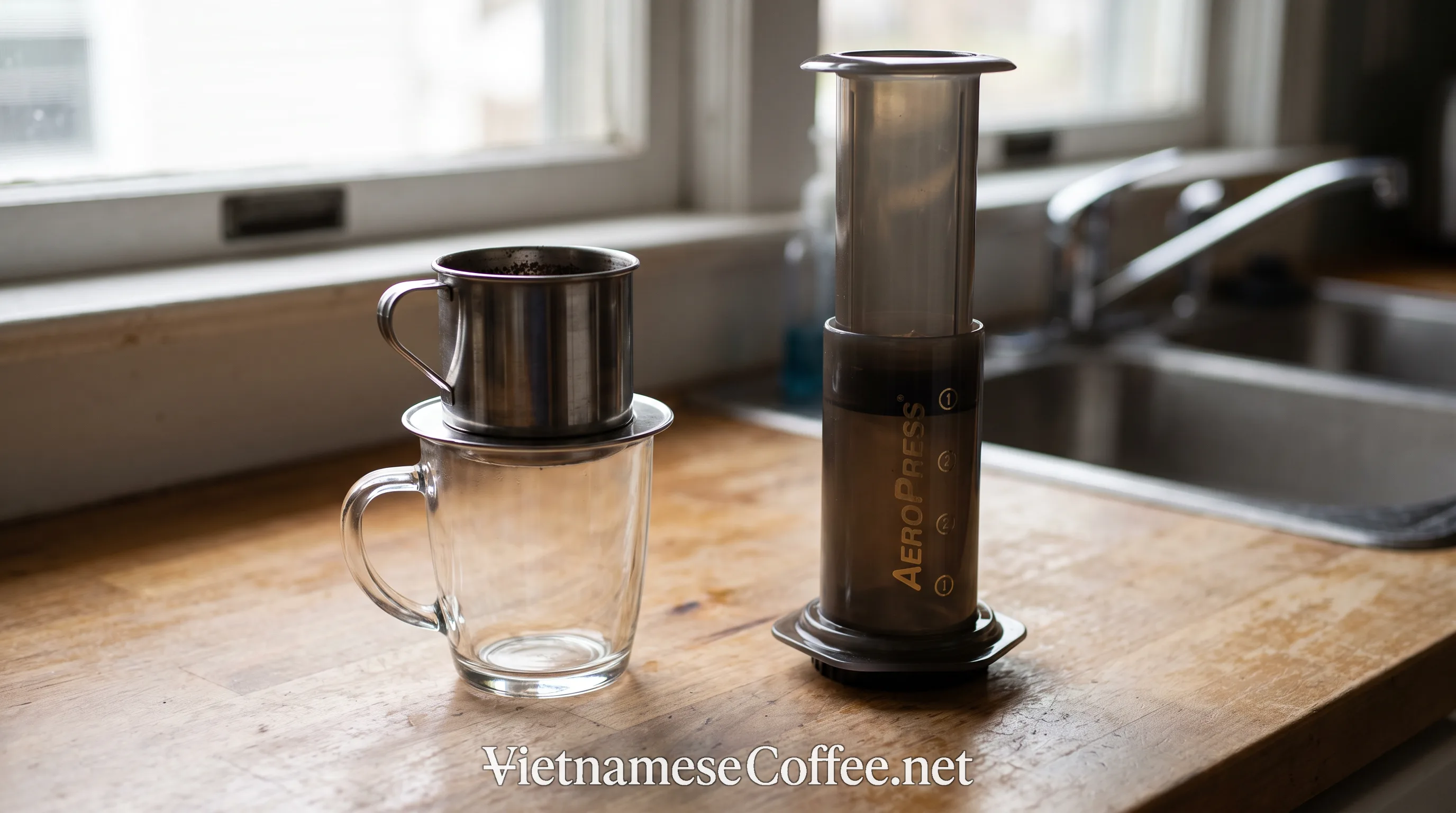
Quick comparison
| Feature | Phin filter | AeroPress |
|---|---|---|
| Brewing force | Gravity only | Manual plunger pressure |
| Typical grind | Varies by source and filter; CoffeeHQ specifies medium-coarse | Medium-fine, consistent across sources compared |
| Typical ratio | 150-200 g coffee per liter, about 1:5 to 1:6.7, per CoffeeHQ | Wide range, roughly 1:6 to 1:17 depending on recipe |
| Total brew time | 5-8 minutes | Roughly 1.5-4 minutes, including the press |
| Filter type | Built-in perforated metal plate | Paper filter by default, or reusable metal disc |
| Closely associated with | Traditional Vietnamese coffee with condensed milk | A wide range of recipe styles and travel brewing |
| Portability | Smallest footprint; fits in a mug | Small but needs filters and pressing space |
How each one brews
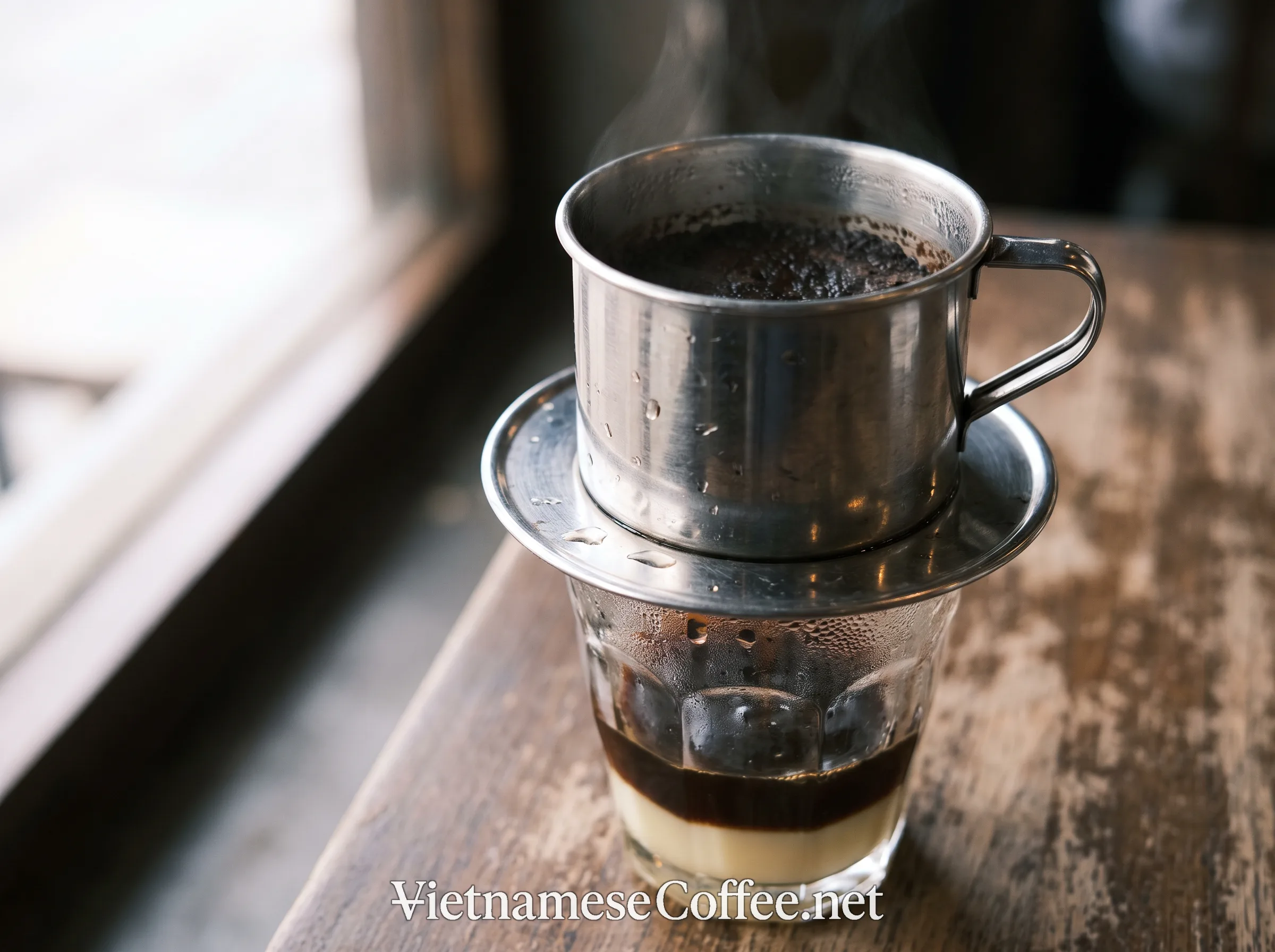
The phin works entirely by gravity. CoffeeHQ describes it as a four-part metal filter, chamber, perforated base, press disc, and lid, that sits directly on the serving glass; water is boiled separately and poured in, then left undisturbed to drip for four to eight minutes. How firmly the press disc sits is one variable that affects drip rate, but grind size, dose, how evenly the coffee bed is prepared, water amount, water temperature, and pre-wetting all affect how a phin brews as well.

The AeroPress works by immersion followed by manual pressure. Grounds and water sit together in the chamber for a set steep time, commonly around 30 seconds to a minute for the standard and inverted methods according to CaffeineNCo's comparison of published recipes, after which the brewer presses a plunger down over 20 to 30 seconds to force the coffee through a filter. This gives the AeroPress a shorter total brew time and a similarly wide set of adjustable variables: steep time, press speed, water temperature, standard versus inverted setup, grind, and ratio.
Grind, ratio, and dose
Grind recommendations for phin are not uniform across sources. CoffeeHQ, the source used for this page's other phin figures, specifies medium-coarse and warns that a fine grind can block the perforated metal plate and stall the drip. Other Vietnamese-coffee-focused sources reviewed elsewhere in this site's research describe fine or medium-fine grinds instead, so treat CoffeeHQ's medium-coarse figure as one detailed, internally consistent source's recommendation rather than a settled standard.
AeroPress guides reviewed for this page, including Coffee Gear HQ and CaffeineNCo's cross-recipe comparison, converge much more consistently on medium-fine, occasionally moving toward a super-fine, near-espresso grind for very concentrated recipes like Counter Culture's 1:6 version. CoffeeHQ gives phin a comparatively narrow published range, roughly 150 to 200 grams of coffee per liter of water, or about 1:5 to 1:6.7 by weight. AeroPress ratios vary far more by source and by goal: from 1:6 for concentrated recipes to about 1:17 for lighter cups.
Taste, texture, and the drink itself
CoffeeHQ describes the phin's output as high body, medium-low clarity, high perceived strength, and a bitterness and sweetness profile that leans heavily on the coffee, typically dark-roast robusta, and the condensed milk it is traditionally poured over, rather than on the filter mechanism itself. Because the metal plate passes oils that a paper filter would catch, phin coffee has a heavier, more coating texture than a paper-filtered brew of similar strength.
AeroPress, by contrast, typically uses a paper filter, though a reusable metal disc is also common, which produces a cleaner, lower-sediment cup than the phin's all-metal filtration, even at a comparably strong ratio. Its recipe flexibility also means the resulting cup varies more from batch to batch than a phin's, since press speed, steep time, inversion, and grind all shift the outcome meaningfully.
Portability and cleanup
Coffee Balcony's direct comparison of the two describes the phin as the more compact option, noting it can fit inside the mug it will be served in and needs only a kettle to operate. The AeroPress is still small and widely considered travel-friendly, but it needs disposable paper filters or a reusable metal one, a grinder for fresh coffee, and a bit more setup space to actually perform the press.
Both devices clean up quickly: a phin's few metal parts rinse easily, while the AeroPress ejects a compact, dry puck of grounds directly into the trash with a single push of the plunger.
Summing up the differences
The phin is closely associated with a specific traditional drink, Vietnamese coffee served over condensed milk, and uses a simpler, largely gravity-driven workflow with fewer moving parts. The AeroPress supports a broader range of recipe styles, from strong and concentrated to closer to drip strength, with a typically shorter total brew time and more adjustable variables like steep time and press speed.
These are the main practical differences between the two methods; which one fits a given routine depends on what you are brewing and how you brew it, rather than one method being a strictly better choice than the other.