
The farmers and the first collectors
Vietnam's coffee sector begins with a very large number of small producers, though exact counts vary by source and definition. The ILO's 2025 reporting on risks facing Vietnamese coffee farmers states that the sector supports the livelihoods of around 1.4 million smallholder farmers. A separate, earlier FarmD supply-chain risk assessment from 2024 estimates roughly 500,000 smallholder farmers specifically growing coffee. These figures are not necessarily contradictory: they may be counting different populations, such as registered coffee-farming households compared with a broader estimate of people whose livelihoods the coffee sector supports, including family members and dependents.
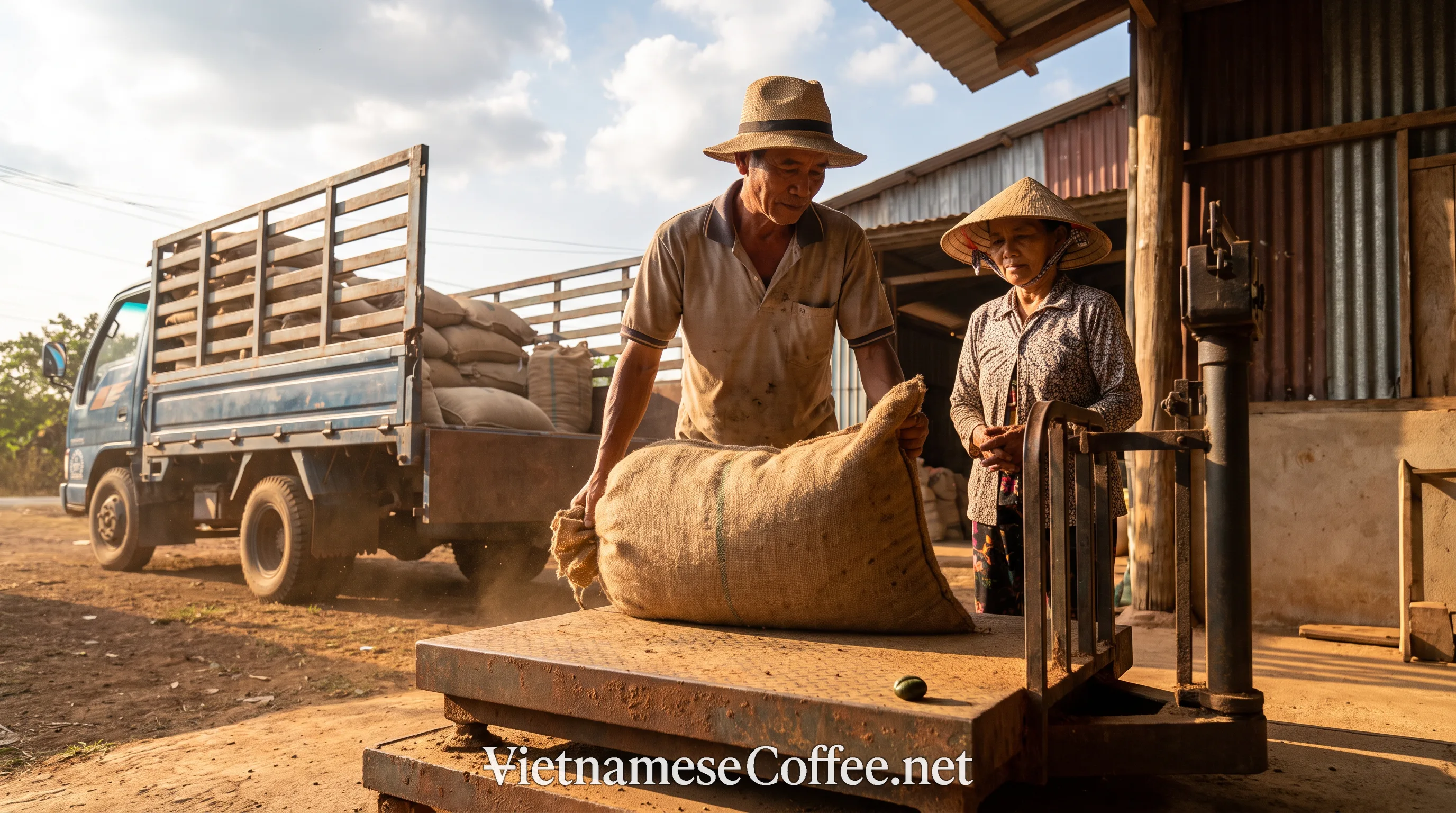
Farmers harvest, and often begin drying, coffee cherries themselves. The ILO's summary of Vietnam's coffee value chain identifies farmers as the actors who grow, process, harvest, and prepare coffee at the household level, before the crop moves further down the chain.
From the farm, coffee typically moves to village-level collectors, agents, or cooperatives. The ILO describes these actors as buying coffee beans directly from farmers, then sorting and distributing that coffee to downstream roasters and processors. FarmD's assessment puts the number of small traders and primary collectors at roughly 1,500 to 2,000 nationally, illustrating how fragmented and localized this first stage of aggregation is compared with the smaller number of processing and export firms further down the chain. A single collector or trader typically buys from many individual farmers, aggregating small volumes into larger, sellable lots.
Processors, exporters, and where the money goes
After collection, coffee moves to processors, who prepare green coffee for sale, and then to exporters, who arrange international shipment. FarmD's assessment counts around 300 small processors nationally, alongside a small number of larger players: 5 to 6 joint-stock companies or state-owned enterprises, 6 to 8 multinational firms or affiliates, and 140 to 150 domestic private firms. Whichever total farmer count is used, Vietnam's coffee supply chain clearly funnels a very large base of farmers and collectors into a comparatively small number of processing and export businesses.
Vietnam's coffee industry is overwhelmingly export-oriented. FarmD's assessment states that approximately 95 percent of Vietnamese coffee is exported, with only about 5 percent consumed domestically. This heavy export orientation shapes the entire chain, since most participants, from collectors to exporters, are ultimately supplying an international rather than a domestic market.
Despite the many hands coffee passes through, a notable feature of Vietnam's chain is how much value reaches the farmer relative to other coffee-producing countries. The World Bank's coffee sector report found that farm-gate prices have historically averaged around 96 percent of the unit value of green coffee exports, sometimes exceeding it, reflecting thin intermediary margins. The Global Coffee Platform's Vietnam analysis similarly models farmers receiving approximately 95 percent of the FOB export price, describing Vietnam as one of the most cost-efficient coffee supply chains in the world. This does not mean farmgate prices are high in absolute terms; it means a relatively small share of the export price is absorbed by aggregators and exporters compared with some other origins.
Roasters, retailers, and the final cup
Downstream of exporters, coffee reaches roasters, both within Vietnam and in importing countries, who roast and grind green coffee before it reaches consumers. The ILO's value-chain summary identifies roasters and processors, followed by importers, distributors, and finally retailers such as cafes, as the remaining links before coffee reaches a cup. A Vietnamese phin coffee served in a Hà Nội cafe and a bag of roasted Vietnamese Robusta sold in a European supermarket both trace back through this same basic structure, even though their final preparation, branding, and price differ enormously.
Domestic consumption represents a smaller, but growing, part of this chain. Vietnamese cafes, from traditional phin-serving shops to larger chains, source roasted coffee either directly from domestic roasters or, less commonly, roast in-house. Because domestic consumption is a small share of total Vietnamese coffee production, changes in international demand and export pricing generally have a much larger effect on the sector than shifts in domestic drinking habits.
Retail-level formats also differ by market. Some coffee is sold as whole bean or ground coffee for home brewing, some as instant coffee, and some enters ready-to-drink products. Each format adds its own additional processing, packaging, and distribution step beyond the roasting stage described here, but all trace back to the same farm-to-collector-to-exporter foundation.
Exporters, traceability, and the EUDR deadline
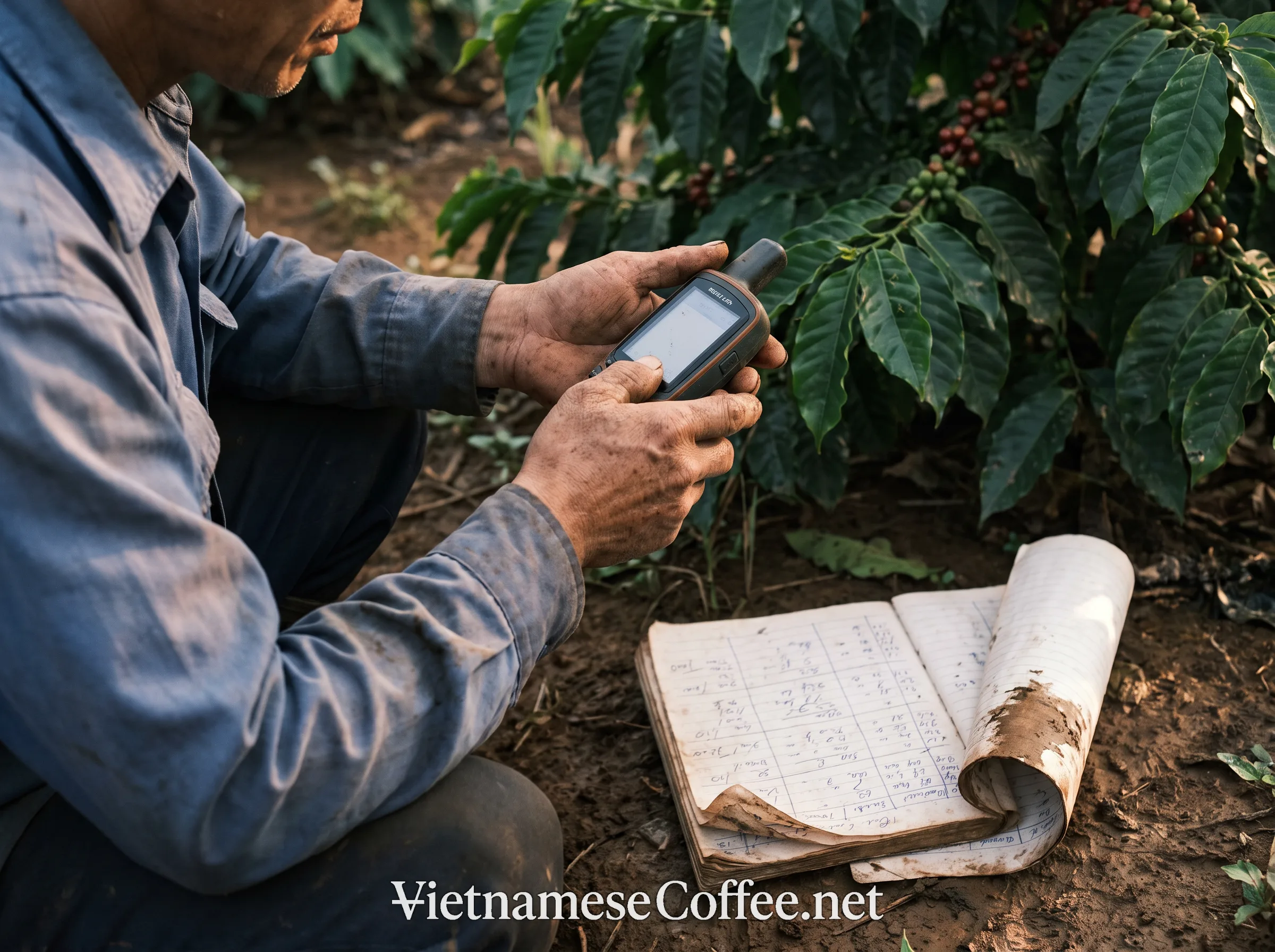
Vietnam's coffee supply chain is currently undergoing a significant traceability shift because of the European Union's Deforestation Regulation, or EUDR. Under Regulation (EU) 2023/1115, geolocation is legally defined as the geographical location of a plot of land, described using latitude and longitude coordinates with at least six decimal digits. For plots of land larger than four hectares used to produce a relevant commodity other than cattle, which includes coffee, the regulation requires that geolocation be provided using a polygon, with sufficient latitude and longitude points to describe the plot's perimeter, rather than a single coordinate. Plots of four hectares or less may generally be reported using either a single point or a polygon, according to official EU guidance. Simply naming a province or region is not sufficient under EUDR.
This requirement interacts directly with Vietnam's fragmented farm structure. A single export container commonly aggregates coffee from many individual smallholder plots. Under EUDR, the required latitude/longitude point, or polygon for larger plots, must be collected for each of those farms individually, not just recorded at the level of the processing facility or province, representing a substantial new data-collection burden across the collector-and-aggregation stage described earlier in this page.
AgNavigator's February 2026 reporting identifies plot-level traceability and land-legality verification across fragmented smallholder networks as the sector's most pressing EUDR-related challenge. The European Commission currently lists entry into application on 30 December 2026 for large and medium operators and 30 June 2027 for most micro and small operators. Exporters, rather than individual smallholders, generally bear the formal compliance burden, since smallholders typically provide farm and legal-production data to exporters, cooperatives, or processors, who then compile and file the required documentation.
The supply chain at a glance
| Stage | Who is involved | Approximate scale | What happens at this stage |
|---|---|---|---|
| Farming | Smallholder farmers | ILO: sector supports about 1.4 million smallholder farmers; FarmD: about 500,000 farmers specifically growing coffee | Growing, harvesting, and initial home drying of cherries |
| Collection | Village collectors, agents, cooperatives | Roughly 1,500 to 2,000 small traders and collectors, per FarmD | Buying from farmers, sorting, and aggregating into sellable lots |
| Processing and export | Small processors, joint-stock companies, multinational affiliates, domestic private firms | About 300 small processors; 5 to 6 joint-stock or state firms; 6 to 8 multinational affiliates; 140 to 150 domestic private firms | Hulling, grading, preparing green coffee, arranging export shipment, and compiling EUDR plot-level data |
| Roasting, retail, and consumption | Domestic and international roasters, cafes, retailers | About 95 percent exported and 5 percent consumed domestically, per FarmD | Roasting, packaging, brewing, and serving coffee to the final consumer |