
Quick comparison
| Feature | Traditional Vietnamese coffee (phin-brewed) | Regular instant coffee |
|---|---|---|
| Preparation | Ground robusta, hot water, phin filter, 4-7 minutes | Just add hot or cold water; dissolves in seconds |
| Production | Brewed fresh at time of drinking | Pre-brewed, then spray-dried or freeze-dried into powder or granules |
| Typical bean | Robusta | Varies; often a robusta/arabica blend or unspecified |
| Caffeine per cup | Varies with dose, ratio, and brew method; robusta generally has more caffeine than arabica | Generally somewhat lower than conventional brewed coffee, per several sources; exact figures vary |
| Flavor | Bold, concentrated, full-bodied | Often described as less complex than fresh-brewed |
| Shelf life and convenience | Requires grinding and equipment | Long shelf life, minimal equipment, fastest prep |
How each is made
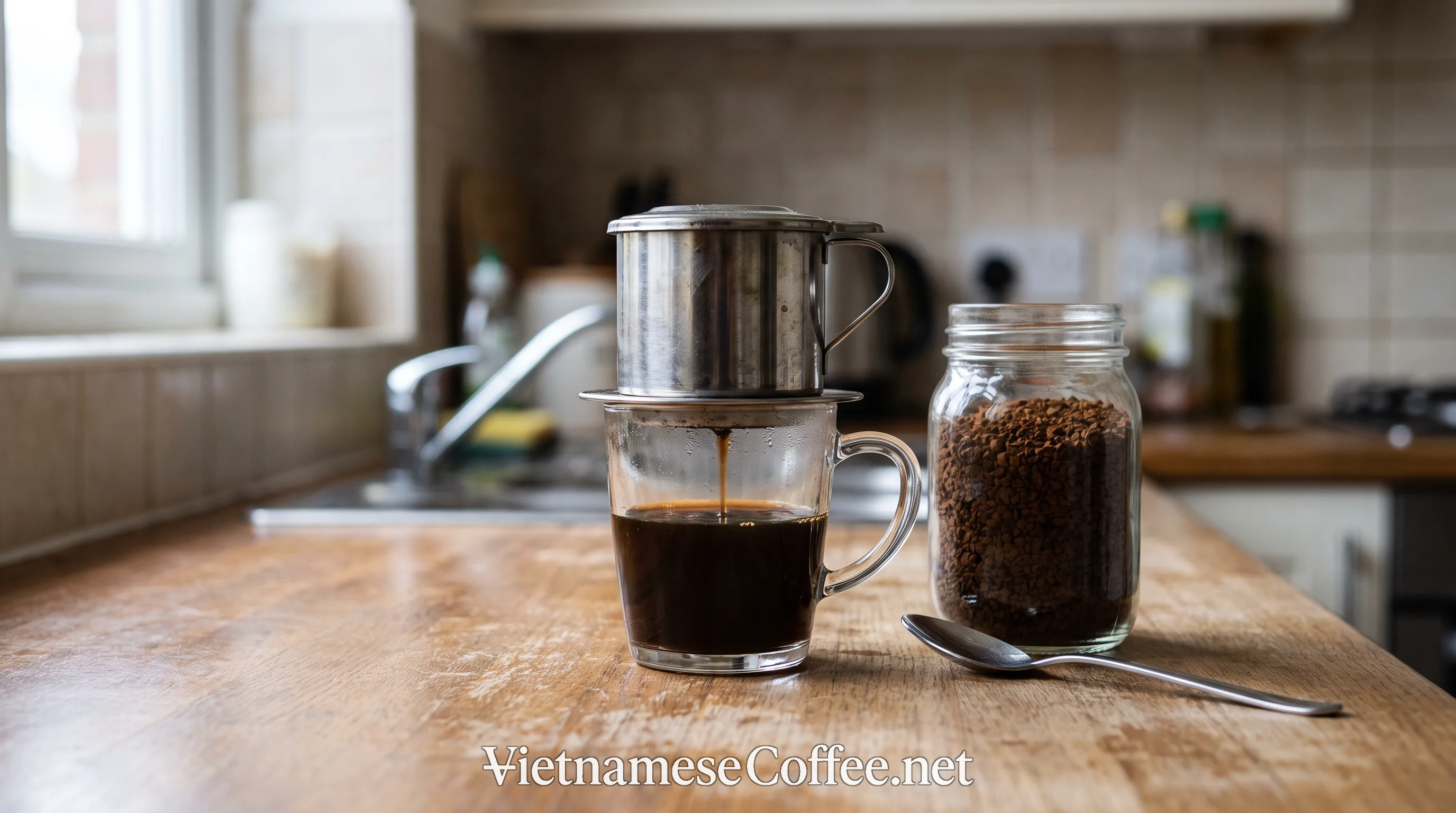
Traditional Vietnamese coffee is brewed to order. Alibaba Product Insights describes hot water dripping slowly through ground robusta in a metal phin filter, a process taking roughly 4 to 7 minutes, producing a concentrated, bold, aromatic brew that forms the base for drinks like cà phê sữa. Nothing about this coffee is processed or dried in advance; it is ground and brewed at the point of drinking.
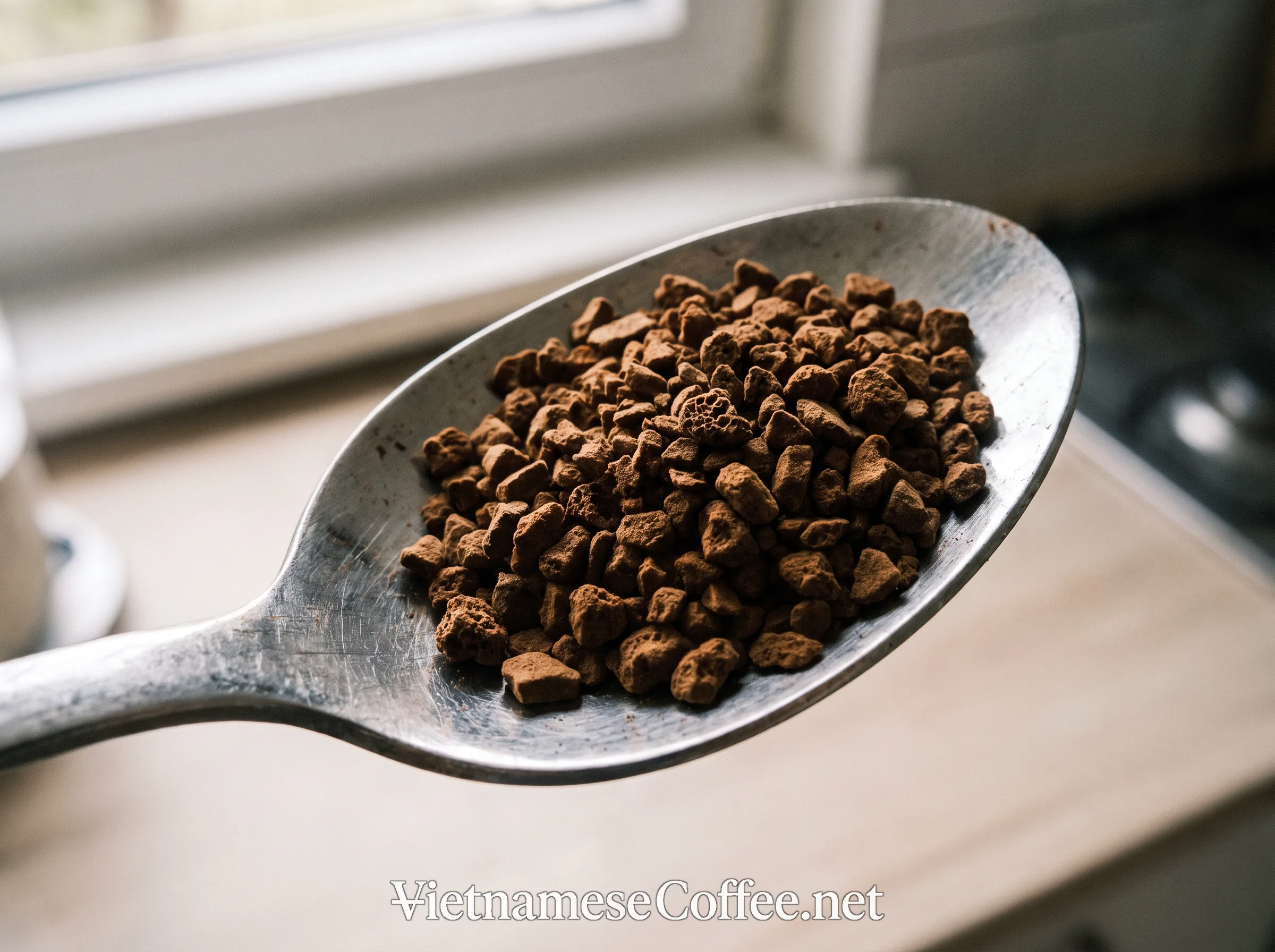
Regular instant coffee takes a fundamentally different path. C&EN and Science Insights both describe brewing coffee in bulk, then removing nearly all the water to leave a shelf-stable powder or granule. Most mass-market instant coffee is spray-dried: coffee concentrate is atomized into a fine mist, then dried almost instantly as it falls through a heated tower. Freeze-drying, used for higher-quality and premium instant products, freezes the brewed concentrate, breaks it into granules, and removes the water through sublimation under vacuum.
Because instant coffee is brewed once at the factory and then rehydrated by the drinker, its flavor is set before it reaches your cup. A phin brew, by contrast, is extracted fresh each time.
Caffeine content
This is where it is worth being precise. Several sources agree that conventional brewed or filter coffee generally contains more caffeine per serving than instant coffee, though the exact figures vary: C&EN cites roughly 95 mg for brewed coffee versus 62 mg for instant per 8 oz cup; Science Insights cites 80 to 120 mg versus 60 to 80 mg; and FoodUnfolded cites 112 mg versus 66 mg per 225 ml cup from its own lab testing. These are generic brewed coffee comparisons, not measurements of Vietnamese phin coffee specifically.
Separately, robusta, the bean most commonly used in traditional Vietnamese coffee, generally contains substantially more caffeine than arabica. At the green bean level, independent sources consistently report roughly 0.8 to 1.5 percent caffeine by dry weight for arabica versus roughly 1.7 to 2.8 percent for robusta. At the level of an actual brewed cup, the ratio depends on dose, ratio, grind, brewing method, and serving size.
This page therefore does not combine the "brewed generally beats instant" pattern with the "robusta generally beats arabica" pattern into a specific claim about exactly how much caffeine a cup of phin coffee contains relative to a cup of instant coffee. Both tendencies matter, but the serving-level result depends on the actual recipe.
Flavor and practical tradeoffs
Alibaba Product Insights states plainly that instant coffee may lack the depth and complexity of freshly brewed coffee, a distinction rooted in how the two are made: instant coffee's flavor compounds have already gone through a full brew-then-dry cycle before you add water, while a phin brew extracts directly into your cup. FoodUnfolded adds that the most volatile aromatic compounds responsible for fresh coffee's smell largely cannot survive the drying process.
The tradeoff runs the other way for convenience. A phin brew requires ground coffee, hot water, a filter, and several unattended minutes of drip time. Instant coffee needs none of that: just hot or cold water and a spoon, with a shelf life measured in months or years rather than the freshness window that applies to ground or whole-bean coffee.
Where Vietnamese instant coffee fits in
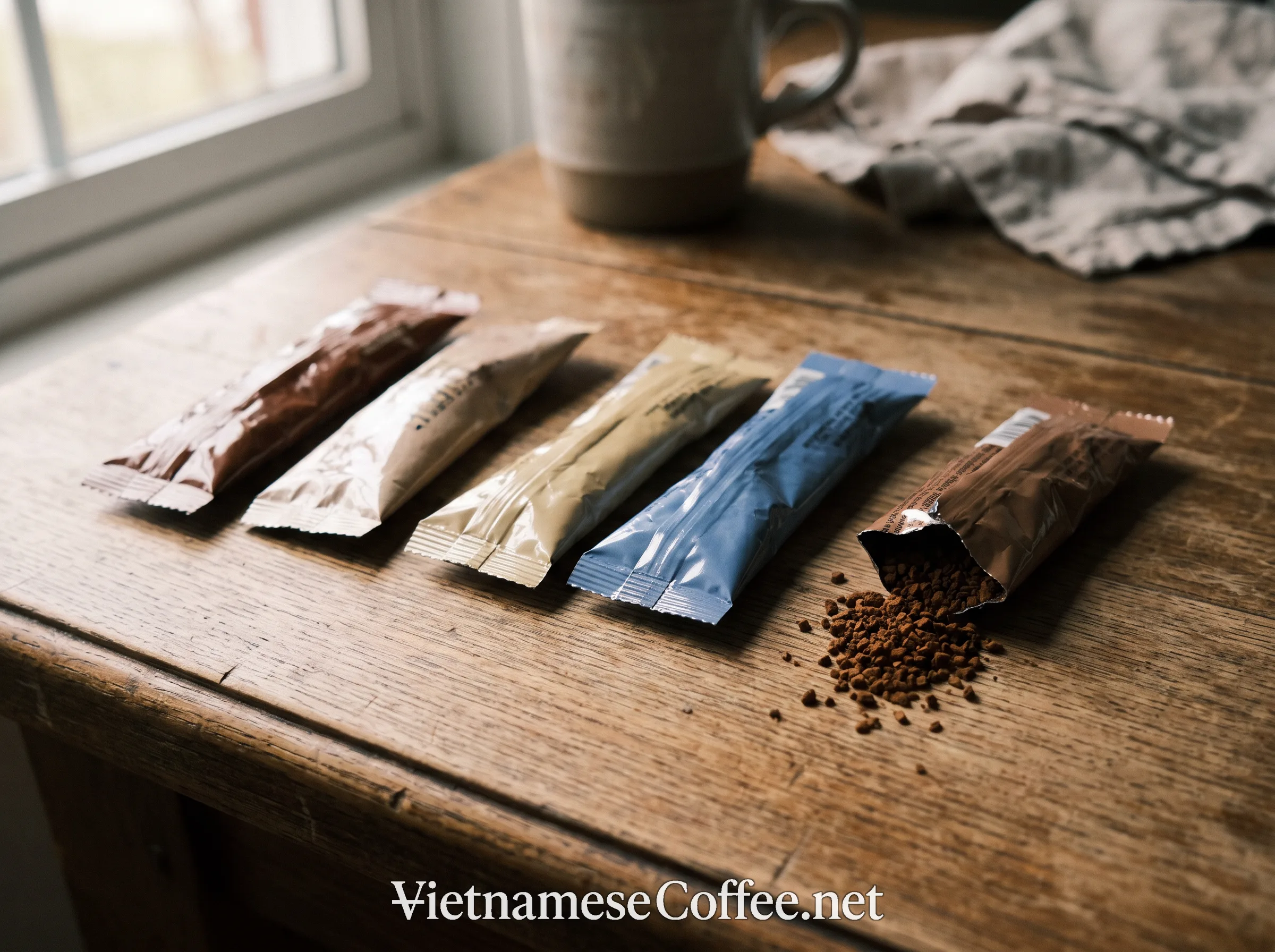
"Vietnamese instant coffee," sold under brands like G7, Vinacafe, and King Coffee, is still instant coffee in production terms: brewed and then dried into powder or granules. Being Vietnamese, robusta-based, stronger-tasting, or sold as a 3-in-1 format with sugar and creamer does not create a separate technical category between instant and brewed coffee.
Within that category, Vinwonders and Local Beans Roastery both describe Vietnamese instant coffee as commonly made from robusta beans and formulated for a stronger, bolder flavor than many Western instant coffees. Savour the Pho recommends G7 and Vinacafe as widely available Vietnamese instant options, with Vinacafe described as creamier and sweeter and G7 also offering an unsweetened pure black version. None of the sources reviewed directly measure how Vietnamese instant coffee's caffeine or flavor compares numerically to traditional phin coffee.