
| Area | Historic Đắk Nông province, M'Nong Plateau |
|---|---|
| Primary variety | Robusta |
| Coffee area | Approx. 143,000 hectares, historic footprint |
| Harvested area | Approx. 131,000 hectares, actively harvested |
| Annual output | Approx. 343,540 tonnes, 2024 estimate |
| Average yield | 2.62 tonnes per hectare, 2024 estimate |
| Geographical indication status | Đắk Nông pepper holds GI Certificate No. 00111 |
| Key districts | Dak Mil, Dak Song, Tuy Duc, Krong No, Dak R'lap, Gia Nghia |
Geography and the M'Nong Plateau
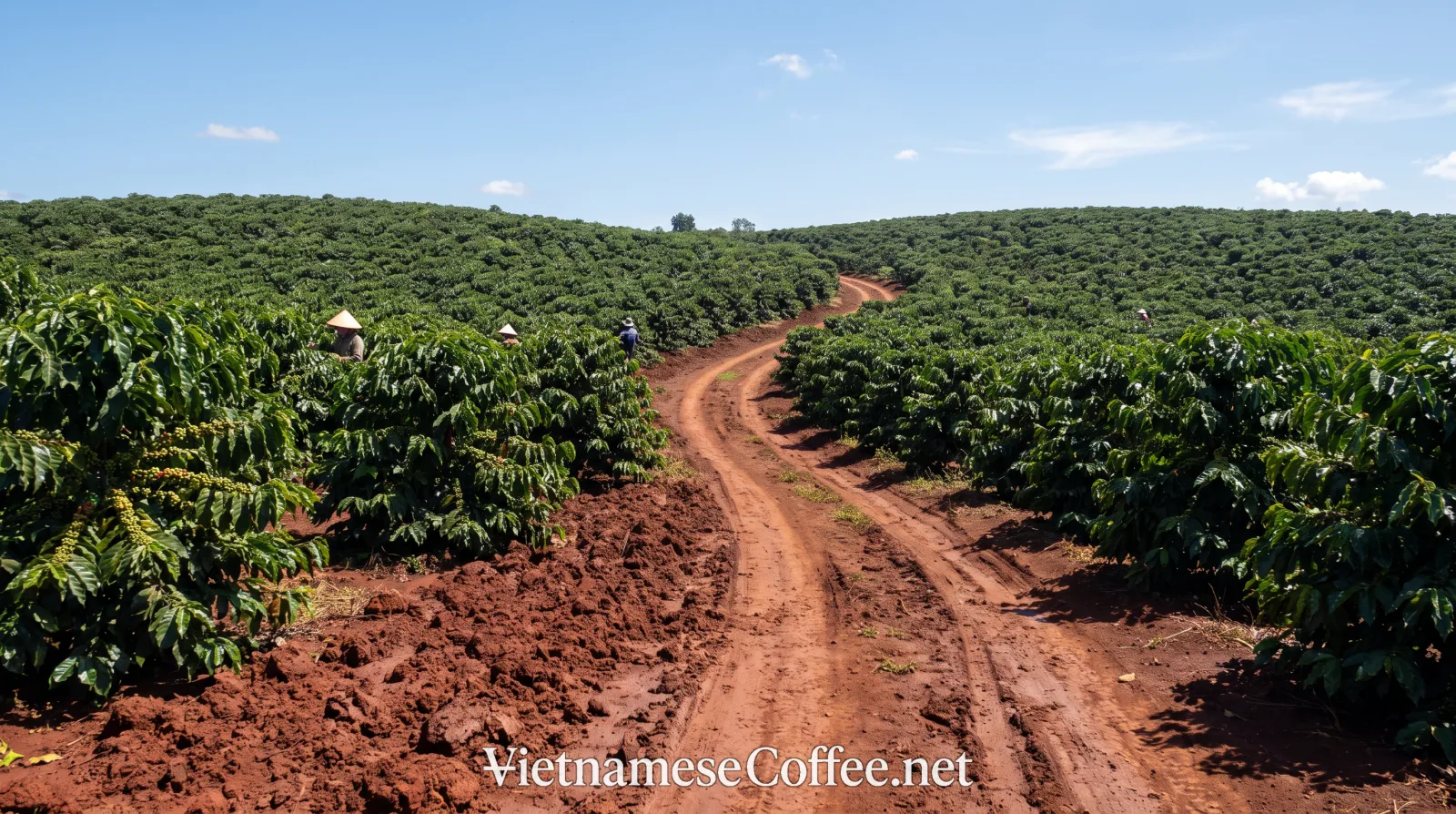
Đắk Nông is a historic administrative province and coffee-growing region in the southern portion of Vietnam's Central Highlands. The region is physically anchored to the M'Nong Plateau.
This geological formation shapes the local agricultural landscape by providing expansive, undulating terrain that supports large-scale robusta plantations.
The historic provincial territory shares boundaries with Đắk Lắk to the north, Lâm Đồng to the east, and Bình Phước to the south. It also shares an international border with Cambodia to the west.
The topography is characterized by rolling hills, valleys, and plateau terrain. The soil across these growing zones is predominantly basaltic red earth.
Coffee cultivation in this region focuses heavily on robusta. GreenTech sourcing profiles describe Vietnam as producing over 40 percent of the world's robusta coffee, with the Central Highlands as the core production zone.
Historic Đắk Nông sits directly within this robusta-dominated agricultural corridor. Key growing areas include Dak Mil, Dak Song, Tuy Duc, Krong No, Dak R'lap, and Gia Nghia.
For broader species context, see Robusta vs Arabica: Why Vietnam Grows Robusta.
Pre-merger scale and administrative integration
Before major administrative reforms, Đắk Nông operated as an independent province with its own statistical tracking. It represented one of Vietnam's largest coffee-producing provinces by planted area.
Data published by Báo Công Thương puts the historic Đắk Nông footprint at approximately 143,000 hectares of coffee. The actively harvested area accounts for roughly 131,000 hectares during the recorded crop cycle.
Vietnam Agriculture News reports that coffee cultivation accounts for more than 35 percent of the historic province's total agricultural land.
In 2025, the National Assembly approved an administrative consolidation that altered the region's boundaries. Đắk Nông, Binh Thuan, and Lâm Đồng were merged into a single enlarged administrative unit named Lâm Đồng.
Lao Động newspaper reports that the newly formed province covers a natural area of 24,233 square kilometers. The main administrative center for this new province is located in Đà Lạt City.
Đắk Nông brings its established robusta footprint and plateau geography into the new borders. Bình Thuận adds coastal and marine activity, while Lâm Đồng adds its legacy highland coffee zones.
This structural shift complicates commodity tracking. Đắk Nông's coffee statistics are now absorbed into expanded Lâm Đồng totals, but coffee can still be geographically identified as coming from the former Đắk Nông territory.
The 2024 drought and yield impact
In 2024, the historic province experienced a severe and prolonged drought during the flowering and fruit-setting months. Bao Cong Thuong reports that the lack of irrigation water directly affected crop development.
The average provincial yield dropped by approximately 151 kilograms per hectare compared with the previous crop cycle. The average yield for the 2024 crop settled at roughly 2.62 tonnes per hectare.
Total regional output for the 2024 crop year fell by about 16,000 tonnes. Final estimated output for the historic province was recorded at approximately 343,540 tonnes.
This calculation accounts for the reduced per-hectare yield and the number of hectares actively harvested during the 2024 agricultural cycle.
The 2024 drought data provides a clear snapshot of Đắk Nông's production capacity under difficult environmental conditions. It shows how dry spells during flowering can reduce harvest volume.
Certifications and cooperative value chains
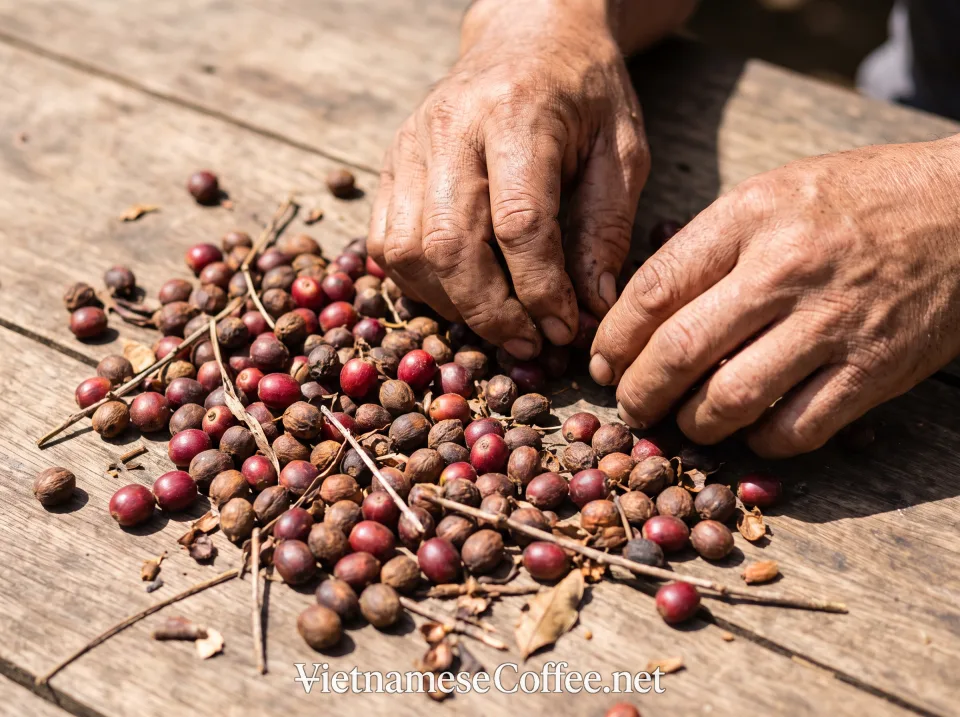
The historic Đắk Nông region contributes significantly to Vietnam's agricultural export economy. Vietnam Agriculture News reports average exports of approximately 165,000 tonnes of green coffee beans annually.
That raw export volume generates nearly 200 million US dollars in direct revenue per year. These export earnings are a major financial pillar for agricultural communities across the historic province.
The region has established sustainability certifications across a designated part of its coffee footprint. This shift aligns with international demand for traceable and sustainably grown coffee.
Vietnam Agriculture News reports approximately 32,954 hectares of coffee certified under international sustainability standards, including 4C, UTZ, Rainforest Alliance, and Fairtrade.
This certified area produces approximately 91,375 tonnes of verified sustainable coffee annually. The historic province also features 25 production-consumption linkage models covering 13,300 hectares.
These cooperative structures help organize production across a region defined by many independent family farms. They provide a practical mechanism for coordinating certified farming practices and output.
EUDR compliance and the pepper GI
Đắk Nông is addressing the requirements of the European Union Deforestation Regulation. The EUDR requires exporters to prove that agricultural products do not originate from recently deforested land.
Vietnam Agriculture News reports that local agricultural departments are implementing initiatives to prove that local coffee products do not cause deforestation.
These compliance efforts involve reviewing agricultural data and mapping cultivation zones to satisfy European traceability requirements. The work aims to keep the European market open to the region's robusta output.
While Đắk Nông standardizes coffee output, the historic province also holds formal intellectual property protection for pepper. According to the Intellectual Property Office of Vietnam, Đắk Nông pepper holds Geographical Indication Certificate No. 00111.
Black pepper is another major industrial crop on the M'Nong Plateau. It is often cultivated in the same agricultural districts that support robusta farming.
The pepper GI highlights the region's participation in agricultural branding programs. It also reflects the wider suitability of the M'Nong Plateau for tropical industrial cash crops.