
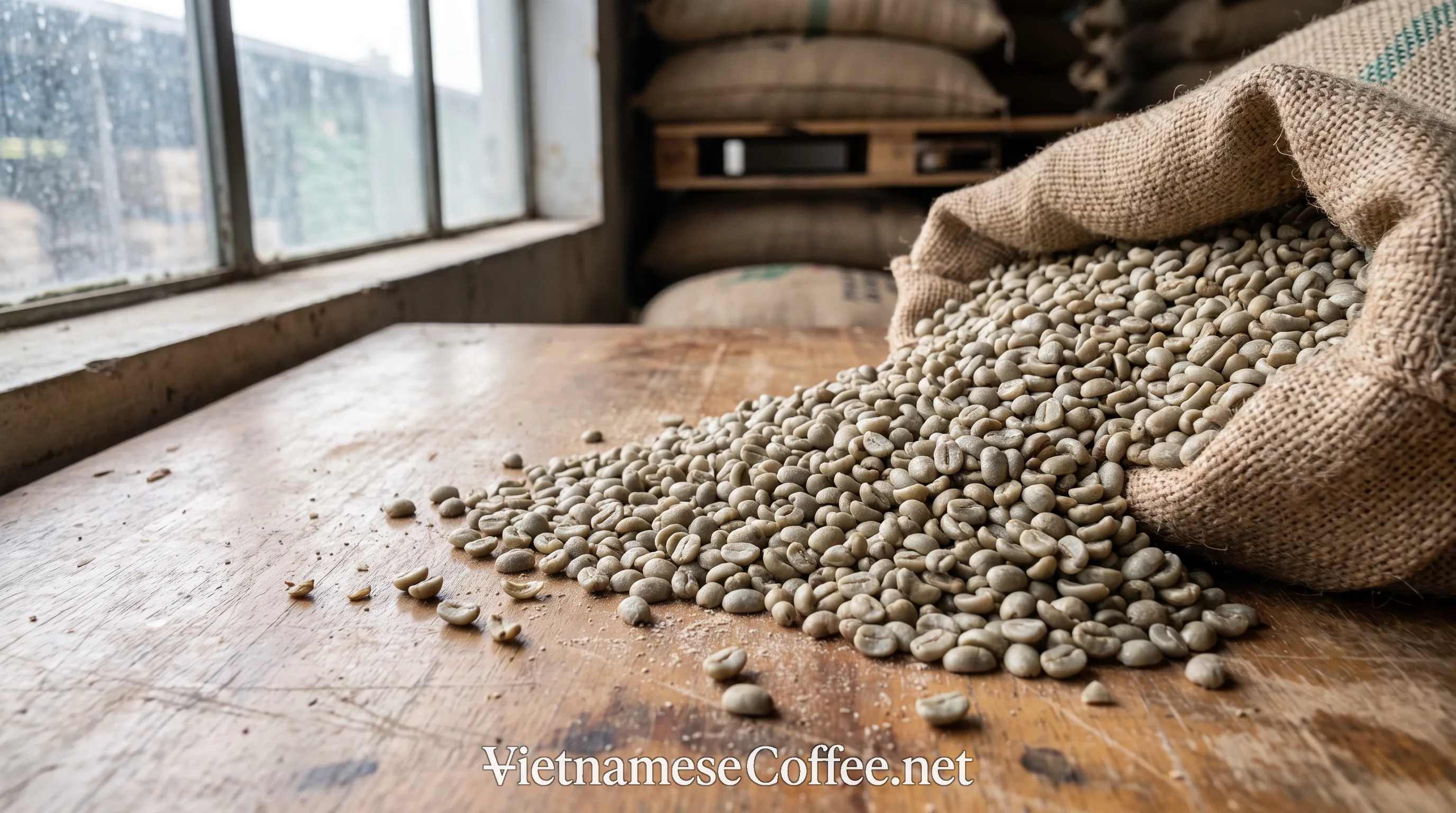
Green coffee bean at a glance
| Definition | Raw, unroasted coffee seed after hulling |
|---|---|
| Appearance | Pale green to grayish-green, dense and hard |
| Key chemical marker | High chlorogenic acid content, reduced by roasting |
| Vietnam grading standard | TCVN 4193:2014, the active version, replacing TCVN 4193:2005 |
| Vietnam grade structure | Grades 1 to 3, with screen-size and quality subclasses |
| Export moisture limit | Maximum 12.5 percent under TCVN 4193:2014 |
| Defect measurement | Allowable defective-bean mass percentage per roughly 300-gram sample |
What makes a bean green
A green coffee bean is simply a coffee seed that has been separated from the fruit and dried, but has not yet been roasted. According to the FAO's coffee quality manual, green coffee is the traded, internationally standardized form of coffee before any heat processing occurs. It is what farmers sell to exporters, what exporters ship in bulk to importing countries, and what roasters buy before turning it into the familiar brown roasted bean.
Visually, green coffee looks nothing like the coffee most drinkers recognize. Depending on the variety and processing method, unroasted beans range from pale green to grayish-green or even yellowish, with a hard, dense, slightly waxy surface. They carry a mild, grassy, almost vegetal smell rather than the rich, toasted aroma associated with roasted coffee. This is because the compounds responsible for coffee's familiar aroma and dark color only form during roasting itself.
Green coffee also differs chemically from roasted coffee in a way that matters beyond appearance. It retains significantly higher levels of chlorogenic acids, a family of natural plant compounds that break down substantially during roasting. This chemical distinction is central to how green coffee is defined internationally. It is also the basis for green coffee's separate, smaller commercial life as a dietary supplement, discussed later on this page.
From cherry to green bean: the journey before roasting
Green coffee does not begin as a bean at all. It begins as the seed inside a ripe coffee cherry. After harvest, producers use one of several processing methods, washed, natural, or honey processing, to remove the fruit's skin, pulp, and mucilage, leaving behind the parchment-covered seed. Once dried to a target moisture level, the parchment layer is mechanically removed in a step called hulling, revealing the raw green bean underneath.
Because green coffee is a stable commodity when properly dried, it can be stored and shipped internationally for months before roasting. This is precisely why it functions as the international unit of trade for coffee. Unlike roasted coffee, which loses freshness and flavor within weeks, correctly dried and stored green coffee can retain its quality far longer. This gives importers and roasters flexibility in timing their roasting schedules.
Moisture control is why this stability is possible, and it is regulated internationally as well as nationally. According to the FAO's coffee quality manual, internationally traded green coffee is typically expected to fall within a moisture range of roughly 8 to 12.5 percent. Commonly referenced ICO-aligned frameworks also set defect limits, such as 86 defects per 300 grams for Arabica and 150 defects per 300 grams for Robusta.
Grading green coffee: Vietnam's current TCVN 4193:2014 standard
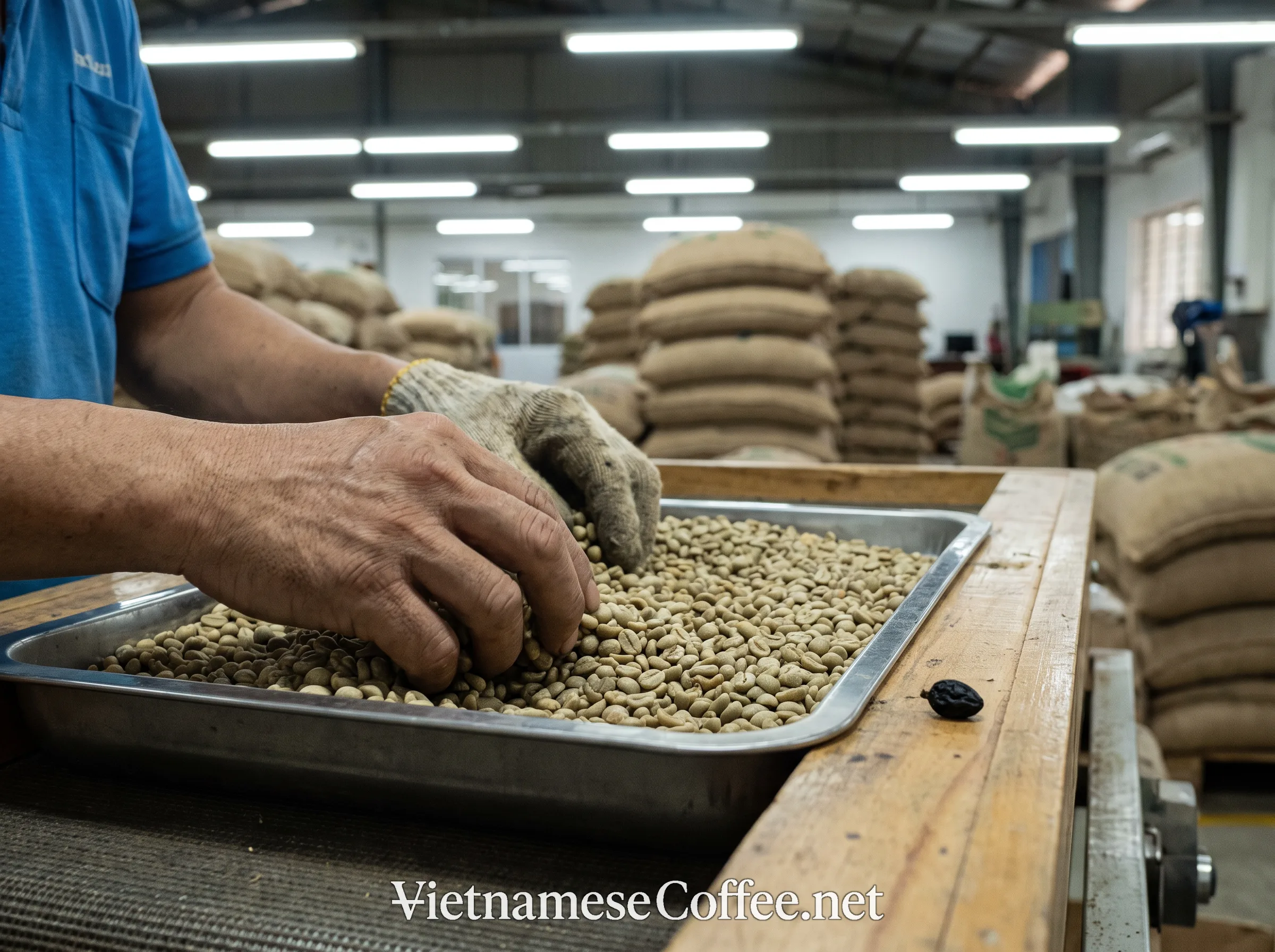
Vietnam grades its green coffee under a national standard called TCVN 4193. It is important to note that this standard has been revised over time, and the version currently in force is TCVN 4193:2014. According to Vietnam's official National Standards and Quality Institute database, the earlier TCVN 4193:2005 version is explicitly marked as withdrawn. TCVN 4193:2014 is listed as active and currently in force.
Under the current 2014 standard, green coffee covering both Arabica and Robusta is classified into three main grades, Grade 1 through Grade 3. This is according to a summary of the standard's technical requirements published by Lawnet. Within these grades, coffee is further divided into detailed screen-size and quality subclasses, such as R1 18a or A1 16b. These subclasses are based on bean size and permitted defect levels, rather than the older Special-to-5 numbering.
TCVN 4193:2014 does not use a simple weighted-points defect count. Instead, it measures quality primarily as an allowable percentage of defective bean mass and foreign matter within an approximately 300-gram test portion, according to Lawnet's technical summary. GreenTech Export's grade comparison guide illustrates how this plays out commercially. A G1 Screen 18 color-sorted lot permits a far smaller defect and foreign-matter allowance than a lower G2 FAQ lot.
Moisture is specified precisely under the current standard. According to Lawnet's summary of TCVN 4193:2014, green coffee moisture must not exceed 12.5 percent. Separately from what the standard itself specifies, coffee quality commentary from Halio Coffee explains the practical food-safety reasoning behind moisture limits generally. Above roughly 13 percent moisture, water activity can rise enough to support mold growth linked to ochratoxin A, a regulated mycotoxin.
A note on green coffee extract
Beyond its role as roasting material, green coffee also has a smaller, separate commercial identity. It appears as an ingredient in dietary supplements, usually labeled green coffee bean extract or green coffee extract. These products are marketed based on the bean's chlorogenic acid content, since much of this compound is broken down during roasting and is therefore more concentrated in unroasted beans.
Clinical research on green coffee extract for weight management exists, but findings are mixed and the evidence base remains limited. One meta-analysis focused specifically on chlorogenic acid dosage. It found that supplementation containing at least 500 milligrams of chlorogenic acid per day, not simply 500 mg of supplement, was linked to results. Average body weight reduction was roughly 1.3 kilograms. The review explicitly cautioned that the number of qualifying studies was small and study durations were short.
This is a health-adjacent claim resting on limited evidence. It should not be read as an established or guaranteed effect, and readers considering such supplements should consult current, independent clinical guidance rather than commercial marketing claims. This supplement use is a minor, secondary application. Green coffee's primary identity as the internationally traded raw material for roasted coffee remains the focus of this glossary entry.