
Fine Robusta at a glance
| Formal name | Fine Robusta Standards and Protocols |
|---|---|
| Originated by | Coffee Quality Institute, with the Uganda Coffee Development Authority |
| Standard history | Development began around 2009-2010; consolidated into a comprehensive edition in 2019 |
| Current credential administration | Q Grader credentials administered by the SCA since October 1, 2025 |
| Minimum cupping score | 80 out of 100 on the Q Robusta cupping scale |
| Defect limit | Zero Category 1 defects; up to five Category 2 defects per 350-gram sample |
| Key Vietnamese regions | Lâm Đồng, Đắk Lắk, Gia Lai |
| Flavor descriptors | Dark chocolate, cacao, roasted nuts, caramel, citrus brightness |
A formal quality standard, not a marketing term
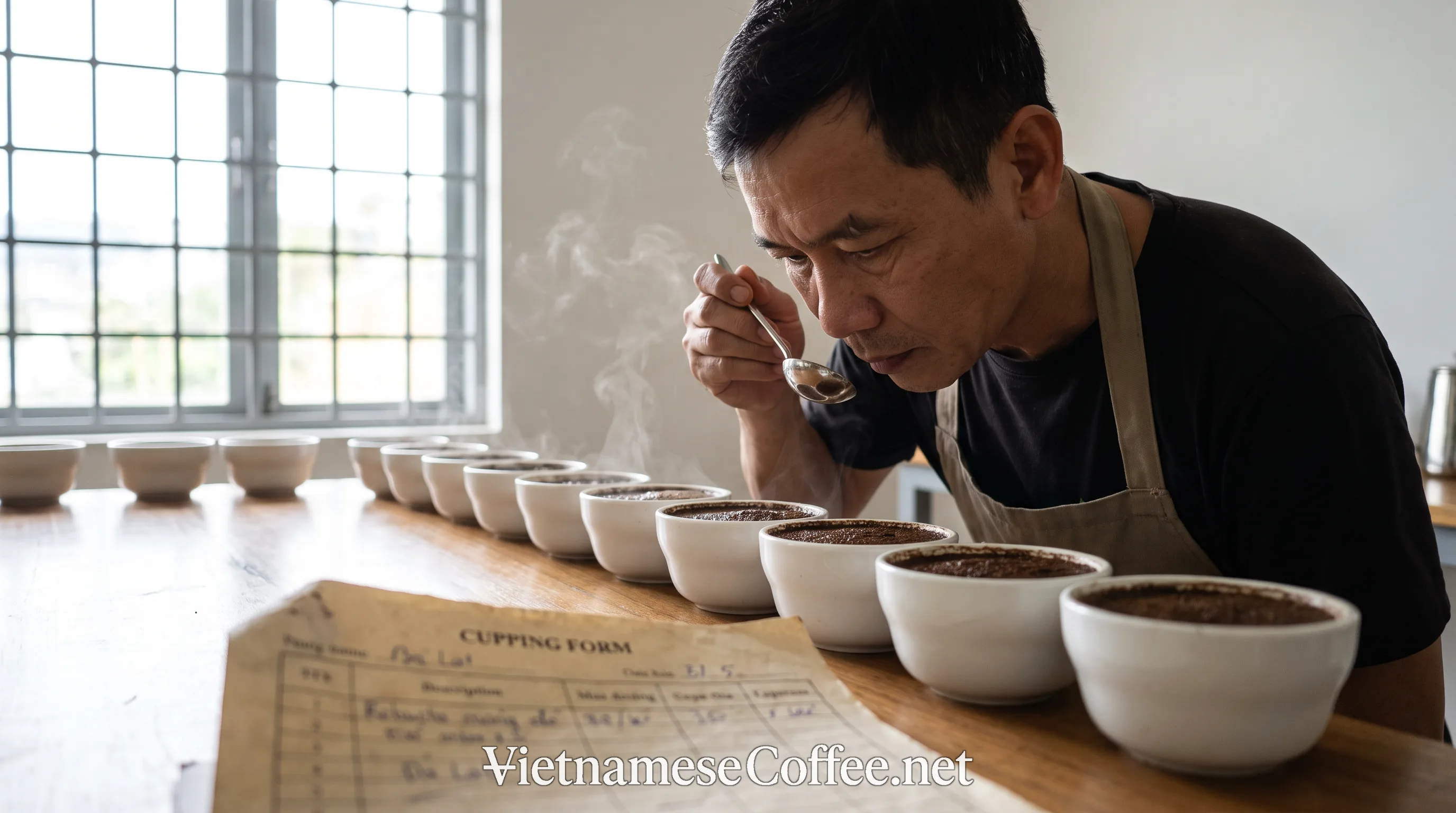
Fine Robusta is not a brand name or an informal way of saying "good robusta." It refers to a specific, published cupping and grading protocol originated by the Coffee Quality Institute (CQI) together with the Uganda Coffee Development Authority (UCDA).
According to Origin Cafe KH's overview of CQI's ecosystem, work on this Q Robusta system began around 2009 to 2010. It was consolidated into a comprehensive edition of the Fine Robusta Standards and Protocols in 2019, rather than being created from scratch that year.
The system works similarly to the SCA's specialty arabica scale, but with sensory criteria adapted to robusta's distinct chemistry. According to Ritachi's technical guide, Q Robusta cupping evaluates green and roasted samples on a 100-point scale.
Robusta lacks the bright acidity central to arabica evaluation. Graders instead assess a salt/acid aspect ratio and a bitter/sweet aspect ratio, reflecting the flavor compounds that actually define robusta's sensory profile. Q Grader credential administration transferred from CQI to the Specialty Coffee Association effective October 1, 2025.
Why robusta needed its own specialty standard
For decades, robusta was treated almost exclusively as a bulk commodity crop. It was valued mainly for its high yield, disease resistance, and low production cost rather than for cup quality. According to Halio Coffee's 2026 analysis, Vietnam and commodity robusta were effectively synonymous in global coffee trade.
That reputation began shifting as some producers, particularly in Uganda and Vietnam, demonstrated a key point. Robusta grown, harvested, and processed with the same care applied to specialty arabica could produce a genuinely complex, high-scoring cup.
Barista Magazine's interview with Vietnamese coffee figure Vu Dinh Tu captures this shift directly. He describes realizing that properly cultivated and processed robusta can be as complex as arabica.
The Fine Robusta protocol gave this emerging quality tier an objective, internationally recognized benchmark. Rather than relying on subjective claims of specialty or premium, a coffee either meets the documented cupping score and defect thresholds or it does not.
How Fine Robusta is commonly produced
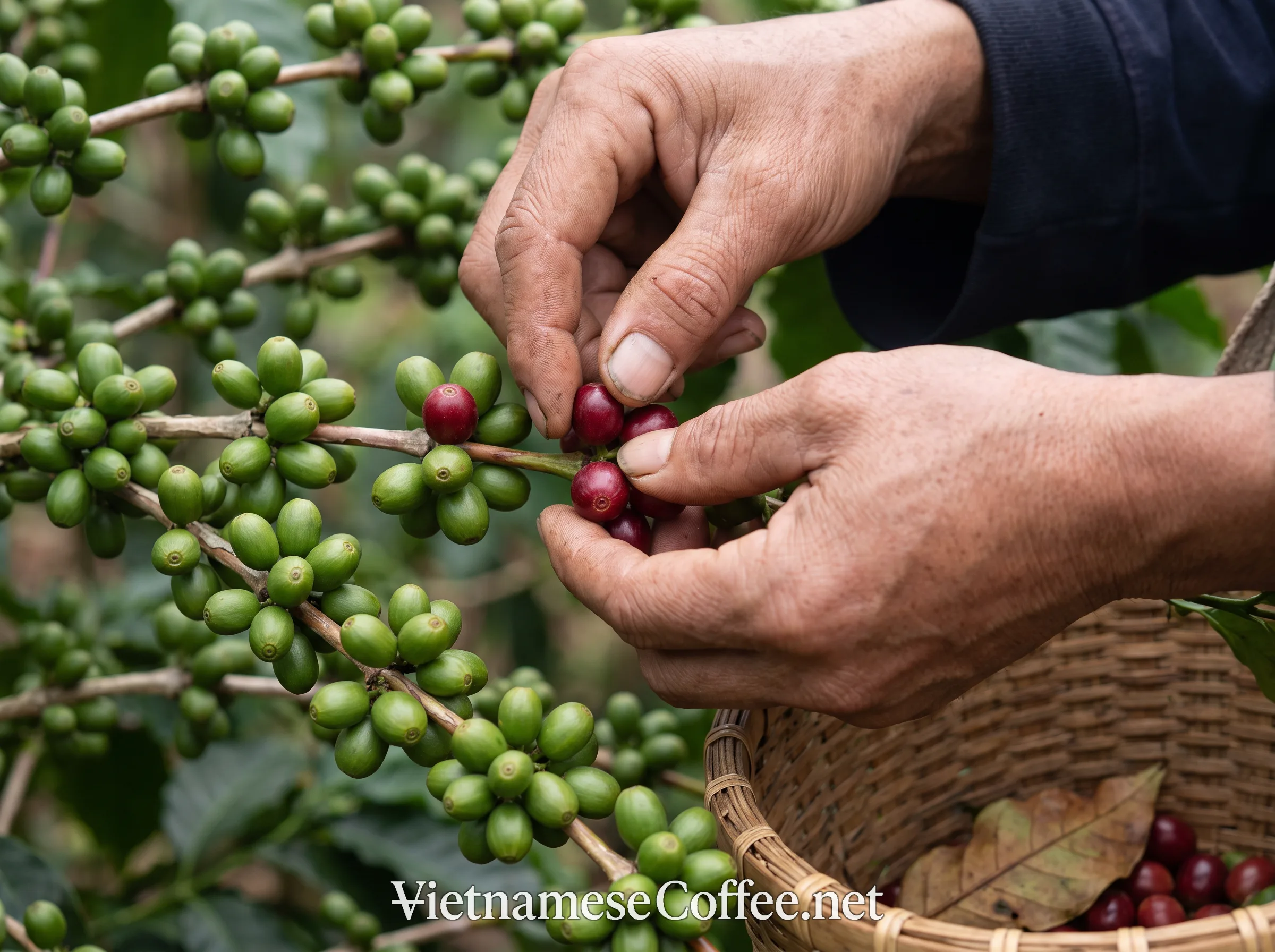
Meeting the Fine Robusta threshold requires deliberate changes at the farm and processing level, though the formal cupping and defect requirements are separate from the production practices commonly used to reach them. According to Caphin's overview, producers commonly hand-pick only the ripest cherries.
This contrasts with strip-harvesting common in commodity robusta production, where branches are stripped of ripe and unripe fruit at once. Processing precision matters just as much as harvest selection.
PRNewswire's coverage of Vietnamese Fine Robusta describes selective harvesting, controlled fermentation, and improved processing methods as common practices behind a more refined, expressive cup. Gaia Cafe Vietnam similarly frames Fine Robusta as a once-overlooked bean gaining recognition.
Some Vietnamese suppliers pursue additional processing techniques and export specifications alongside, but separate from, Fine Robusta cupping certification. Halio Coffee describes Wet Polished Robusta and Grade 1 export specifications as separate Vietnamese processing and export practices, not part of the protocol itself.
Flavor profile and how it differs from commodity robusta
Well-produced Fine Robusta departs noticeably from the harsh, one-dimensional bitterness often associated with cheap robusta. According to PRNewswire's reporting, Vietnamese Fine Robusta is characterized by a dense body and natural sweetness.
It offers flavor notes of dark chocolate, cacao, roasted nuts, and caramel, complemented by citrus brightness such as grapefruit or orange peel. This combination of intensity and clarity is presented as a direct contrast to traditional perceptions of robusta as simply strong and bitter.
Caphin's comparison reinforces this distinction. Standard commodity robusta is generally rougher and more aggressively bitter. Fine Robusta, by contrast, shows smoothness, increased sweetness, and significantly less harsh bitterness.
Fine Robusta is defined by a cupping score rather than a fixed recipe of flavor notes, so individual lots can vary. The common thread is a fuller, cleaner, sweeter profile verified through structured cupping rather than marketing language alone.
Fine Robusta in Vietnam
Vietnam, the world's largest robusta producer, has become one of the most closely watched countries in the global push toward Fine Robusta. According to Hello5 Coffee's regional roundup, several provinces have begun producing coffee that meets or exceeds the Fine Robusta threshold.
Cầu Đất in Lâm Đồng province has applied organic farming, selective harvesting, and wet processing aligned with Fine Robusta standards. Hello5 Coffee reports that Fine Robusta from Lâm Đồng has achieved scores above 83 points on the cupping scale.
Gia Lai province, including areas such as Ia Grai, Chư Prông, and Pleiku, has produced Fine Robusta scoring above 82 points according to the same evaluation framework. Buôn Ma Thuột in Đắk Lắk, Vietnam's historic robusta heartland, also appears among the regions actively pursuing this designation.
Dedicated Vietnamese producers have emerged specifically to pursue this category. Fine Robusta Vietnam (FiRo) is a Vietnamese producer focused on Fine Robusta, describing its approach as ecological and organic and built around certification.