
Filter material: the biggest single difference
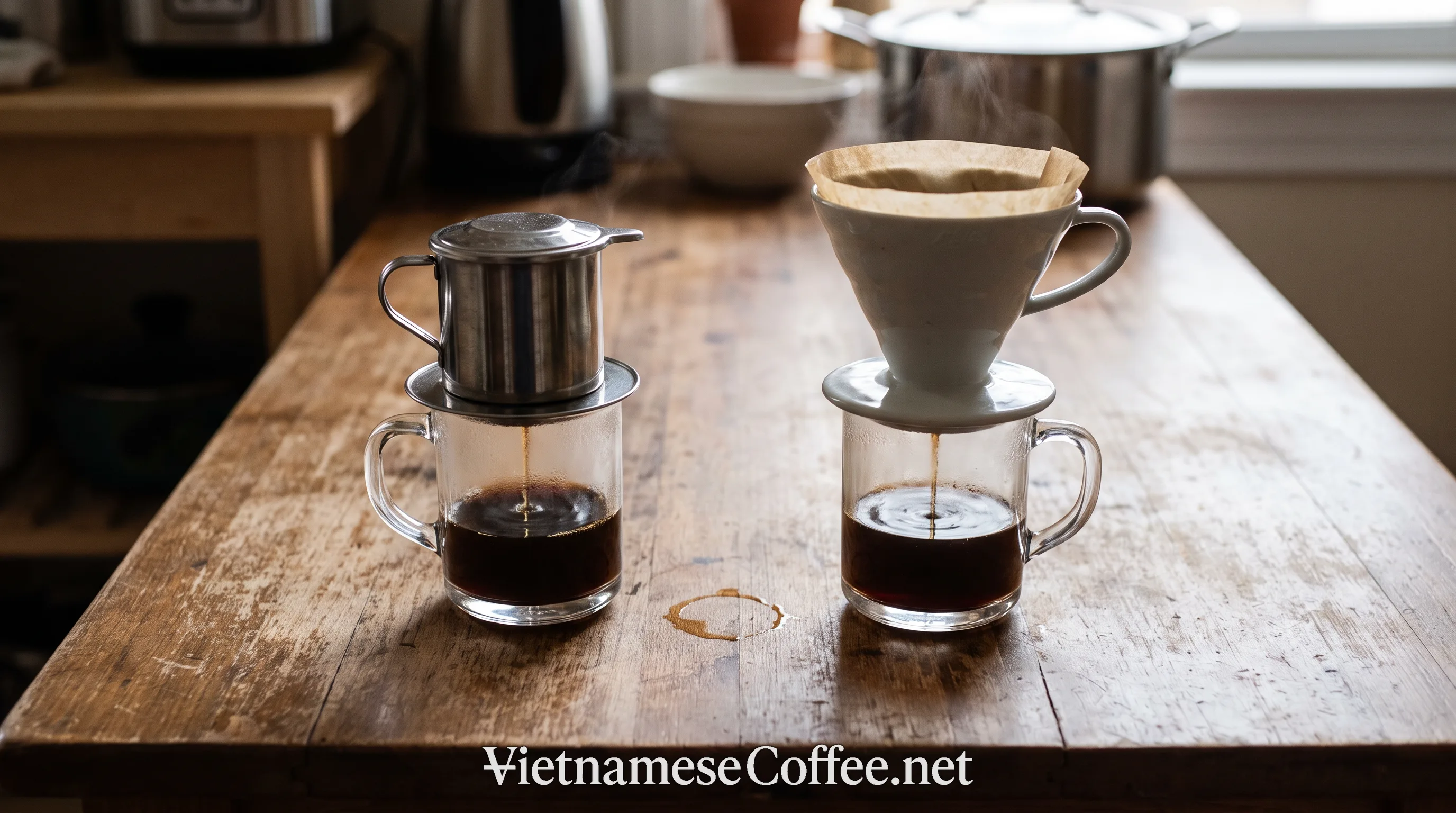
The most consistently cited difference between these two methods is filter material, not brewing mechanics. The phin's reusable stainless steel mesh lets fine particles and natural oils through, while the V60's paper filter catches much more of both.
This filtration difference affects body and texture, not concentration by itself. Metal filtration is documented here as a driver of body, oils, and sediment; the phin's stronger cup comes mainly from its tighter coffee-to-water ratio.
Grind size
Grind recommendations are not settled for either method. One tested phin recipe uses a coarse to medium-coarse grind, while another source describes medium-fine grind as appropriate for some phin recipes. Pour-over grind is similarly inconsistent, ranging from medium-fine to medium-coarse across sources.
Treat published grind descriptions as starting points. For both the phin and V60, the best grind depends on the specific brewer, dose, filter, and target flow rate, rather than one universal setting.
Brewing technique and time
The methods differ in how actively you manage the brew. Phin brewing usually involves adding water once and letting gravity do the work. Pour-over is more active: bloom first, then pour in controlled stages to encourage even extraction.
Brew time comparisons favor pour-over as the faster method across the sources reviewed here. V60 methods commonly land around 2:30 to 4 minutes, while a full phin drip is often described as taking 5 minutes or more.
Ratio and strength
Published ratios vary, but the direction of the gap is clear. V60 pour-over ratios commonly sit around 1:15 to 1:17, while phin ratios documented across this site's brewing comparisons range roughly from 1:5 to 1:12.
That means a phin reliably produces a stronger, more concentrated cup than a typical V60 pour-over, primarily because of its tighter coffee-to-water ratio. The heavier body and oil content come from the metal filter, which is a separate effect.
Body and clarity
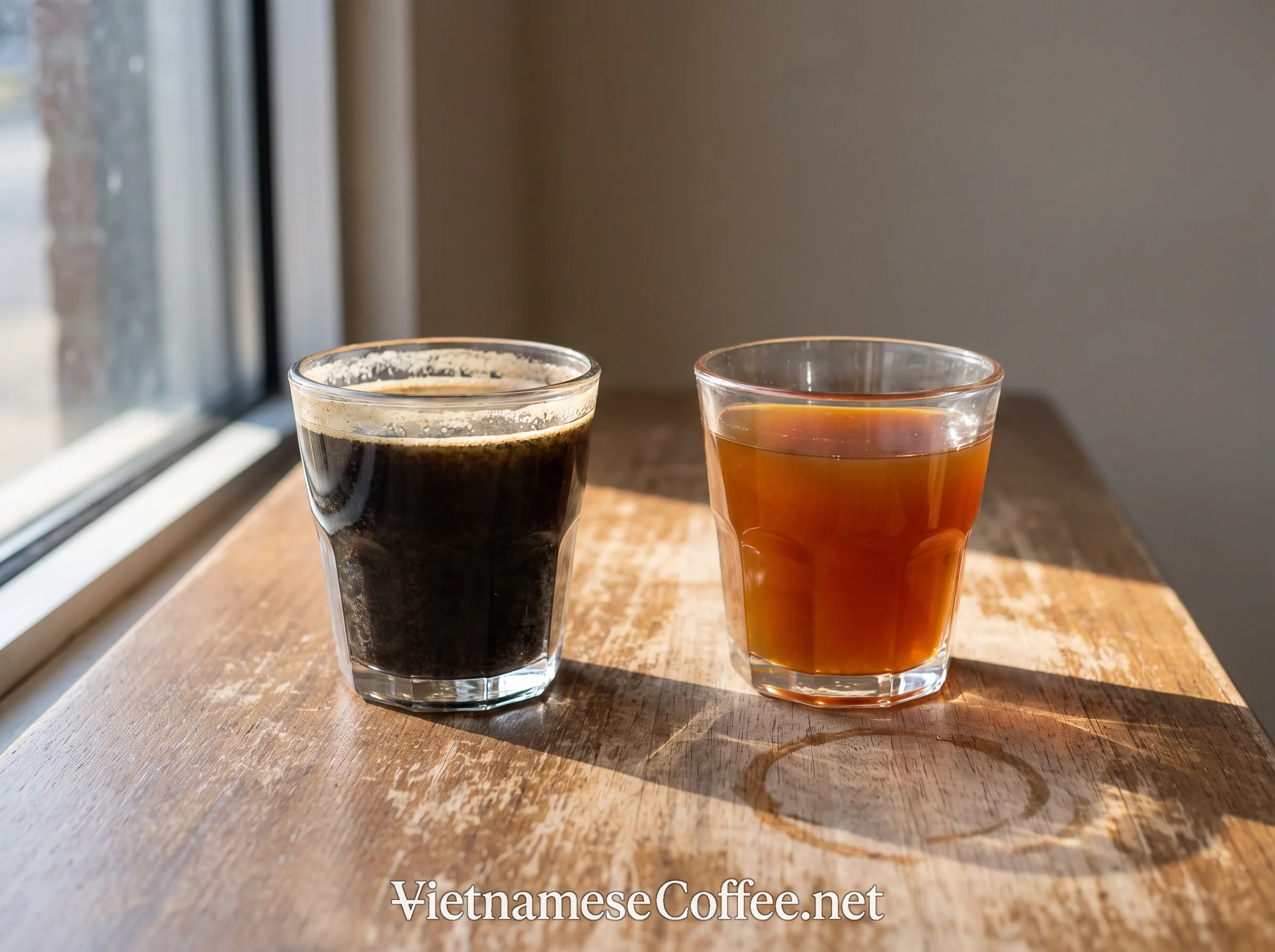
Body and clarity are where the two methods diverge most dramatically. Sources describe the phin as heavy, syrupy, and oily, against the V60's lighter, cleaner, more tea-like profile.
Both brewers can be used with many beans and roasts. The useful distinction is one of common usage: V60 pour-over is commonly chosen when clarity is the priority, while phin brewing is associated with fuller-bodied, concentrated coffee for Vietnamese condensed-milk drinks.
Phin vs pour over (V60) at a glance
| Factor | Phin | Pour Over (V60) |
|---|---|---|
| Filter material | Reusable stainless steel mesh | Paper, typically V60 size 02 |
| Typical grind | Disputed: coarse to medium-fine depending on source, phin, and dose | Disputed: medium-fine to medium-coarse depending on source |
| Pouring technique | Single pour, unmanaged drip | Staged bloom plus controlled pours |
| Brew time | Roughly 5-10 minutes | Roughly 2:30-4 minutes, consistently faster across sources |
| Typical ratio | Roughly 1:5 to 1:12 | Roughly 1:15 to 1:17 |
| Resulting body | Heavy, syrupy, oily | Light, clean, tea-like |
Which one should you choose?
Choose a phin if your goal is a strong, concentrated coffee to pair with sweetened condensed milk, whether for cà phê sữa đá or cà phê đen, and you do not mind a slower, hands-off brew with more sediment and oil in the cup.
Choose a V60 pour-over if you want a faster, cleaner cup and clarity is your priority. Pour-over is less commonly used as a base for Vietnamese-style condensed-milk drinks, since its lighter result does not pair with condensed milk in the same way phin coffee typically does.