
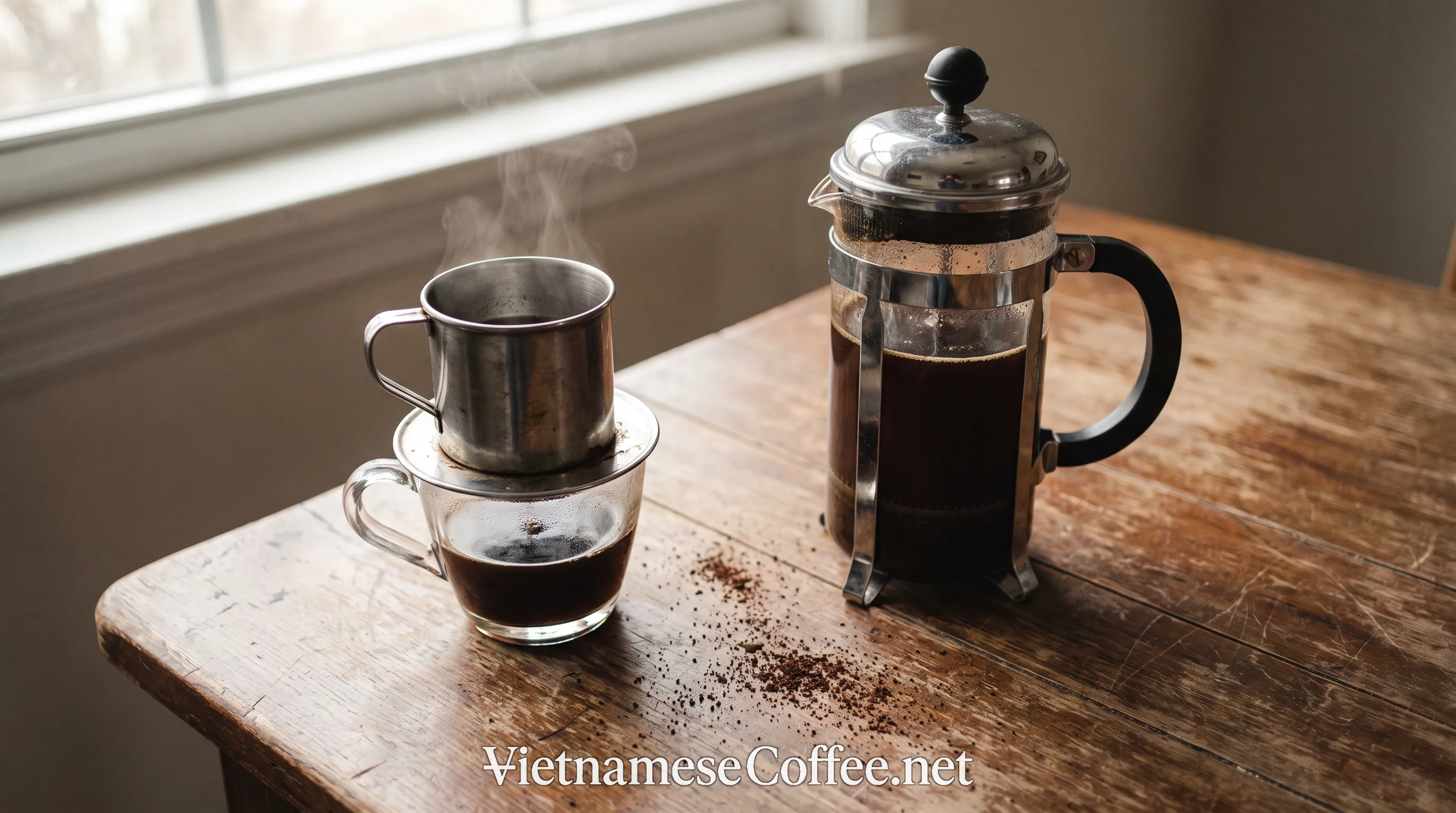
Extraction method: drip, immersion, or both
The two methods work differently, though sources disagree on exactly how to categorize the phin. Some describe the phin as gravity-based drip extraction, contrasted directly with the French press's full immersion, where grounds steep in water for several minutes before being separated by a plunger.
Other sources characterize the phin as a hybrid mechanism, sitting between pure pour-over drip and full immersion, since water sits in contact with the grounds before dripping through. French press, by contrast, is consistently described as full immersion across the sources reviewed.
Grind size and extraction method
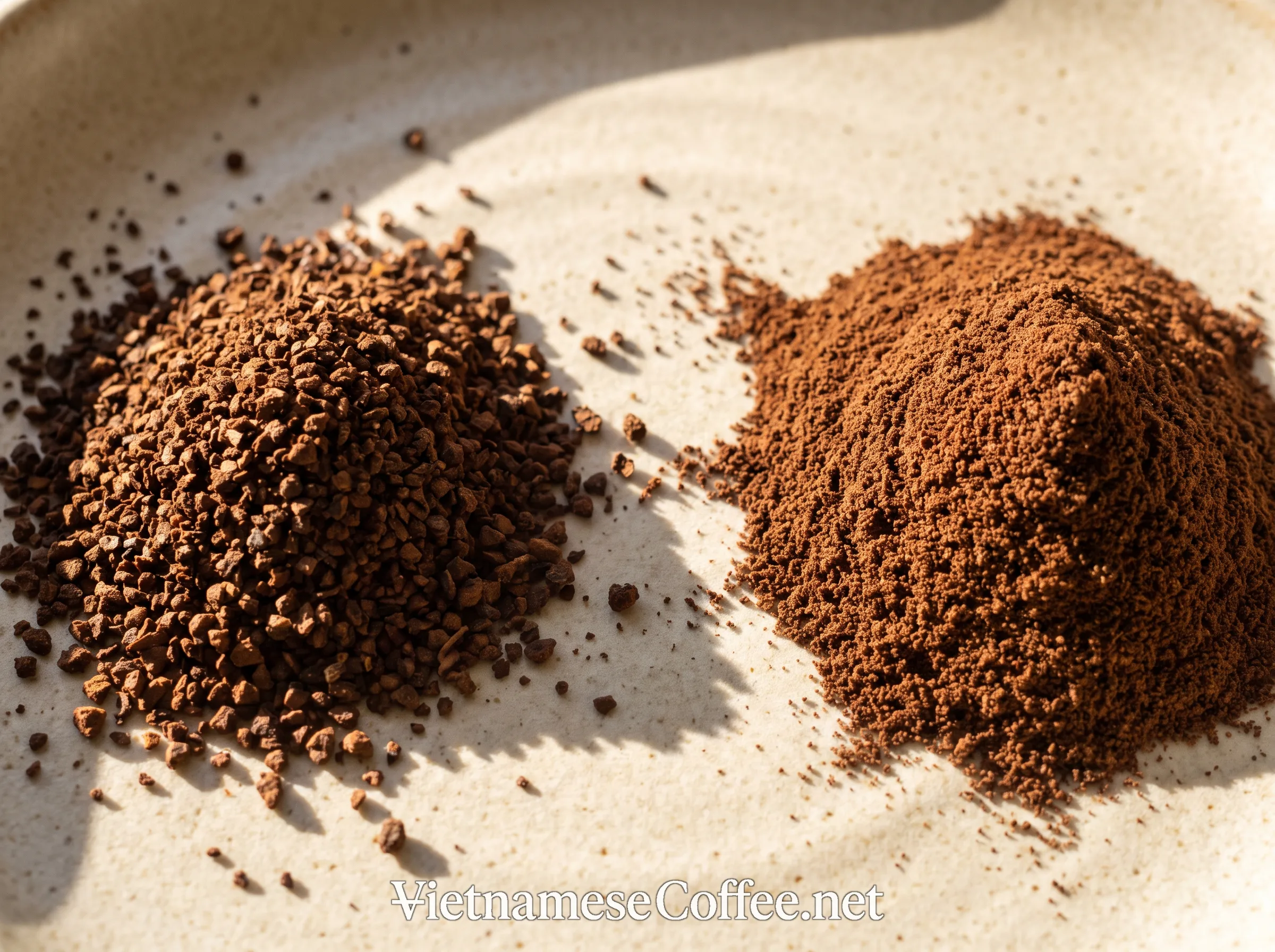
Grind size recommendations vary across sources for both methods. Some describe phin grind as medium to medium-fine, contrasted with a coarser French press grind. Others describe phin grind as coarse or medium-coarse, closer to French press than to a fine drip grind.
Start with a medium-coarse grind resembling coarse sea salt and adjust based on how quickly water drips through your phin. If the coffee drips too fast and tastes thin, the cause could be too coarse a grind, too loosely seated a press disc, or both. If the drip stalls or tastes bitter, try a slightly coarser grind or a looser press seating.
Brew time and batch size
Brew time comparisons are inconsistent across sources. Several describe the phin as taking roughly 4 to 8 minutes to fully drip, generally similar to or slightly longer than a typical 4-minute French press steep. At least one source states the opposite, with a shorter phin brew and a longer French press brew.
Batch size differences are more consistent. The phin is described as a single-serving brewer, while French press is designed for larger batches and is available in a wider range of sizes. If you regularly brew for more than one or two people, French press has a clear practical advantage.
Strength, body, and ratio
Both methods produce a fuller-bodied cup than paper-filtered drip coffee because metal filters allow oils and fine coffee particles into the final brew. Beyond that shared point, strength depends heavily on ratio.
Published phin ratios vary substantially, from roughly 1:5 to 1:12 across the cited sources. French press ratios are somewhat more consistent, generally around 1:12 to 1:17. The practical takeaway is that phin coffee can be brewed considerably stronger than a typical French press serving, but the exact gap depends on the specific recipe.
Cost, equipment, and practical use
Phin filters are generally simpler, cheaper, and more compact than French presses. They also brew directly into the serving glass, which fits Vietnamese coffee traditions where coffee often drips over sweetened condensed milk.
French press requires brewing separately, then pouring the finished coffee over condensed milk or ice afterward. That extra transfer does not ruin the drink, but it changes the process and makes the brewer better suited to larger batches than single Vietnamese-style servings.
Phin vs French press at a glance
| Factor | Phin | French Press |
|---|---|---|
| Extraction method | Gravity drip, though some sources describe it as a drip/immersion hybrid | Full immersion, confirmed consistently across sources |
| Typical grind | Disputed: medium-fine to coarse depending on source | Generally coarser, though at least one source treats the ranges as overlapping |
| Brew time | Disputed: roughly 2-8 minutes depending on source | Roughly 4-5 minutes across most sources |
| Typical batch size | Single serving, about 60-180ml | Multiple servings, about 355ml to 1L+ depending on press size |
| Published ratio range | Roughly 1:5 to 1:12 depending on source | Roughly 1:12 to 1:17 depending on source |
| Typical cost | Generally lower | Wider range, generally higher at larger sizes |
Which one should you choose?
Choose a phin if you usually brew for yourself, want a small, concentrated single serving, and plan to pair the coffee with condensed milk for a Vietnamese-style drink. Its compact size, low cost, and direct-to-cup brewing make it well suited to that use case.
Choose a French press if you regularly brew for multiple people, want more control over steep time and strength through a familiar immersion method, or already own one and do not want to buy additional equipment. Neither brewer produces a categorically better cup; they suit different serving sizes and slightly different body profiles.