
| Area | Historic Quảng Trị coffee territory, now within the enlarged Quảng Trị Province |
|---|---|
| Primary variety | Arabica, mainly Catimor |
| Recorded coffee area | Approx. 3,900 hectares at the end of 2022 |
| Coffee area target | At least 5,000 hectares under the pre-merger provincial plan |
| Annual output | Nearly 4,500 tonnes of green coffee at the end of 2022 |
| Average yield | 1.15 tonnes of green coffee per hectare |
| Geographical indication status | Khe Sanh GI, Certificate No. 00148, Decision No. 699/QD-SHTT |
| Registered GI scope | Green coffee beans, roasted coffee beans, and coffee powder |
| Registered GI elevation | 450 to 680 meters above sea level |
| Key growing area | Khe Sanh and Huong Phung in the former Huong Hoa district |
| Harvest season | Ripening and harvesting begin in November |
Geography and the Khe Sanh microclimate
The coffee-growing territory associated with Quảng Trị lies in the western uplands of the province's pre-merger boundaries. In 2025, Quang Binh and Quảng Trị were combined into an enlarged province retaining the Quảng Trị name.
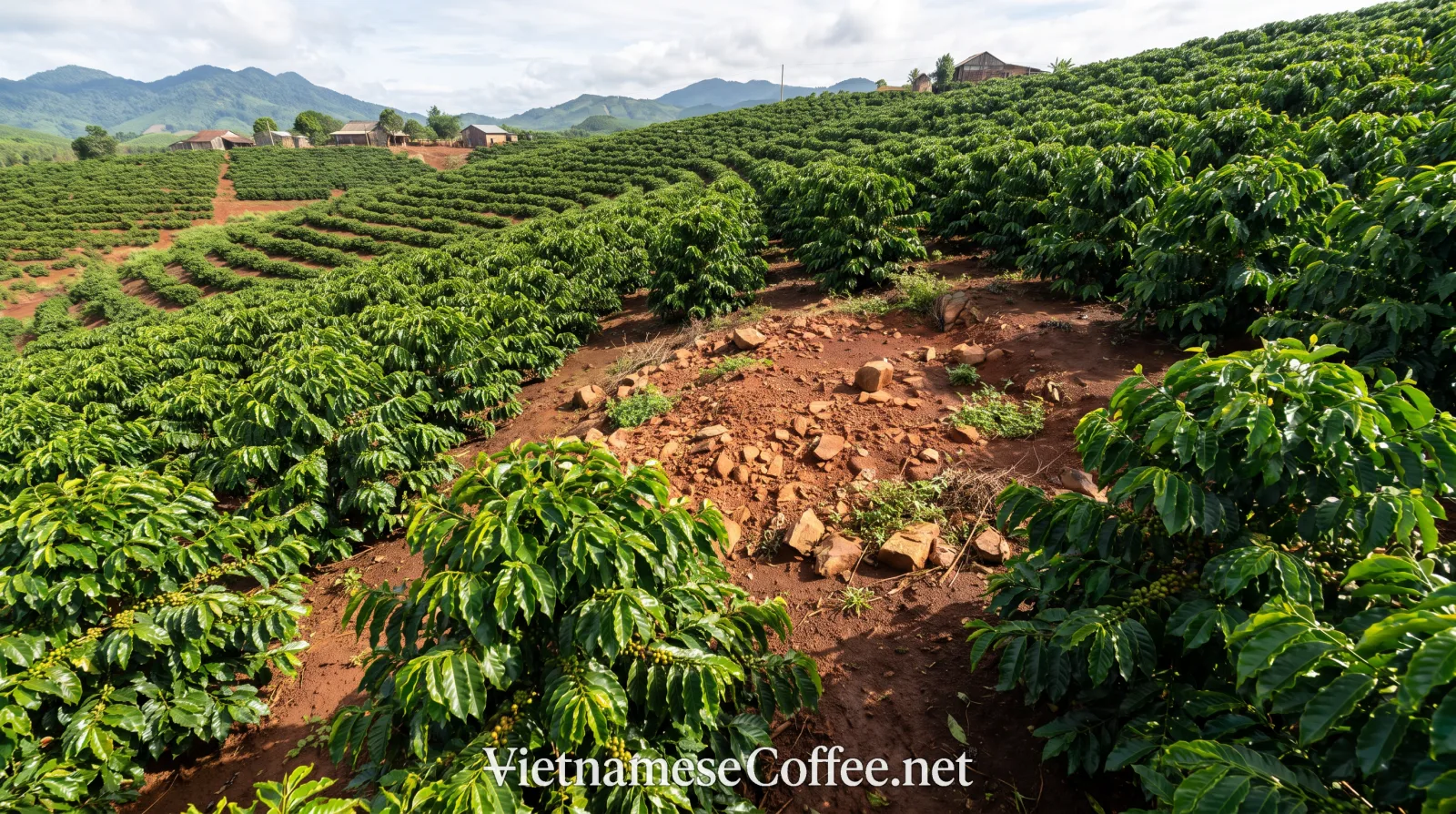
The Khe Sanh and Huong Phung coffee areas remain geographically distinct within the western highland portion of the enlarged province. Coffee cultivation is concentrated in specific upland areas rather than broad plateau systems.
Khe Sanh, historically part of Huong Hoa district near Vietnam's western border, is the best-known local origin. Its hills, valleys, and surrounding forested land create a defined coffee-growing landscape.
The official geographical indication describes the protected Khe Sanh area as lying between 450 and 680 meters above sea level. VietnamPlus describes the main growing area as approximately 500 to 680 meters.
Khe Sanh supports commercial arabica because elevation interacts with local temperature, terrain, rainfall, and soil. VietnamPlus identifies a cool climate and basaltic red soil as central features of the origin.
The region is primarily associated with Catimor, an arabica hybrid widely planted in Vietnam. Its cultivation remains concentrated around Khe Sanh, Huong Phung, and nearby communities.
For a broader species and elevation comparison, see Robusta vs Arabica: Why Vietnam Grows Robusta.
Scale, output, and administrative context
Quảng Trị is a small arabica origin compared with Vietnam's large robusta-producing territories. The coffee statistics commonly used for the region were recorded before the 2025 merger with Quang Binh.
Vietnam Agriculture News reported that the former province had approximately 3,900 hectares of coffee at the end of 2022. Most of this area was located in the former Huong Hoa district.
The same report recorded an average green-coffee yield of 11.5 quintals, or 1.15 tonnes, per hectare. Total green-coffee output was nearly 4,500 tonnes.
These figures provide a dated production benchmark rather than a permanent current-output number. Planted area, productive area, weather, tree age, and farm management can all change.
The former provincial plan aimed to maintain and stabilize at least 5,000 hectares of coffee. That target is separate from the 3,900 hectares recorded at the end of 2022.
The 2025 merger changed the administrative unit used for provincial reporting. Quang Binh and Quảng Trị were combined into a new province retaining the Quảng Trị name, with its administrative center in former Dong Hoi city.
That change does not erase Khe Sanh as a coffee origin. Coffee can still be identified through production location, geographical indication, farm records, and processing chain.
The Khe Sanh geographical indication
Khe Sanh coffee received formal geographical-indication protection in 2025. On November 4, the Intellectual Property Office of Vietnam issued Decision No. 699/QD-SHTT and granted Registration Certificate No. 00148.
The People's Committee of Khe Sanh commune was assigned to manage the geographical indication. The official record defines both the protected products and the geographic area associated with the Khe Sanh name.
The registered area includes Khe Sanh and surrounding communes in the historic Huong Hoa coffee territory. The official list includes Huong Phung, Huc, Huong Tan, Ba Tang, Tan Lien, Tan Hop, Tan Lap, Huong Linh, Huong Son, Huong Loc, and A Doi.
The geographical indication covers three commercial forms: green coffee beans, roasted coffee beans, and coffee powder. This means the protected name can apply beyond the raw agricultural product.
The GI followed several years of development work involving research institutions, provincial science and technology authorities, local government bodies, and coffee cooperatives.
A geographical indication does not mean every coffee in the wider province automatically qualifies. Coffee sold under the protected name must come from the registered territory and meet relevant requirements.
Harvest season and arabica production
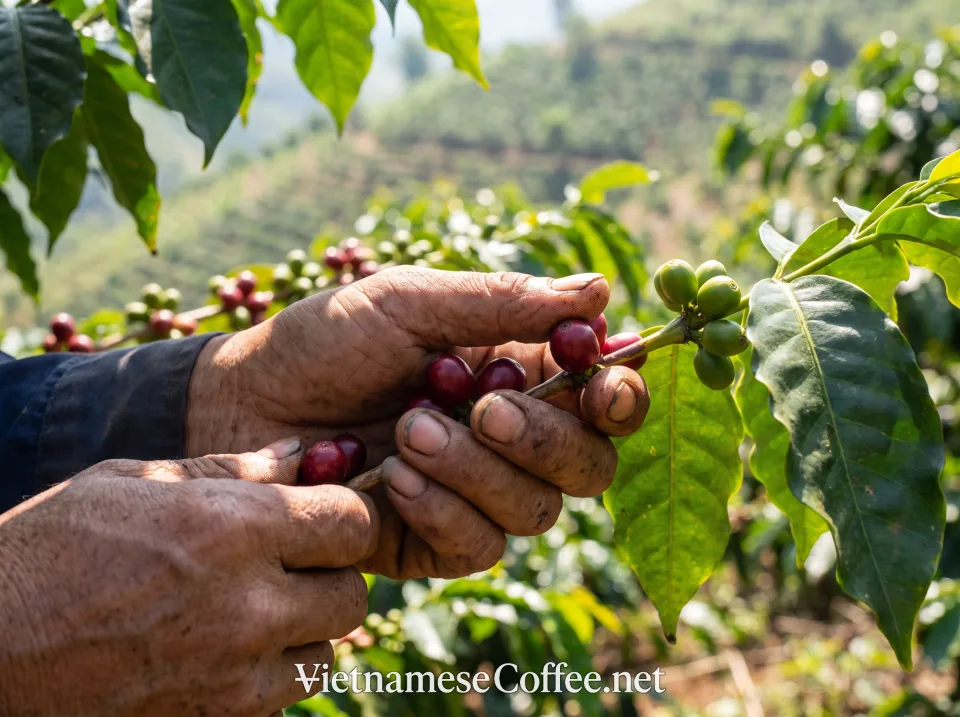
Arabica cherries in Khe Sanh and Huong Phung begin ripening in November. Regional harvest reporting describes the end of the year as the main picking period across the coffee-growing hills.
Harvesting is performed manually, with workers selecting ripe cherries from the branches. Selective picking leaves green or insufficiently ripe fruit on the plant for a later pass.
VietnamPlus reports that Khe Sanh arabica is harvested when more than 95 percent of the cherries are ripe. Processing, drying, and storage are controlled to support product quality.
Manual selection does not by itself determine specialty quality. The final result also depends on farm practices, sorting, processing, drying, storage, roasting, and brewing.
Coffee has been cultivated in the Khe Sanh area for more than a century. The region's long association with arabica remains part of its agricultural identity.
The historic coffee area now covers around 4,000 hectares, according to VietnamPlus. More than 3,700 hectares were reported as under harvest, with thousands of households involved.
For other Vietnamese arabica-region comparisons, see Sơn La: Coffee Growing Region Profile and Đà Lạt: Coffee Growing Region Profile.
Deforestation-free production and EUDR preparation
The historic Quảng Trị coffee sector is participating in a deforestation-free production project supported by Denmark. Vietnam Agriculture News reported that the project runs from July 2023 through June 30, 2027.
The project has total funding of approximately USD 1.2 million. Its stated purpose is to support deforestation-free coffee production in the former Quảng Trị province.
This work became relevant as exporters prepared for the European Union Deforestation Regulation. The regulation requires relevant commodities placed on the EU market to meet deforestation and traceability requirements.
Coffee farms are often small and distributed across many households. Reliable origin records therefore require information that connects coffee with specific production areas.
The project supports traceability and organization of material-producing areas. Reported cooperation agreements connect cooperatives, production groups, processors, and purchasing businesses.
Vietnam Agriculture News reported agreements involving two cooperatives, 10 production groups, and several consumption contracts. The contracted production area totaled approximately 250 hectares.
The project sits alongside the Khe Sanh geographical indication, but the two systems serve different purposes. The GI protects an origin name, while traceability addresses land-use and supply-chain requirements.