
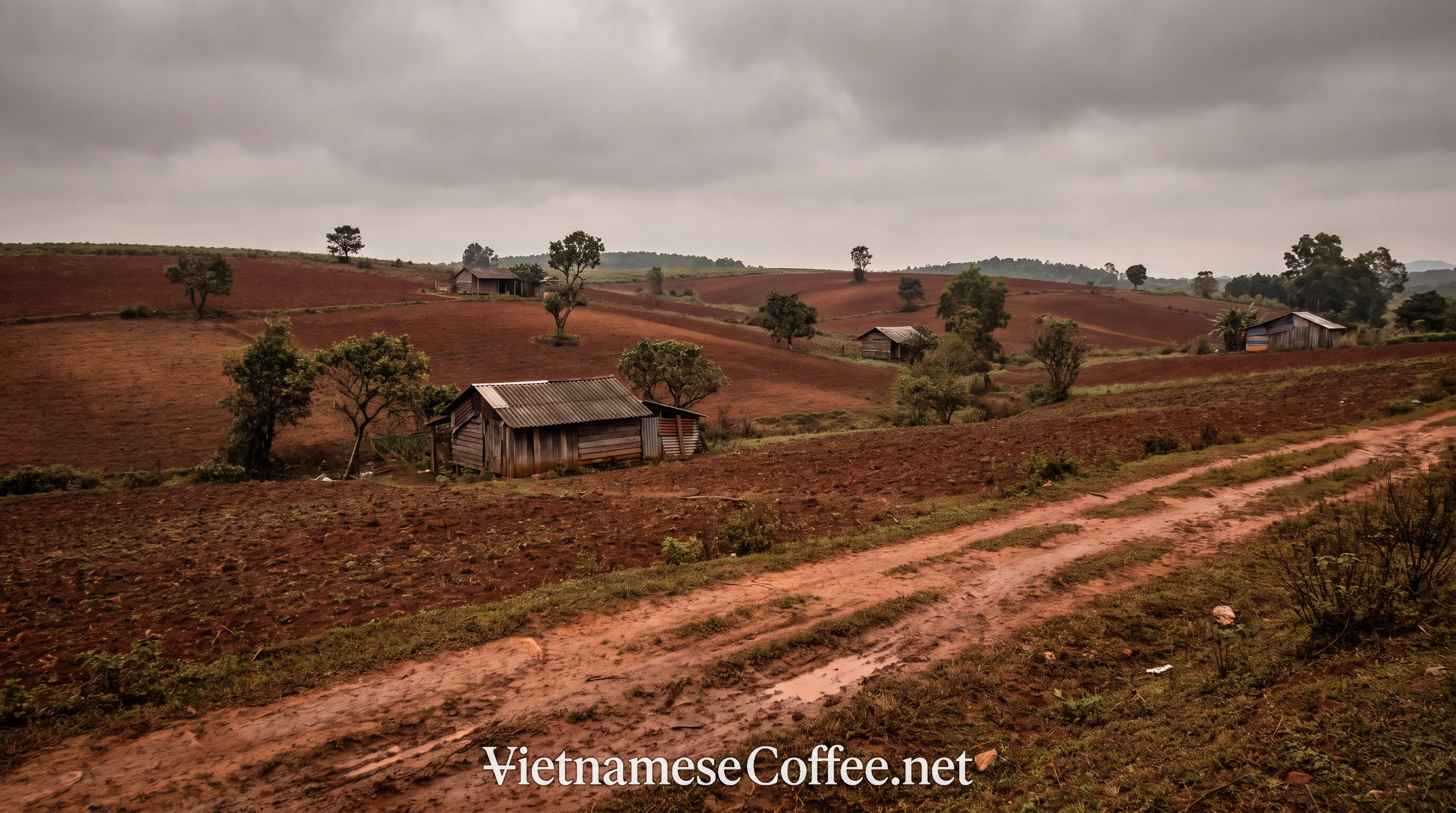
| Province | Nghệ An, north-central Vietnam |
|---|---|
| Historic coffee area | Phủ Quỳ area, within Nghĩa Đàn district |
| Species grown historically | Arabica and Robusta; the primary cited source's account of the planting sequence is not fully consistent |
| Typical Arabica elevation elsewhere | Generally 600 meters and above |
| Phủ Quỳ's actual elevation | Approximately 50 to 80 meters |
| Soil type | Red basalt soil, roughly 13,400 hectares suitable in the Phủ Quỳ area |
| Historic peak coffee area | Roughly 7,000 hectares |
| Area by 2005-06 | Approximately 500 hectares, as reported in 2023 |
| Area by 2012-13 | Just over 100 hectares, as reported in 2023 |
| Status reported in 2023 | Báo Nghệ An reported coffee cultivation had disappeared from the area; no newer confirming source located |
Phủ Quỳ's colonial-era origins
Nghệ An's coffee history centers on the Phủ Quỳ area, within what is now Nghĩa Đàn district. According to Báo Nghệ An, French colonial authorities identified the area's climate and land as suitable for crops originating in Latin America, including coffee, from around 1913. Colonial pressure led to the seizure of land for plantations.
French plantation owners and a small number of Vietnamese landholders came to occupy approximately 15,498 hectares in the area, according to the same source. Individual holdings were large: one plantation owner held 6,000 hectares in Đồng Hiếu and Tây Hiếu, another held 500 hectares in Nghĩa Hợp, and a plantation company held 7,560 hectares in Nghĩa Hưng. Coffee grown here was exported to France under the label "Arabica du Tonkin," marketed as comparable in quality to Brazilian and Colombian coffee.
After the August Revolution of 1945, French landholders left, and the large plantations were nationalized. By 1956, the former Phủ Quỳ National Farm had been divided into Đồng Hiếu Farm and Tây Hiếu Farm. The saying "South Đắk Lắk, North Phủ Quỳ" reflects Phủ Quỳ's historic standing as a major coffee-growing counterpart to the Central Highlands during this period. Nghệ An's coffee research also has an institutional history: Helena Coffee Vietnam confirms the Phủ Quỳ Tropical Plant Research Station was founded in April 1960.
Species history: a source with mixed detail
Báo Nghệ An's account of which species were planted, and in what order, is not fully consistent within the article itself. In one passage, it describes early plantings as including both Robusta and Arabica, followed by a period in which Arabica was successfully introduced and performed well. Elsewhere, the same source contrasts Arabica against Robusta and against Liberica, locally referred to as "jackfruit coffee," when explaining why growers and buyers favored Phủ Quỳ's Arabica.
Because the source does not present one clean, chronological planting sequence, this profile does not assert a specific order in which Robusta, Liberica, and Arabica were introduced at Phủ Quỳ. What is consistently supported is that Arabica became the area's defining crop, and that its flavor was described favorably relative to Robusta and Liberica grown in the same area. A firmer chronological claim would require a clearer historical or agricultural-record source than the one available here.
Why Phủ Quỳ's low altitude was unusual
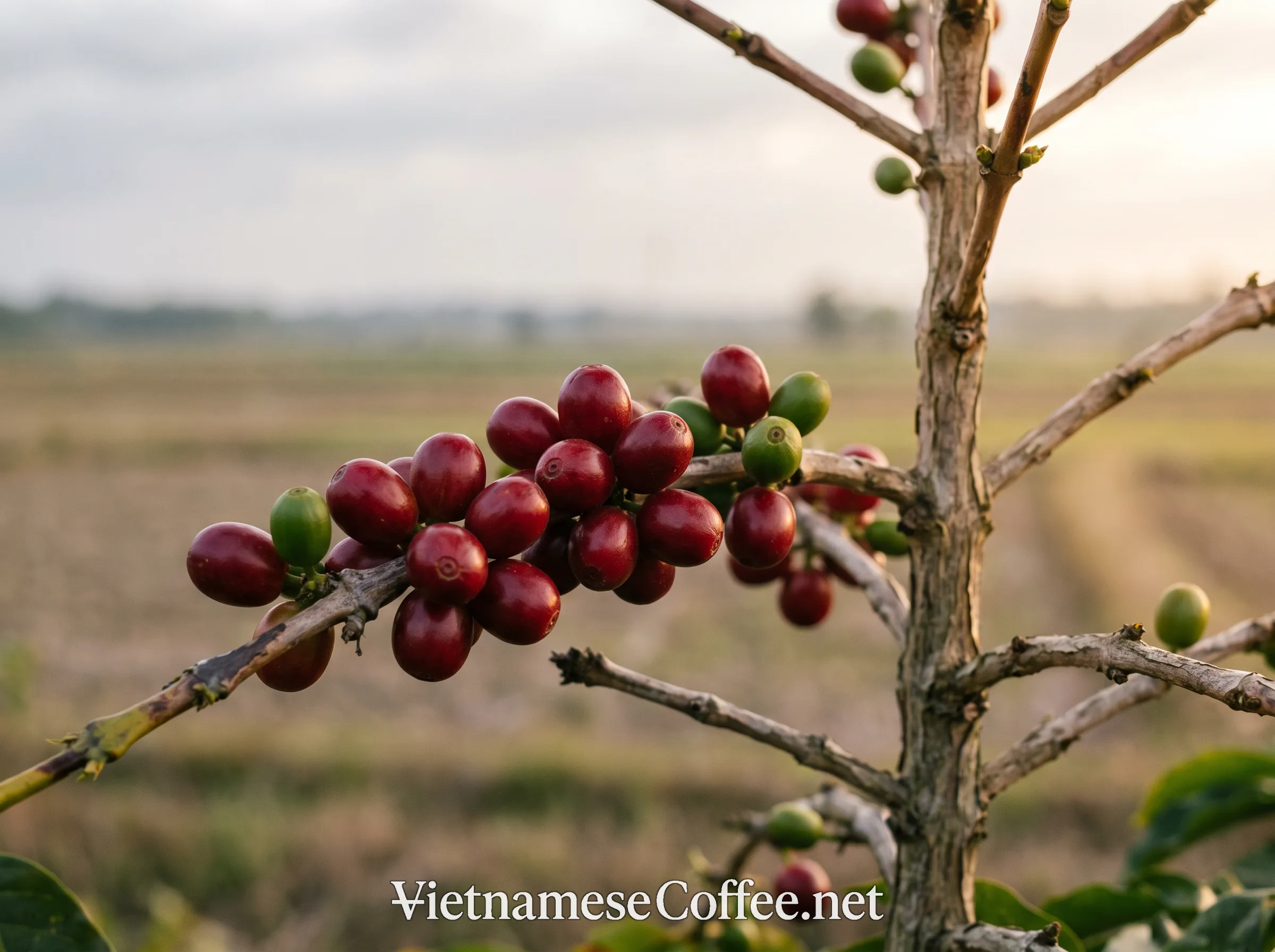
Arabica is normally associated with higher elevation. Báo Nghệ An quotes engineer Lê Đình Dinh, who notes that Arabica is typically recommended for elevations above 600 meters, and sometimes above 1,000 meters, for quality reasons. Phủ Quỳ's Arabica growing areas instead sat at only 50 to 80 meters above sea level.
Despite this, Lê Đình Dinh reports that the trees grew well and produced flavor favored by buyers. According to the source, Phủ Quỳ's Arabica bean lacked the bitterness associated with Liberica and the sour aftertaste sometimes associated with Robusta, with a smooth, stimulating bitterness and a notable aroma.
This combination of characteristics attracted outside interest. Báo Nghệ An reports visits from an Egyptian deputy minister of agriculture in 1990 and from an overseas Vietnamese coffee businessperson based in Paris, whose family had previously owned a plantation in the area. Despite this interest, the region never established a dedicated brand or geographical indication for its coffee, a gap the same source describes as a lasting regret among people connected to the area.
Decline reported through 2023
Phủ Quỳ's coffee area peaked at roughly 7,000 hectares, within a broader area of about 13,400 hectares of suitable red basalt soil. Plans once existed to expand cultivation toward 9,400 to 10,000 hectares, targeting production of 9,300 to 10,000 tons of coffee beans, according to Báo Nghệ An.
That expansion did not happen. The 2023 report identifies soil degradation, pest pressure, and heavy pesticide use as key factors in the decline. It states the coffee area fell from about 7,000 hectares to roughly 500 hectares by 2005-06, then to just over 100 hectares by 2012-13. A company representative, Hoàng Thanh Tùng of Nghệ An Coffee-Rubber One Member Limited Liability Company, told Báo Nghệ An that coffee had gradually been replaced by cassava, sugarcane, and rubber over roughly the preceding decade.
Arabica's specific agronomic demands contributed to the shift. Tùng explained that Phủ Quỳ's Arabica flowers in clusters and its cherries must be picked individually rather than stripped, raising labor costs compared with other crops. Combined with a roughly 20 to 30-year productive tree lifespan and price volatility, many growers moved to faster-turnover crops instead. Báo Nghệ An reported in 2023 that coffee trees had by then been completely eliminated from the area, although Tùng suggested replanting could be possible with adequate funding. This site has not located a source published after 2023 confirming whether that status has changed.
Nghệ An's place among Vietnam's Arabica regions
Nghệ An is one of several smaller Arabica-growing provinces outside the Central Highlands. Perfect Daily Grind lists Nghệ An alongside Đà Lạt, Điện Biên, Sơn La, and Quảng Trị as Vietnamese Arabica origins. VietFarm's overview places Nghệ An among a group of provinces, including Lâm Đồng, Thừa Thiên Huế, Quảng Trị, Hòa Bình, Sơn La, and Điện Biên, sharing roughly 35,000 hectares of national Arabica area, a small fraction of Vietnam's total coffee land.
Unlike Lâm Đồng's Đà Lạt, which continues active, high-altitude Arabica production, Nghệ An's Phủ Quỳ area was described in 2023 reporting as having lost its coffee cultivation entirely. Readers researching current Vietnamese Arabica supply should treat Nghệ An primarily as a case study in early plantation history and reported regional decline, based on 2023 reporting, rather than as a confirmed active sourcing region today.