
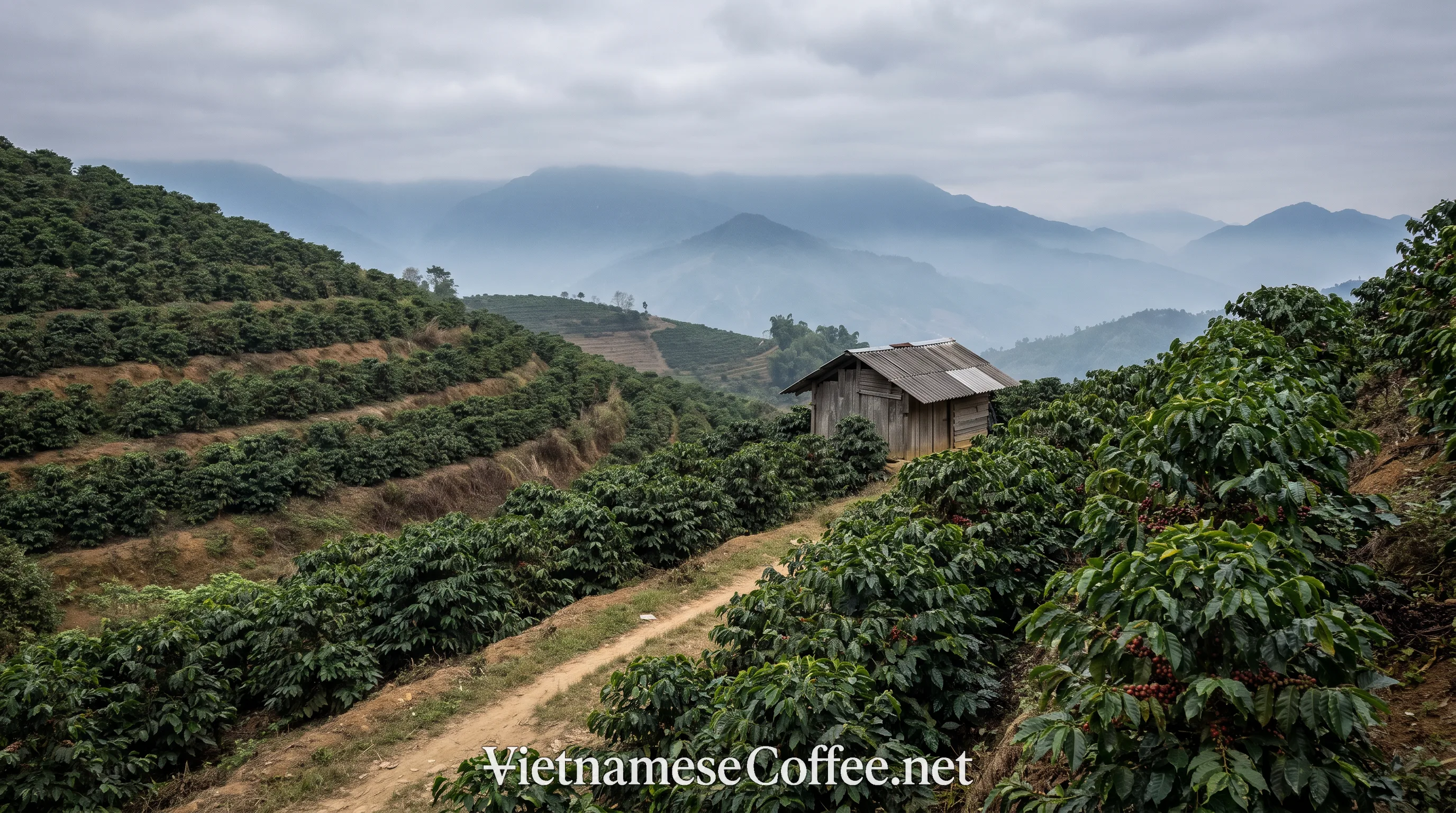
| Province | Điện Biên, northwestern Vietnam |
|---|---|
| Primary species | Arabica |
| Key coffee districts | Mường Ảng, Tuần Giáo, Quài Tở, Búng Lao |
| Arabica introduced | 1970s, at the Điện Biên and Mường Ảng farms, per Vietnam's Intellectual Property Office |
| Coffee area, 2013 | Approximately 3,961 hectares, per FAO |
| Coffee area, end of 2025 | More than 8,133 hectares, per Party Committee reporting |
| Documented existing area, Jan-Aug 2026 | Approximately 8,368 to 8,500 hectares across multiple provincial sources |
| Reported area by end of June 2026 | Nearly 11,000 hectares, per Báo Mới citing provincial data |
| 2026 new-planting target | Approximately 5,000 to 8,500 additional hectares, varying by source |
| Year-end 2026 / longer-term target | Variously reported above 13,000 hectares to more than 20,000 hectares, depending on the plan cited |
| Geographical Indication | "Mường Ảng" coffee, Decision No. 703/QĐ-SHTT, Certificate No. 00150, granted 6 November 2025 |
Arabica coffee since the 1970s
Điện Biên's documented coffee history begins later than some other Vietnamese growing regions. According to Vietnam's Intellectual Property Office, in its official decision materials for the "Mường Ảng" Geographical Indication, Arabica coffee has existed in Điện Biên since the 1970s, developing and expanding in area at the Điện Biên and Mường Ảng farms. This is a primary government source, and this page treats it as the more reliable basis for Điện Biên's coffee origin story compared with secondary sources that describe earlier, French colonial-era planting in the province.
For much of the following decades, Điện Biên's coffee sector remained comparatively small. FAO's policy brief on Vietnam's Shan tea and Arabica coffee sectors reported the province's coffee area at approximately 3,961 hectares in 2013, representing only about 0.6 percent of the country's total coffee area at that time. The same report described Điện Biên's coffee farms as small-scale and scattered, with an average plantation size of just 0.5 to 1 hectare, a structure typical of smallholder-dominated Vietnamese Arabica production.
That scale has changed substantially in the years since. Điện Biên's shift from a marginal, smallholder Arabica area toward a province targeting tens of thousands of hectares represents one of the more significant recent developments within Vietnam's Arabica sector, discussed further below.
Mường Ảng: Điện Biên's certified coffee area
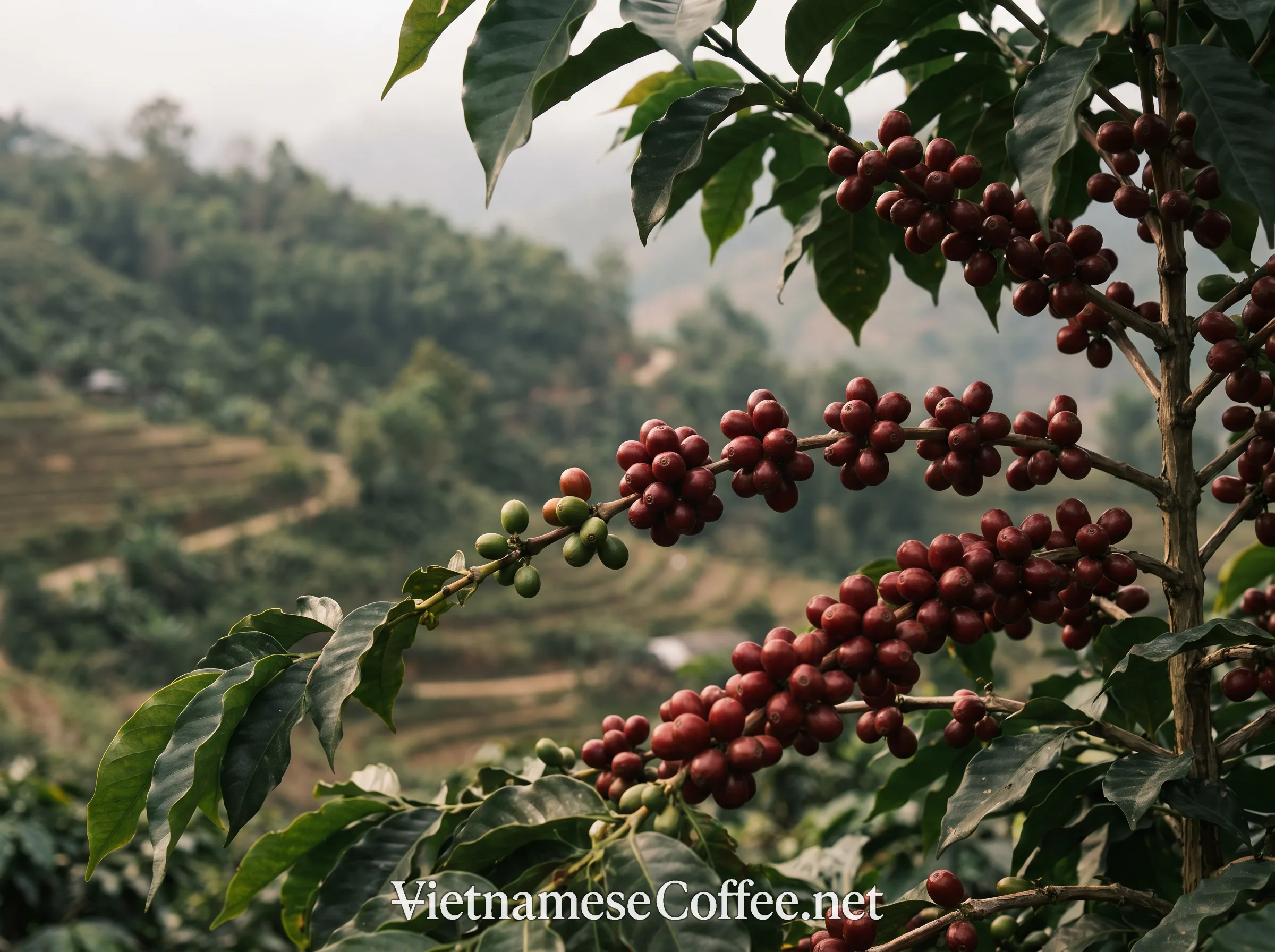
Mường Ảng district anchors Điện Biên's coffee identity. On 6 November 2025, Vietnam's Intellectual Property Office issued Decision No. 703/QĐ-SHTT, granting Geographical Indication Certificate No. 00150 for "Mường Ảng" coffee, with Điện Biên's Department of Agriculture and Environment as the managing organization. The protected area covers several communes within the district.
Provincial reporting from Báo Điện Biên Phủ, published in January 2026, describes Mường Ảng's Arabica as grown between 700 and 1,700 meters elevation. The same report credits Mường Ảng commune alone with close to 1,700 hectares of coffee, describing it as the province's largest coffee-growing area and referring to it as the "Arabica capital" of the northwest region. It states the commune's estimated 2025 parchment coffee output at roughly 3,300 tons.
These figures come from provincial news reporting and have not been independently cross-checked against a national dataset for this profile. They are presented here as reported, with source and publication date, rather than as independently confirmed national statistics.
Existing area, new planting, and year-end targets
Điện Biên's coffee area has grown quickly, and provincial reports from 2025-2026 are clearer when existing area and new-planting plans are kept separate rather than combined into a single figure. By the end of 2025, the province's own Party Committee reporting placed total coffee area at more than 8,133 hectares. Provincial agriculture reporting through the first half of 2026 placed the existing area in a narrow band around that figure: 8,378 hectares in April, and 8,368 hectares in reports from June and August. ASEAN Connect Vietnam's August 2026 report placed the figure at approximately 8,500 hectares, ranking Điện Biên third nationally for Arabica area after Sơn La and Lâm Đồng.
Separately, the province has announced new-planting targets for 2026 that vary by source and by the specific plan referenced. Lao Động's June 2026 report cited a 2026 target of 5,930 new hectares of coffee, alongside 6,070 hectares of macadamia, under a broader land-conversion program. The provincial Party Committee's resolution-based target, reported separately, called for 5,000 new hectares, raising the total above 13,000 hectares. ASEAN Connect Vietnam's report described a 2026 target of 6,000 additional hectares, moving toward a longer-term target near 20,000 hectares under the Provincial Party Congress Resolution.
By September 2026, provincial reporting aggregated by Báo Mới indicated that new planting had outpaced some earlier targets, with nearly 11,000 hectares of coffee already established provincewide by the end of June 2026, and coffee area projected to exceed 20,000 hectares by year-end when combined with continued new planting. Because these figures come from multiple provincial announcements made at different points across 2026, each tied to a different plan or reporting period, this page presents them as a documented range and a set of stated targets rather than as a single confirmed year-end total.