
| Area | Historic Lâm Đồng highlands and expanded merged province |
|---|---|
| Registered GI altitude | Arabica 1,200 to >2,200 m; robusta 700 to 850 m |
| Primary varieties | Robusta and arabica |
| Coffee area, pre-merger | Approx. 176,000 hectares |
| Arabica area, pre-merger | Over 16,000 hectares |
| Coffee area, merged province | Over 328,000 hectares combined with Đắk Nông and Bình Thuận |
| Annual output, merged province | Over 1 million tonnes |
| Geographical indication status | Lâm Đồng GI, Certificate No. 00147, Decision No. 636/QD-SHTT |
| Flagship specialty origin | Đà Lạt arabica, including Cầu Đất and Lạc Dương |
Geography and altitude
Lâm Đồng comprises two distinct geographic scales. The first is the historic Central Highlands territory, which remains the primary focus of most coffee trade literature.
The second is the enlarged administrative province resulting from the recent merger with Đắk Nông and Bình Thuận. The coffee origins historically associated with the Lâm Đồng name are rooted in the legacy highlands anchored by Đà Lạt City.
This historic territory includes well-known agricultural districts such as Bảo Lộc, Di Linh, Lâm Hà, Lạc Dương, Đức Trọng, and Don Duong.
In this profile, historic Lâm Đồng refers to the pre-merger highland coffee origin. Expanded Lâm Đồng refers to the post-merger administrative province. Keeping those terms separate avoids mixing the geographical indication's defined production area with merged provincial statistics.
The Intellectual Property Office of Vietnam publishes the official protected geographical indication record for Lâm Đồng. This document defines the registered coffee-growing area based on topography and elevation.
For arabica coffee, the GI states that cultivation ranges from 1,200 meters to over 2,200 meters above sea level. For robusta, the official document limits the registered concentration to elevations between 700 and 850 meters.
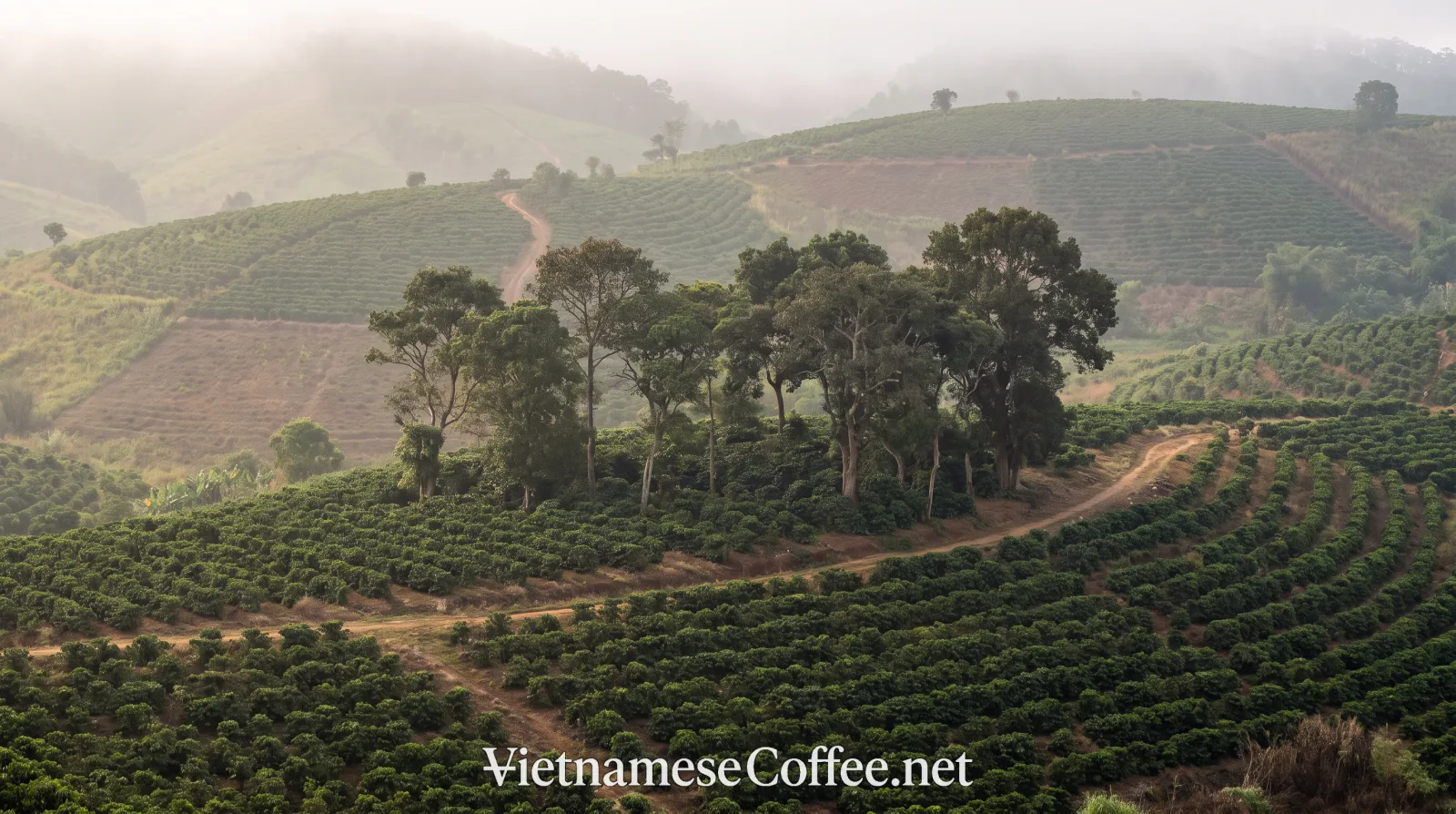
The historic growing zones include basaltic red earth, cool plateau conditions, and relatively high rainfall. That mix supports both robusta and arabica across Lâm Đồng's legacy coffee areas.
The soil offers drainage while retaining essential nutrients, making it well-suited for intensive agricultural production. The stable temperatures and rainfall also help explain why Lâm Đồng can support both highland arabica and lower-elevation robusta.
For broader species context, see Robusta vs Arabica: Why Vietnam Grows Robusta.
Pre-merger scale and expanded boundaries
Lâm Đồng's coffee production is tracked across two separate timelines and scopes. Before the administrative merger, the historic province had approximately 176,000 hectares of dedicated coffee cultivation.
Within that pre-merger footprint, robusta was the dominant crop, covering nearly 159,000 hectares. Arabica covered over 16,000 hectares.
Vietnam Agriculture News reported these figures, establishing the historic province as Vietnam's second-largest coffee locality at the time, trailing only Đắk Lắk.
Di Linh district alone historically accounted for over 45,000 hectares of coffee production. This made Di Linh the historic province's largest single robusta hub.
An administrative merger significantly altered the province's boundaries by combining Lâm Đồng, Đắk Nông, and Bình Thuận into a single new administrative entity. The new province retains the Lam Dong name.
According to Lao Động newspaper, the newly formed province covers a natural area of 24,233 square kilometers. The main administrative center remains in Đà Lạt City.
Đắk Nông, historically a separate Central Highlands province, brought its own robusta footprint and natural resources into the new borders. Bình Thuận added coastal, marine-economy, and renewable-energy activity.
This structural shift creates a more diverse economic entity, but it also complicates statistical tracking for individual agricultural commodities such as coffee.
Because Đắk Nông's coffee statistics are now absorbed into Lam Dong's totals, the expanded province encompasses over 328,000 hectares of coffee. Vietnam Agriculture News reports estimated annual output exceeding 1 million tonnes.
These figures describe the enlarged administrative province, not a single continuous geographic coffee origin. The newly added Dak Nong territory represents a separate robusta-producing plateau now counted under Lâm Đồng administration.
The Lâm Đồng geographical indication
The historic Lâm Đồng territory is formally recognized by a protected geographical indication. On October 10, 2025, the Intellectual Property Office of Vietnam issued Decision No. 636/QD-SHTT.
This granted Geographical Indication Registration Certificate No. 00147 for Lâm Đồng coffee products. The GI covers arabica and robusta coffee grown exclusively in specific registered areas within the province's traditional boundaries.
For arabica coffee, the registered area includes wards and communes clustered around Đà Lạt City. It also covers Lạc Dương District and designated zones in Đơn Dương, Lâm Hà, and Dam Rong districts.
The Đà Lạt portion includes Wards 3, 4, 5, 7, 10, and 11, plus the communes of Xuân Thọ, Ta Nung, Tram Hanh, and Xuan Truong.
For robusta coffee, the protected boundary includes parts of Da Lat City and communes in Bảo Lộc City and Lạc Dương District. It prominently features Di Linh District and robusta-producing areas in Lâm Hà District.
The robusta boundary lists Di Linh Town and surrounding communes, including Dinh Trang Thuong and Gia Hiep. It also covers Lâm Hà areas including the towns of Dinh Van and Nam Ban.
The GI specification sets physical and chemical standards for the coffee. Green arabica beans must have moisture from 11 to 12.5 percent, while robusta follows the same moisture range.
The record also sets caffeine bands and a minimum bean-size threshold of 5.6 millimeters. These specifications link Lâm Đồng's cup profile to climate, basaltic red soils, and rainfall patterns.
The GI record outlines expected cup profiles too. Arabica sourced from Đà Lạt and Lạc Dương is characterized by bright acidity and floral aromas, while the record also lists physical and sensory traits for the region's robusta crop.
Đà Lạt arabica and Starbucks Reserve

Đà Lạt and surrounding districts, including Cầu Đất and Lạc Dương, are the center of the historic province's arabica cultivation. Cầu Đất is recognized as a primary arabica area.
For a detailed breakdown of this micro-origin, see Đà Lạt: Coffee Growing Region Profile.
Đà Lạt arabica gained international visibility when it was introduced to the Starbucks Reserve program. Comunicaffe describes Đà Lạt as Starbucks' first single-origin Vietnamese coffee to join the Reserve lineup.
The Reserve program focuses on small-lot coffees sourced from selected regions around the world. Before its release in Vietnam, Starbucks indicated that this coffee had been sold in the United States and other international markets.
Starbucks marketing notes describe Đà Lạt arabica as having bright acidity, with flavor notes of kola nut, toffee, and vanilla.
Specialty-grade arabica accounts for a relatively small share of the province's total coffee area. It remains one of Vietnam's most recognized premium coffee export segments.
The Reserve designation is a prominent example of a Vietnamese micro-origin being marketed separately from the country's bulk robusta trade.
Harvest and sustainability
Lâm Đồng grows both robusta and arabica for the commercial export market. Robusta accounts for the vast majority of the province's coffee area, while arabica occupies the high-altitude core districts outlined in the geographical indication.
Harvest timing broadly follows the Central Highlands agricultural calendar. Hand-picking for the region's arabica crop typically begins earlier in the season.
The robusta harvest across lower-altitude districts usually runs later, matching broader regional patterns for Central Highlands coffee.
On sustainability, the province is participating in traceability projects aimed at adapting to international trade requirements, including the European Union Deforestation Regulation.
Vietnam Agriculture News reports that local initiatives focus on improving supply-chain traceability and establishing verification data. Mapping coffee plots against forest land is part of that compliance work.
The Lâm Đồng Department of Agriculture and Rural Development has requested that local districts review and map forest land against coffee cultivation zones. The department coordinates with land-use agencies to cross-check records.
Enterprises in the region are working with production households to distribute information and organize verifiable sourcing networks. These programs shift the focus from volume alone toward traceable commodity trading.
The division between large robusta output and a smaller arabica segment allows Lâm Đồng to supply both industrial buyers and specialty roasters. Its agricultural strategy now combines modernization with stricter supply-chain documentation.