
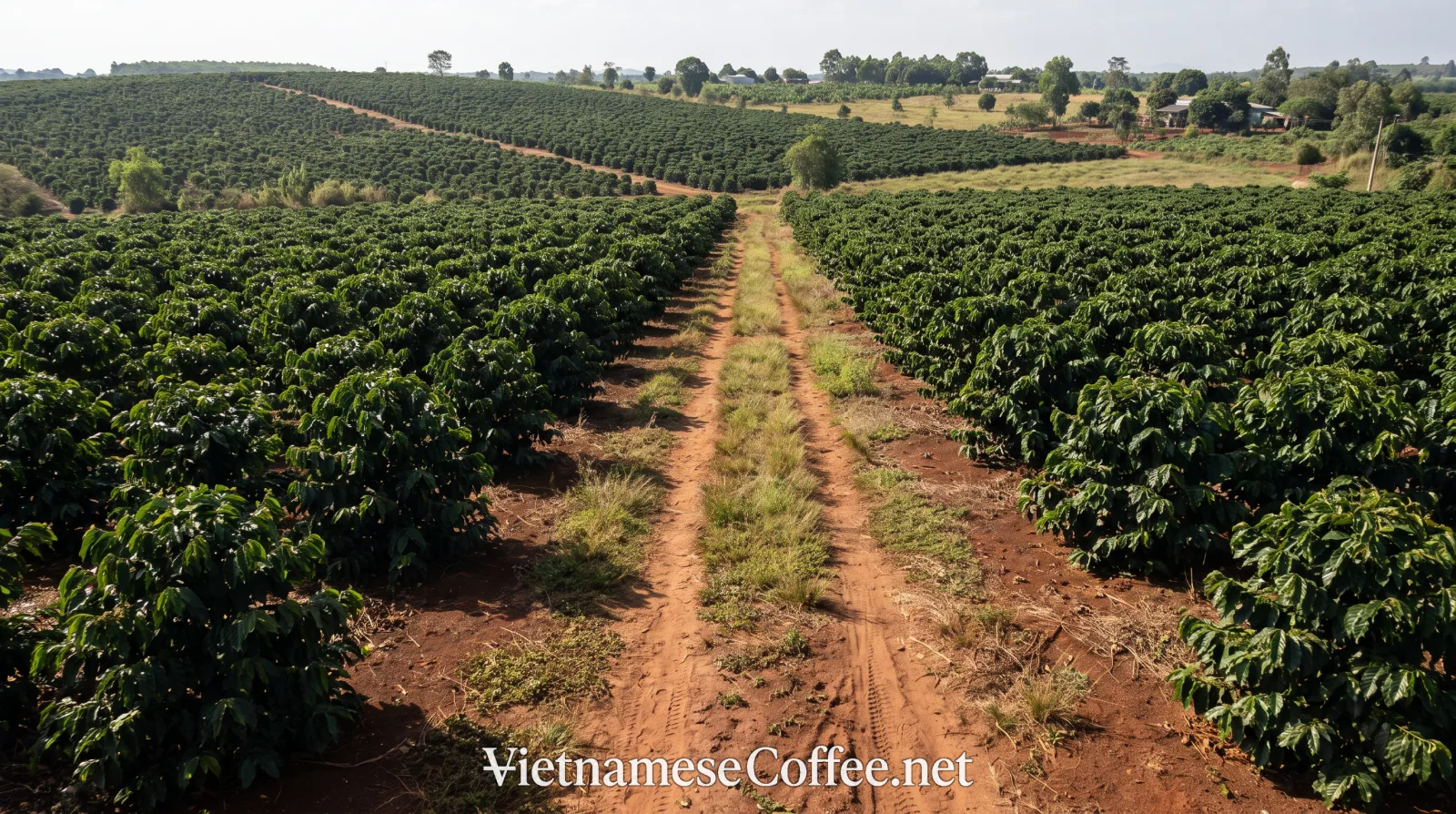
| Area | Historic Bình Phước territory, now within Đồng Nai Province |
|---|---|
| Primary variety | Robusta |
| Target coffee area | Approx. 8,000 hectares by 2030, historic zone |
| Target output | Approx. 20,800 tonnes by 2030, historic zone |
| Export value | Nearly 1.6 billion US dollars in 2025, enlarged province |
| Geographical indication status | Bình Phước cashew holds GI Certificate No. 00066 |
Geography and the Southeast agricultural environment
Bình Phước is historically situated in Vietnam's Southeast region. It acts as a transitional zone between the Central Highlands and the lower coastal plains.
Before the administrative merger, the historic province bordered Cambodia to the north and west. It also bordered Đắk Nông and Lam Dong to the east, and Đồng Nai and Bình Dương to the south.
The historic territory has a lower topographical profile than the Central Highlands. Gently undulating transitional plains connect coastal lowlands to steeper highland plateaus.
The climate is tropical and influenced by the southern monsoon. Temperatures remain warm and humid year-round, without the sharp nighttime cooling common in highland regions.
This combination of low elevation and heat favors robusta over arabica. Robusta tolerates warmer lower-altitude conditions better than arabica, which generally needs cooler highlands.
Bình Phước also contains significant tracts of fertile red basaltic soil. This soil supports nutrient retention and drainage for robusta roots.
For broader species context, see Robusta vs Arabica: Why Vietnam Grows Robusta.
Pre-merger scale and the 2025 administrative merger
Bình Phước's agricultural production is tracked across two separate timelines and scopes. Before the merger, provincial statistics described the historic Bình Phước province.
According to agricultural strategies from the Bình Phước Provincial People's Committee, local authorities aim to stabilize the active coffee area at 8,000 hectares by 2030.
That coffee footprint is projected to generate 20,800 tonnes of output. The target reflects regional efforts to manage land use while maintaining coffee as a cash crop.
Bình Phước's broader agricultural economy is focused on other industrial crops. The same plan sets 2030 targets of 138,000 hectares for cashew, 200,000 hectares for rubber, and 10,000 hectares for pepper.
These targets show that Bình Phước is primarily a cashew and rubber powerhouse. Coffee acts as a supplementary crop rather than the dominant agricultural focus.
On July 1, 2025, National Assembly Resolution No. 202/2025/QH15 formally combined Bình Phước and Đồng Nai into an enlarged province under the Đồng Nai name.
Because Bình Phước's agricultural statistics are now absorbed into Đồng Nai totals, merged-province reporting describes a larger footprint. Bao Đồng Nai reports nearly 511,500 hectares of industrial crops in the newly merged province.
Coffee can still be identified as coming from the former Binh Phuoc territory. Its geographic sourcing remains distinct despite the administrative border change.
Cashew intercropping and agricultural diversification
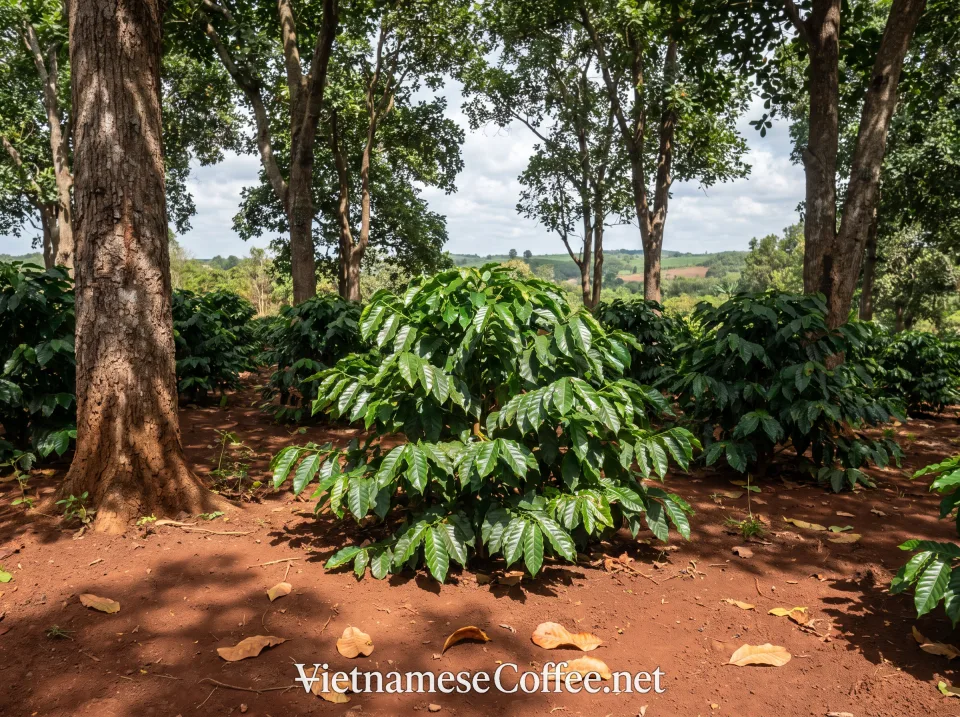
Bình Phước has become a leading region for agricultural diversification in the Southeast. Many farmers use intercropping systems instead of cultivating coffee as strict monoculture.
Given the region's cashew dominance, coffee is frequently intercropped with cashew trees. The taller cashew canopy can provide dappled shade for understory coffee plants.
The historic Bình Phước territory holds formal intellectual property protection for cashew. The Intellectual Property Office of Vietnam records Bình Phước cashew under Geographical Indication Certificate No. 00066.
This cashew GI highlights the region's role in national agricultural branding programs. It also shows how the local government documents key agricultural origins.
Integrating coffee among established cashew groves provides a diversified model for farming households. This approach fits the tropical lowland setting better than relying on coffee alone.
Export infrastructure and deep processing targets
The region's integration into the merged Đồng Nai province gives it access to advanced agricultural processing infrastructure. Green coffee from historic Bình Phước can move by highway to industrial zones farther south.
Bình Phước authorities recognized the need for deep processing before the merger. The 2030 agricultural plan established formal value-addition targets for coffee.
The plan requires deep-processed coffee to eventually account for 20 to 25 percent of total coffee output. It also set an export target of 80 to 85 percent of regional output.
The same plan focused on increasing processed goods rather than relying only on raw green beans. It aimed for processed coffee to account for 10 to 20 percent of direct exports.
This strategy complements the processing infrastructure associated with Đồng Nai. Bao Đồng Nai reported nearly 1.6 billion US dollars in coffee export turnover for the enlarged province in 2025.
Coffee sits beside other major processed exports in the region, including cashew, wood, and rubber products. This reinforces the Southeast's role as both an agricultural and manufacturing base.
EUDR compliance and traceability
The origin of raw material is becoming increasingly important because of international environmental regulations. The export sector is adapting to the European Union Deforestation Regulation.
The EUDR requires European operators and traders to prove that imported agricultural products are deforestation-free. Coffee must not be linked to forest clearing after December 31, 2020.
Imported coffee must be produced according to local legislation and covered by due diligence documentation. This framework demands transparency from each participant in the coffee trade.
Because the enlarged province processes beans from the Southeast and Central Highlands, traceability is critical. Vietnamese exporters must link processed coffee back to farm plots.
The Centre for the Promotion of Imports states that suppliers must provide exact geolocation points for origin plots. Polygons are required for plots larger than four hectares.
Single GPS points are required for plots smaller than four hectares. This geolocation data helps buyers and authorities assess whether forests were cleared after the cutoff date.
Bình Phước's 2030 plan anticipated stricter agricultural tracking. Local authorities aimed for more than 70 percent of coffee areas to receive formal growing area codes.