
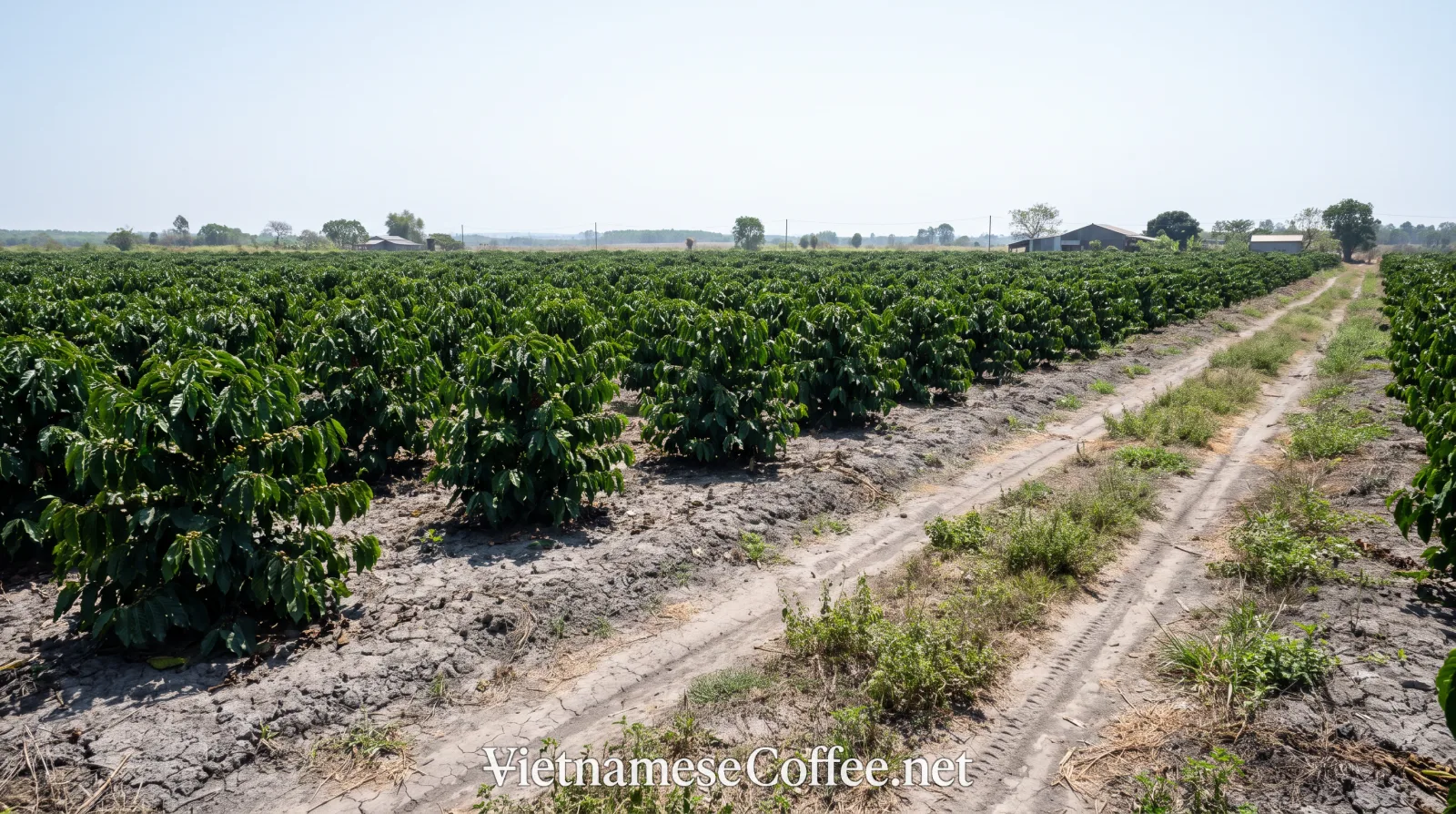
| Area | Đồng Nai province, Southeast region |
|---|---|
| Primary variety | Robusta |
| Historic cultivation area | Approx. 5,300 hectares |
| Target coffee area | Approx. 6,000 hectares by 2030, historic zone |
| Export value | Nearly 1.6 billion US dollars in 2025, enlarged province |
| Processing hub | Home to major international facilities, including the Nestle Tri An factory |
Geography and the Southeast agricultural environment
Đồng Nai is a major economic and agricultural province in Vietnam's Southeast region. Unlike the high-altitude terrain of the Central Highlands, Đồng Nai has flatter plains and low-lying hills.
This setting places its agricultural zones at much lower elevations than traditional coffee-growing centers such as Đà Lạt or the M'Nong Plateau.
The climate is tropical and influenced by the southern monsoon system. Temperatures remain warm and humid through the year, with less nighttime cooling than the highlands.
This combination of low elevation and constant heat shapes the type of coffee that can be cultivated. The environment is suited to robusta rather than arabica.
Robusta is adapted to warmer, lower-altitude conditions and can withstand intense sun better than arabica. Arabica generally requires cooler conditions and higher elevations.
The historic Đồng Nai agricultural districts also include fertile basaltic and gray soils. These soils support nutrient retention and drainage for robusta root systems.
For broader species context, see Robusta vs Arabica: Why Vietnam Grows Robusta.
Local cultivation and stabilization strategy
Đồng Nai's coffee production must be viewed through two lenses. The first is the historic cultivation area covered by regional planning. The second is the enlarged administrative unit created by recent reforms.
On July 1, 2025, a major administrative merger formally combined Đồng Nai and neighboring Bình Phước. National Assembly Resolution No. 202/2025/QH15 established the enlarged province under the Dong Nai name.
Bình Phước brought its own agricultural footprint into the new administrative borders. That makes merged-province statistics different from figures that describe only the historic Đồng Nai cultivation zone.
Bao Đồng Nai reports that the historic province's active coffee growing area stands at approximately 5,300 hectares. Historical peak cultivation exceeded 10,000 hectares before land-use priorities changed.
These figures make historic Đồng Nai a niche raw-coffee producer. Its cultivation footprint trails the large robusta outputs of Đắk Lắk and Lâm Đồng.
Rapid industrialization and shifting crop economics have reduced the local farming acreage. Farmers in the Southeast often compare coffee against crops such as durian, pepper, or cashew.
Despite those pressures, local strategy aims to protect and stabilize the remaining coffee sector. By 2030, the province aims to slightly increase and stabilize coffee area near 6,000 hectares.
A global center for deep processing
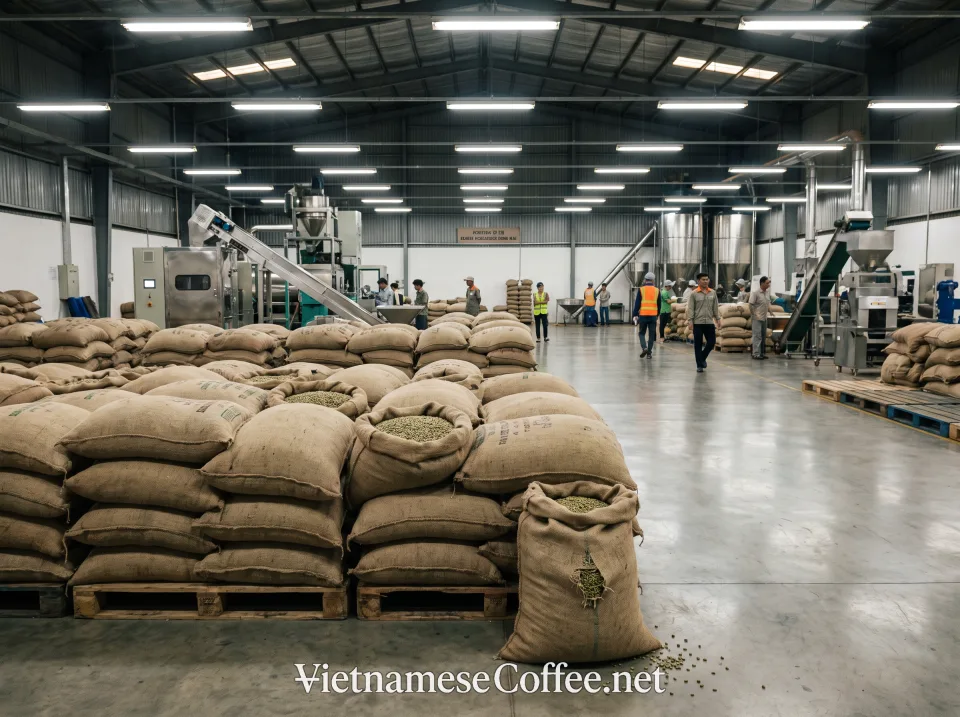
Đồng Nai's primary significance in the global coffee sector lies in industrial processing. Rather than relying only on its local harvest, the province serves as a manufacturing destination.
Raw green coffee beans are transported in large volumes from the Central Highlands into Đồng Nai's industrial zones. The province sits near Hồ Chí Minh City and deep-water seaports in Ba Ria-Vung Tau.
That logistical position makes it useful for export-oriented manufacturing. Highway connections link agricultural zones with factories, warehouses, and ports.
A prominent example is the Nestle Tri An factory. Bao Đồng Nai reported that Nestle Vietnam announced a nearly 1.9 trillion dong investment in 2025 to expand the Tri An operation.
That capital injection brought recent investment in the Tri An plant to over 4.3 trillion dong for the 2024-2025 period. The scale reinforces Đồng Nai's role in finished coffee manufacturing.
Deep processing transforms raw green robusta into higher-value consumer products. This lets more value remain in Vietnam before coffee reaches international markets.
Export value and economic impact
The concentration of processing facilities and exporters in Dong Nai translates into large financial figures. Bao Đồng Nai reports that the enlarged province recorded nearly 1.6 billion US dollars in coffee export turnover in 2025.
This figure places coffee among the province's major agricultural exports. Other processed regional staples include cashew, wood, and rubber products.
It is important to distinguish export value from local agricultural output. The nearly 1.6 billion US dollars represents coffee processed, packaged, and exported from the enlarged province.
That economic footprint relies extensively on raw robusta beans sourced from the Central Highlands and transported to Đồng Nai's manufacturing centers.
The local harvest grown within historic Đồng Nai contributes raw material to the region. The specific sourcing split between local beans and external beans varies by facility.
Đồng Nai's export figures demonstrate Vietnam's shift from raw commodity exports toward higher-value manufacturing. The province shows how processing infrastructure can reshape coffee economics.
EUDR compliance and traceability
The origin of raw material processed in Đồng Nai is becoming more important because of international environmental regulations. The export sector is adapting to the European Union Deforestation Regulation.
The EUDR requires European operators and traders to prove that imported agricultural products are not linked to recent deforestation. The regulation uses a cutoff date of December 31, 2020.
Imported coffee must be deforestation-free, produced according to local legislation, and covered by due diligence documentation. This framework demands traceability across the coffee trade.
Because Đồng Nai processes beans from multiple supply zones, its factories face complex compliance needs. Exporters must provide data that links processed coffee back to farm plots.
The Centre for the Promotion of Imports states that suppliers must provide exact geolocation points for coffee plots. Polygons are required for plots larger than four hectares.
GPS points are required for plots smaller than four hectares. These compliance efforts are essential for keeping European markets open to Đồng Nai's export volume.