
| Area | Historic Kon Tum territory, now within Quang Ngai Province |
|---|---|
| Primary varieties | Robusta and arabica, including cold-climate coffee |
| Arabica expansion target | Over 5,000 hectares of cold-climate coffee by 2025 |
| Geographical indication status | Dak Ha coffee GI, covering green, roasted, and powdered coffee |
| Registered GI altitude | 523 to 875 meters above sea level for Dak Ha GI |
| Key robusta district | Dak Ha, with a coffee area of 12,260 hectares |
| Key arabica districts | Dak Glei, Tu Mo Rong, Kon Plong |
Geography and agricultural landscape
The historic Kon Tum territory represents the northernmost coffee-growing region in Vietnam's Central Highlands. Formerly an independent province, Kon Tum was merged into enlarged Quang Ngai Province in 2025.
Before the merger, the historic province bordered Quảng Nam to the north and Quang Ngai to the east. It bordered Gia Lai to the south and shared international borders with Laos and Cambodia to the west.
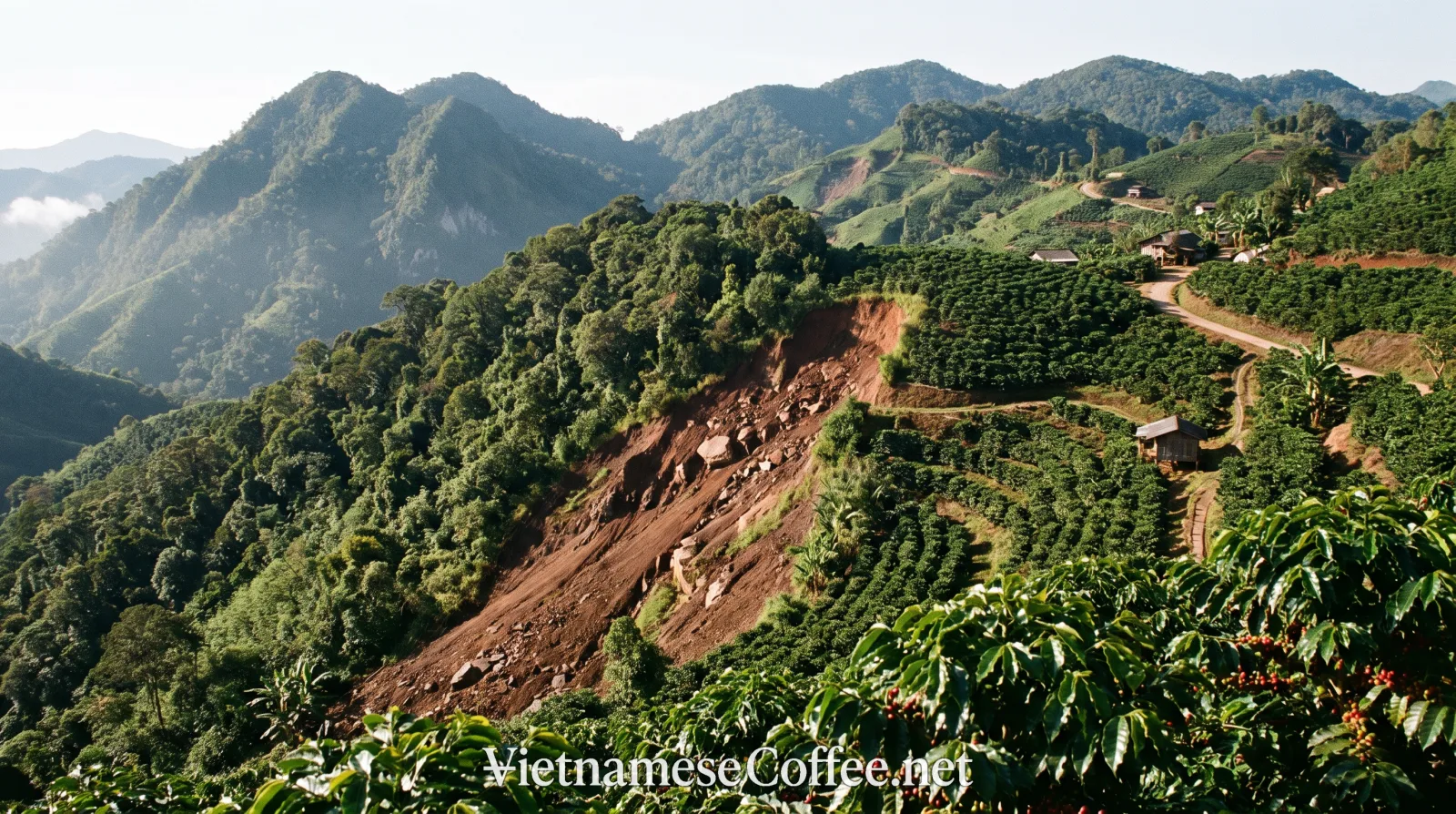
The territory features distinct elevation zones that support different coffee cultivation patterns. The terrain moves from lower river valleys in southern districts to steep forested mountain ranges in the remote north.
Lower-elevation districts such as Dak Ha sit roughly between 500 and 800 meters above sea level. This warmer band suits robusta, supporting rapid vegetative growth and high yields.
Mountainous northern districts, including Dak Glei, Kon Plong, and Tu Mo Rong, reach elevations above 1,000 meters. These cooler microclimates are the focus of arabica expansion.
The key growing zones are dominated by basaltic red earth. This volcanic soil is common across the Central Highlands and provides a deep rooting zone for perennial industrial crops.
For a broader species and altitude comparison, see Robusta vs Arabica: Why Vietnam Grows Robusta.
Scale, output, and the 2025 merger
Coffee is a foundational economic crop for the historic Kon Tum territory, alongside rubber and macadamia. The region has steadily developed agriculture to support rural communities.
In 2025, National Assembly Resolution No. 202/2025/QH15 merged historic Kon Tum with coastal Quang Ngai Province. The combined administrative entity now operates under the name Quang Ngai Province.
This merger integrates the coastal economy of historic Quang Ngai with the highland agricultural zones of historic Kon Tum. Consequently, Kon Tum now refers to a historic Central Highlands territory rather than an active independent province.
Despite this administrative change, the coffee supply chain remains geographically distinct. Robusta and arabica grown in districts such as Dak Ha and Dak Glei continue to be identified by their historic Central Highlands origins.
Recent agricultural development has focused on stabilizing the coffee footprint rather than expanding it indefinitely. Officials advise farmers against spontaneous expansion into unsuitable soil or water-limited areas.
Instead of broad acreage expansion, the region prioritizes intensive farming, deep processing infrastructure, and replanting programs. These efforts target higher value from existing coffee land.
Dak Ha robusta and geographical indication
Dak Ha district is the primary engine of the historic territory's robusta production. VietnamNet describes Dak Ha as the locality with the largest coffee production area in the region.
The district manages a total coffee area of 12,260 hectares. This footprint establishes Dak Ha as the commercial core of the local coffee industry.
In 2019, the Intellectual Property Office of Vietnam officially granted a geographical indication for Dak Ha coffee. Government registration documents place the protected zone at 523 to 875 meters above sea level.
This altitude band ensures that protected Dak Ha coffee is grown within the district's robusta microclimate. The legal protection zone includes Dak Ha town and surrounding communes.
Registered communes include Dak Mar, Ngok Wang, Ha Mon, Dak Ui, Dak La, Dak Long, Dak Pxi, Dak Ngok, Ngok Reo, and Dak Hring.
The Dak Ha GI covers more than raw green coffee. It also includes roasted coffee beans, powdered coffee, and refined coffee, connecting the protection to the local value chain.
Cold-climate arabica expansion
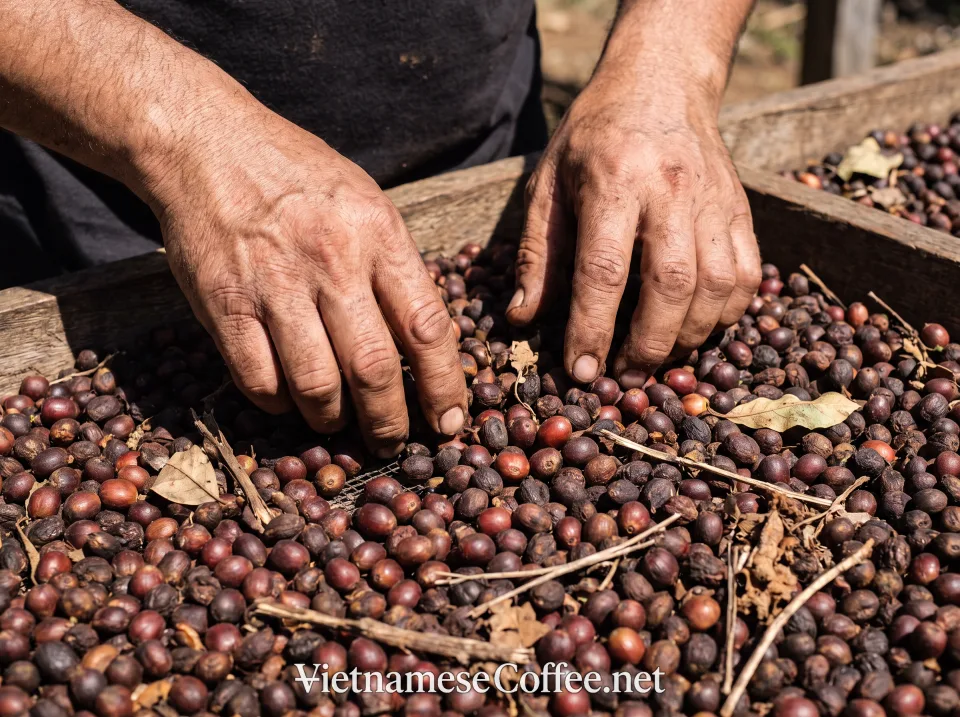
While robusta dominates Dak Ha, the mountainous northern districts are the focus of specialized arabica expansion. Local agricultural departments often describe this crop as cold-climate coffee.
These high-altitude zones provide cooler conditions needed for successful arabica cultivation. The most important target districts are Dak Glei, Tu Mo Rong, and Kon Plong.
Lao Động reports that local authorities set a target to expand the arabica footprint by 2025. Localities accelerated new seedling planting to complete a target of 1,000 newly planted hectares.
This expansion is designed to raise the region's total cold-climate coffee area to more than 5,000 hectares. Authorities view the higher-value crop as a driver for remote mountain communities.
The strategy positions historic Kon Tum as an emerging Vietnamese arabica source. It complements established arabica hubs such as Da Lat and Sơn La.
Diversifying into arabica also helps reduce exposure to bulk robusta price volatility. Premium supply chains can reward farmers for careful harvesting and processing.
Deep processing and sustainability initiatives
The region is working to increase export value by investing in deep processing infrastructure. Historically, much of the output was sold as raw green beans, which limited local margins.
Recent strategies prioritize modern processing facilities that can produce roasted, ground, and instant coffee products at scale. These facilities aim to keep more value in the growing region.
Kon Tum is also adapting to strict international trade requirements, especially the European Union Deforestation Regulation. The EUDR requires exporters to prove coffee is not linked to recent deforestation.
SNV's work on coffee in biodiverse landscapes in Kon Tum highlights deforestation-risk management, mapping, traceability, and cooperative linkage models in the historic territory.
As a mountainous territory with forested areas near coffee farms, historic Kon Tum faces significant compliance challenges. Local agricultural sectors are working to build traceability records for export markets.
Cooperatives play a central role in these sustainability efforts. They help smallholder farmers pool resources, standardize practices, and build transparent contracts with exporters.
The commitment to stable land use, arabica expansion, and better processing keeps the region relevant in Vietnam's evolving coffee sector.