
| Area | Former Gia Lai territory in Vietnam's Central Highlands |
|---|---|
| Registered GI altitude | Flat to low-slope topography; no specific altitude mandated |
| Primary variety | Robusta |
| Coffee area, 2019 | 97,200 hectares |
| Coffee area, 2024 | Over 105,000 hectares |
| Coffee area, reported January 2026 | 107,400 hectares |
| Output, reported January 2026 | Over 333,250 tonnes |
| Export value, 2025 | 1.5 billion US dollars |
| Geographical indication status | Gia Lai GI, Certificate No. 00125, Decision No. 5372/QD-SHTT |
| Origin era | Early 20th century; modern commercial surge early 1990s |
| Harvest season | October to mid-December per GI; broader logistics into February |
Geography and climate
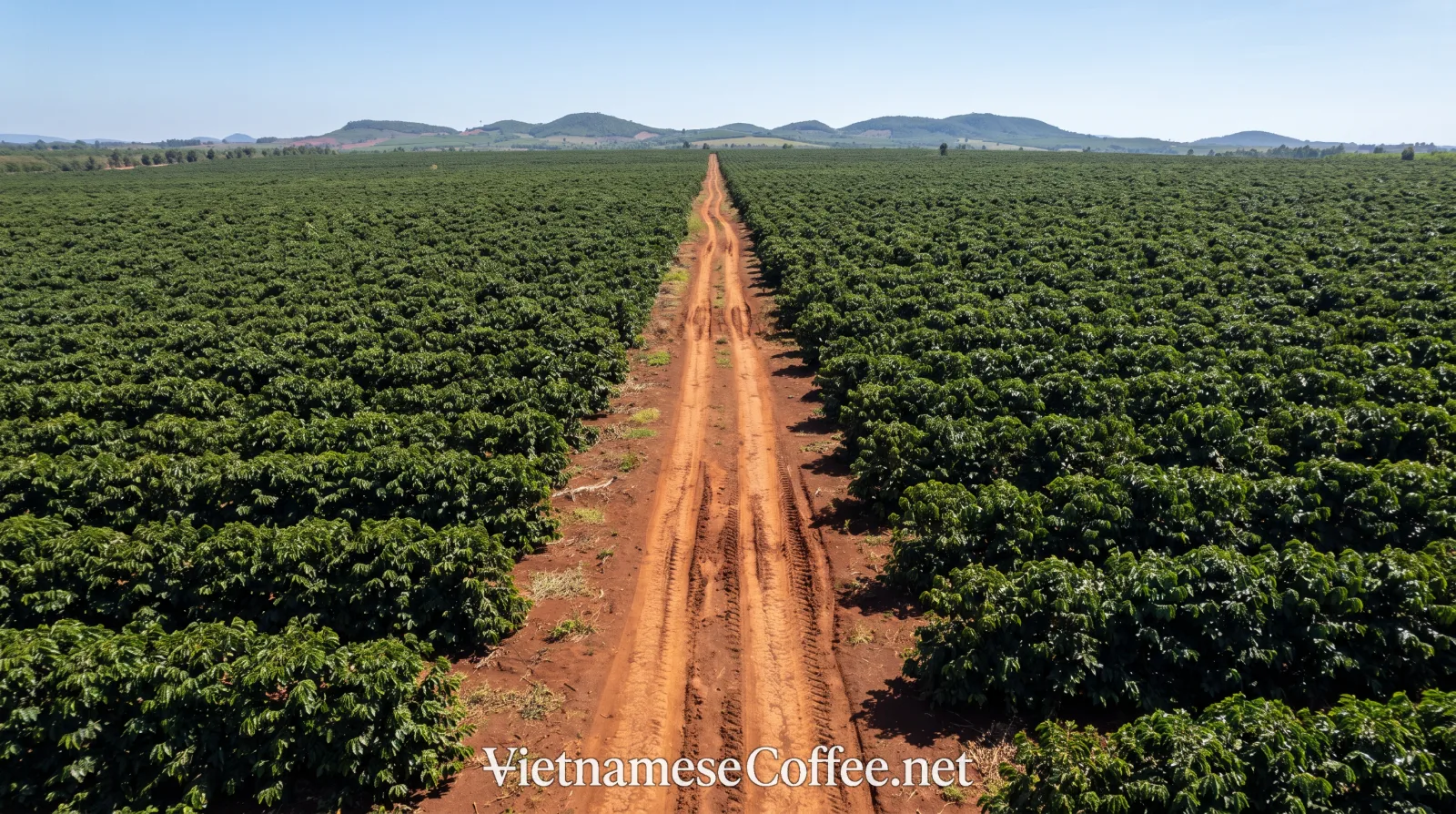
Gia Lai is a vast administrative province in the northern Central Highlands. It is one of Vietnam's major robusta-growing regions and part of the site's Vietnam's Coffee Growing Regions map.
The National Office of Intellectual Property publishes the official geographical indication record for Gia Lai coffee. It describes the registered coffee area as predominantly ferralitic soil.
This includes brown-red soil formed on magma rock and brown-red soil on limestone. The GI record describes flat to low-slope topography and a topsoil layer thicker than 70 centimeters.
The climate is divided into two seasons. The dry season runs from early November to early April, while the wet season peaks in June, July, and August.
Annual rainfall reaches 2,000 to 2,400 millimeters. Stable temperatures and heavy rainfall make the Gia Lai plateaus suitable for robusta rather than arabica. See Robusta vs Arabica: Why Vietnam Grows Robusta.
Scale and export growth
Gia Lai operates at the upper end of Vietnam's robusta scale. Helena Coffee cited historical 2019 figures placing the province's coffee area at 97,200 hectares.
A 2024 Vietnam Government Portal report updated that baseline to more than 105,000 hectares across 10 districts and cities. It also described annual output above 400,000 tonnes.
Reporting in January 2026 from Vietnam Agriculture News and the Gia Lai Provincial Portal cited an active area of 107,400 hectares. That same reporting placed output above 333,250 tonnes.
The official GI record states that Gia Lai coffee growing began in the early 20th century. VCU Coffee traces the modern commercial surge to the early 1990s.
In 2025, coffee exports reached 1.5 billion US dollars. The current province includes former Gia Lai and Bình Định, while coffee-growing remains concentrated in the former Gia Lai highland territory.
The Gia Lai geographical indication
Gia Lai has a formal geographical indication protecting its regional coffee identity. Vietnam's National Office of Intellectual Property issued Decision No. 5372/QD-SHTT on November 10, 2022.
That decision granted Geographical Indication Registration Certificate No. 00125 for Gia Lai coffee. The province's Department of Science and Technology manages and monitors the GI.
The registered zone covers designated coffee-growing areas in the former Gia Lai territory. It includes locations across Chu Puh, Chu Se, Chu Prong, Duc Co, Ia Grai, Chu Pah, Dak Doa, Mang Yang, Kbang, and Pleiku City.
The GI record sets physical and chemical standards for protected coffee. Green coffee must meet specified bean length, moisture, and caffeine ranges.
For roasted beans, it specifies caffeine and crude-protein ranges, plus a sensory profile with strong aroma, rich taste, slight astringency, and lingering sweet aftertaste.
Harvest and processing practices
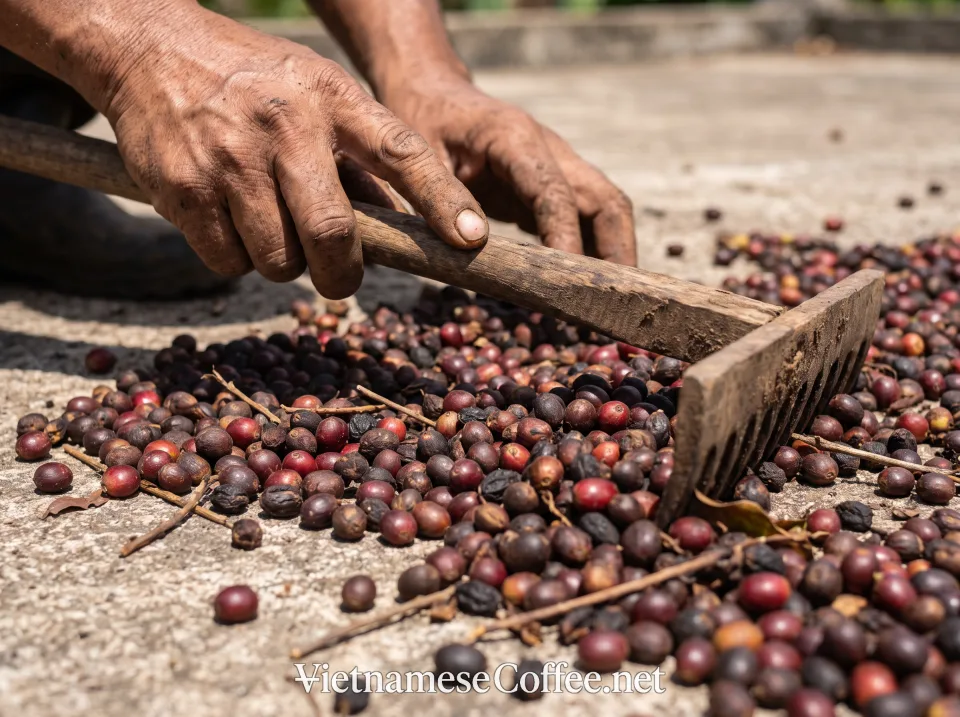
Harvest timing follows the Central Highlands robusta calendar. The official GI record mandates harvesting during the dry season, when ambient humidity is low.
It sets a harvest window from October to no later than mid-December. The record also requires hand harvesting to support uniform ripeness.
Other industry sources describe a wider logistical window. VCU Coffee places the Central Highlands robusta harvest, including Gia Lai, from October through February.
The GI record requires harvested cherries to undergo preliminary processing within 24 hours. Traditional natural sun-drying is formally specified under the indication.
Whole cherries are dried for 12 to 15 days under direct sunlight, turned four times a day, then rested in storage bags for two to three months before final milling.
Processing and sustainability goals
Gia Lai is trying to shift away from raw green-bean exports toward higher-value processed coffee. Provincial reporting notes a large gap in local processing capacity.
One report estimates 106,400 hectares yielding 312,000 tonnes overall, with roughly 240,000 tonnes exported as green coffee beans. Local deep-processing capacity is about 12,000 tonnes per year.
A November 2024 strategy aims to make deep-processed coffee 20 to 25 percent of total yield by 2030. Local policy encourages cooperatives and semi-wet processing.
Sustainability work is also expanding. VietnamPlus reported a project across Gia Lai and Kon Tum to train 10,000 coffee-producing households in emission-reducing methods and traceability.
Vietnam Agriculture News reports that 56,691 hectares of Gia Lai coffee are certified under Organic, Rainforest Alliance, and 4C standards.